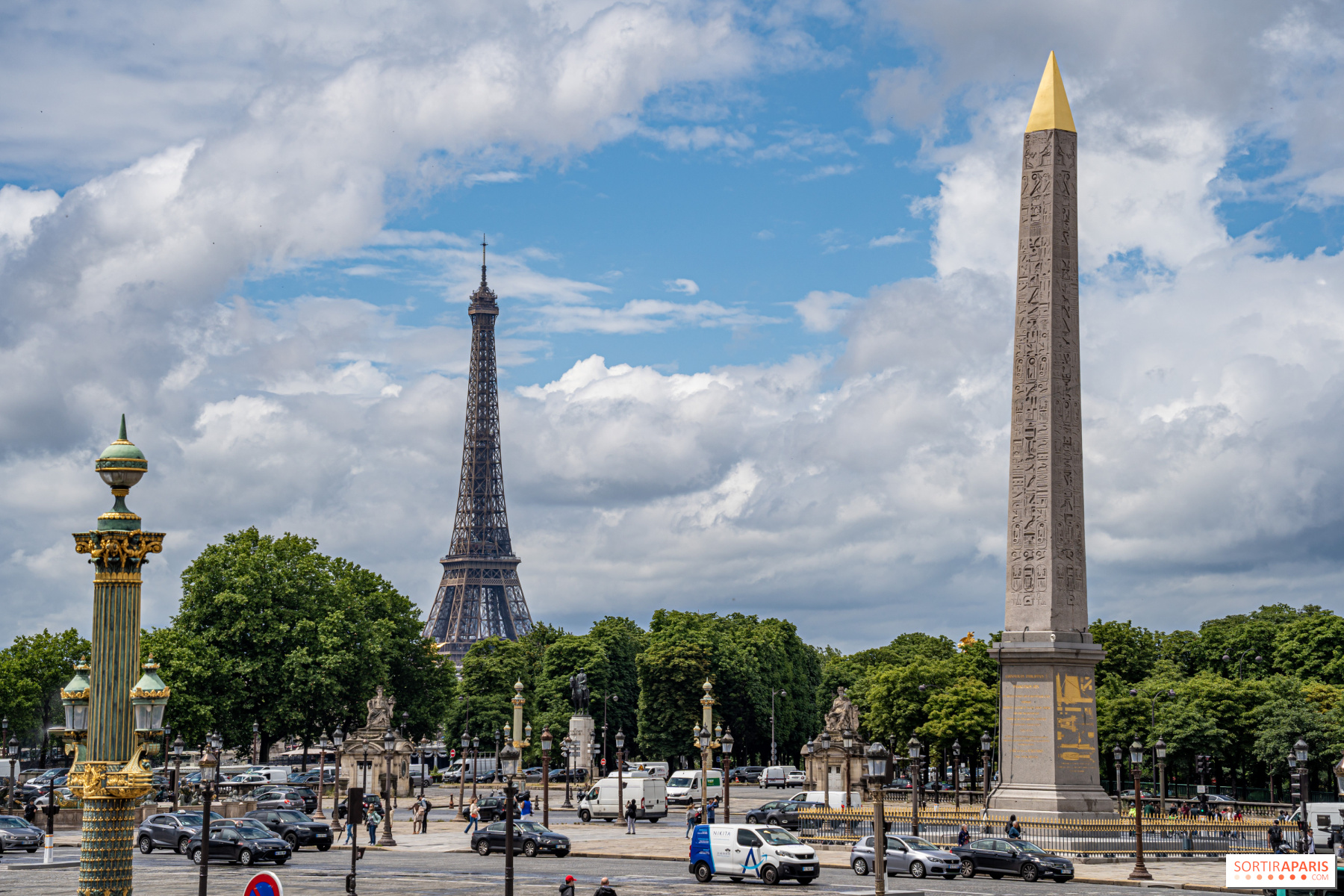
Standing proudly in Place de la Concorde, it often catches visitors off guard: after all, it’s quite startling to come across a 23-meter-tall Egyptian obelisk in the heart of Paris. The Louxor Obelisk is one of the capital’s most iconic landmarks, symbolizing the enduring ties between France and Egypt.
But the ancient monument isn’t just a tourist attraction or a diplomatic gift: it has also served a secret purpose since 1999...
During this special year, Parisians are preparing for the turn of the millennium. On June 21, 1999 — the date of the summer solstice — a circular pattern of cobblestones was laid around Place de la Concorde. These stones are inscribed with Roman numerals, arranged like the numbers on a clock. At the center stands the Obelisk, serving as a gnomon: as the sun moves across the sky, its shadow shifts and points toward specific stones, effectively marking the time for attentive passersby.
This massive sundial also reveals the curvature of the solstices and marks the equinoxes, thanks to metal inlays and bronze nails embedded along the paving. Of course, the system works only when the sun is shining—an occurrence that can be quite rare in Paris, depending on the season...
However, be careful not to be late: the time displayed by the Obelisk does not match the official French time zone, especially during summer after the daylight saving time change. The Luxor Obelisk shows the exact time only during the winter and summer solstices, as well as at the equinoxes. For everything else, it's best to rely on your watch.
This giant sundial project was officially launched in 1999, but its concept dates back much further. Astronomer Camille Flammarion, founder of the Société Astronomique de France (SAF), was the first to attempt to bring this idea to life in 1913. However, his plans were abruptly halted by the outbreak of World War I. In 1939, architect Daniel Roguet and Camille Flammarion’s widow, Gabrielle, renewed efforts to create this sundial, in honor of the astronomer’s legacy. Once again, global conflict prevented the project from coming to fruition.
Ultimately, it was Denis Savoie (director of the planetarium at the Palais de la Découverte and chair of the Solar Dial Commission at SAF) and Philippe de la Cotardière (science journalist and former SAF president) who brought this idea to life, just as the 21st century was beginning.
Location
Place de la Concorde
Place de la Concorde
75008 Paris 8