Did you know that Adventureland at Disneyland Paris hides a giant egg, pirate treasures and mysterious messages? Discover the secrets and stories behind this iconic land.
What if the greatest treasures in Adventureland aren’t necessarily the ones you’d expect? Behind the facades of the oriental bazaar, around a bend in the pirates’ caves, or amid the ruins of the Indiana Jones temple, Adventureland at Disneyland Paris is full of secrets, easter eggs and hidden details that even the most devoted visitors might miss. From references to Disney films and anecdotes about the park’s creation to former attractions and stories dreamed up by the Imagineers, this iconic land, which opened in 1992, holds plenty of surprises. Join us as we uncover the little secrets that make Adventureland even more fascinating. Keep your eyes peeled: some are right above your head!




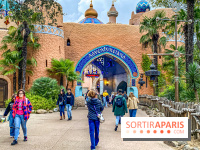
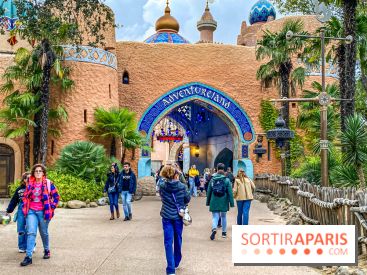
The entrance to Adventureland and Adventureland Bazaar
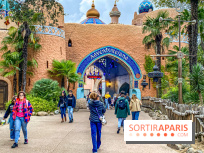
- The compass visible on the Adventureland entrance arch is a tribute to the True-Life Adventures, wildlife documentaries produced by Walt Disney between 1948 and 1960. The Land was originally intended to be called True-Life Adventureland.
- The initials “WDI” are hidden in the mosaic on the entrance arch. They stand for Walt Disney Imagineering, the creators of Disney parks.
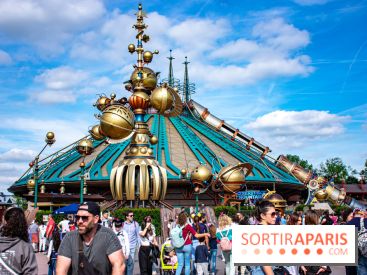
- The entrance on the Central Plaza side was designed as an Oriental bazaar, inspired by souks and the world of The Arabian Nights.
- A huge nest with a giant egg sits atop one of the Bazaar’s towers. It refers to the Roc, the gigantic bird encountered by Sinbad the Sailor in The Arabian Nights.
- A large chandelier hanging beneath the main arch is said to have been given to Disneyland Paris by King Hassan II of Morocco when the park was being created.
- A buffalo skull is part of the scenery near the entrance, an easy-to-miss detail as you enter the Land.
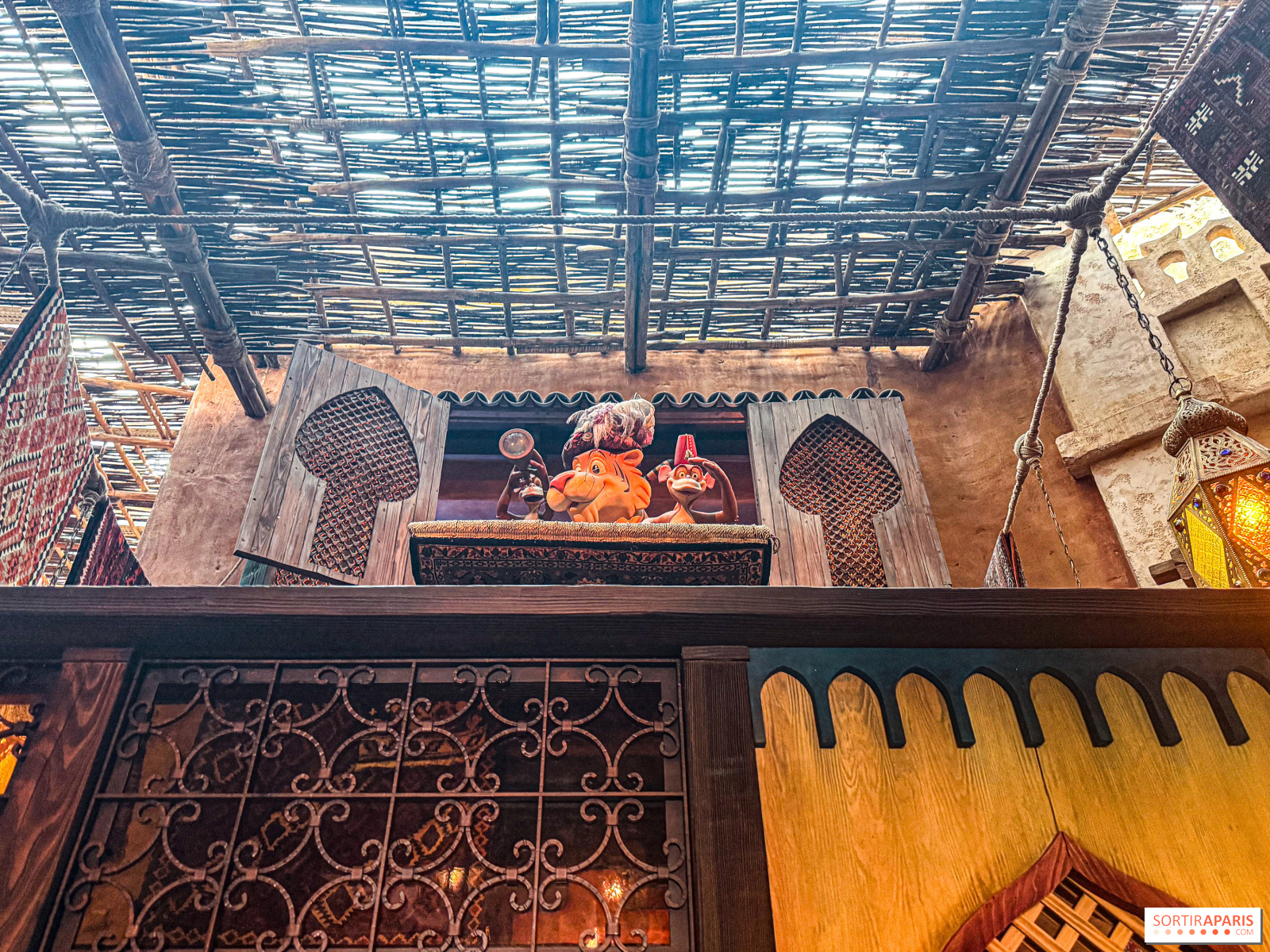
- The Bazaar’s walls and ceilings feature several specific references to The Arabian Nights: one painting depicts The Ebony Horse, another refers to The Magic Lamp, while The Talking Bird also appears in the décor. In addition, the character Yamlika, Queen of the Serpents, was associated with the former La Reine des Serpents shop. The architecture deliberately uses vaults, lanterns, narrow passages and broken sightlines to create the impression of walking through a real souk.
- The music gradually changes across the different areas of Adventureland, particularly between the Oriental bazaar, Africa and the jungle.
The former Bazar shops and the Agrabah Café
- When it opened in 1992, the Bazaar included four shops in particular: Aladdin’s Shop, The Snake Charmer’s Shop, The Song of the Tam-Tams and Scheherazade’s Treasures. Much of this space was later incorporated into the Agrabah Café. Scheherazade’s Treasures is the main shop to have retained its retail function.
- Inside the Agrabah Café, several decorative elements preserve memories of these former shops. Jute sacks hanging from the ceiling evoke a snake’s body, a nod to the former Snake Charmer’s Shop. A shelf filled with babouches recalls the artisans who once worked in the Bazaar.
- When the park opened, real artisans made babouches and engraved copper objects, among other things.
- Swords hang from the ceiling, and may represent the weapons of the adversaries defeated by Sinbad the Sailor.
- The Agrabah Café therefore also serves as a time capsule of Adventureland in 1992.
- Aladdin’s Enchanted Passage tells the story of the film in chronological order through a series of display windows and dioramas.
- One of the scenes depicts Aladdin and Jasmine on the magic carpet.
- The scenes work like miniature theaters, offering a storytelling experience very different from a classic dark ride.
- Several details are tucked into the background of the displays, encouraging visitors to stop rather than hurry through the passage.
The Curious Giraffe
- The Curious Giraffe is indeed an Audio-Animatronic, not a mere sculpture. Its mold comes from the Jungle Cruise giraffes at Disneyland in California.
- Its presence is also a remnant of a more ambitious idea: Adventureland was supposed to feature more Audio-Animatronic animals, in the spirit of Jungle Cruise.
- Disneyland Paris gave the building a backstory: a merchant crossing the desert supposedly had an accident while trying to avoid an overly curious giraffe. The wrecked Jeep was initially considered as a sales outlet, before the idea was dropped.
- The Jeep bears an inscription reading “Curios”, among other things, like an improvised advertisement for the merchant’s business.
- Inside the shop, there is a tent, a camp chair, a fedora and a camera, as if the owner had just returned from a safari.
- Several crates bear humorous inscriptions, including “Dr Leakey”, “Sligo, Safaris Inc”, “M. Sapristi” and “Porcelain for the Elephant”.
- The façades and motifs also draw on African architecture, particularly Hausa architectural references.
The vegetation of Adventureland
- Much of the vegetation was chosen to create a tropical feel while withstanding the climate of the Île-de-France region.
- Several varieties of cold-hardy bamboo were used in particular. The bamboo also serves as a windbreak, creating a more favorable microclimate in certain areas.
- Disney worked with Bill Evans, Disneyland’s longtime landscape designer in California, to create some of the garden settings.
- The transition between the Land’s different regions is also conveyed through the plants, ground surfaces and materials, without signs explicitly indicating a change of “country.”
- As you approach this area, the music shifts toward more African percussion.
- The restaurant is presented as a savanna hut.
- The architecture, colors and plantings create a gradual transition from the Bazaar’s oriental atmosphere to a stylized Africa.
- Le Colonel Hathi’s Outpost was originally called Explorer’s Club Restaurant. Several traces of the former restaurant are still visible.
- You can spot the initials “EC”, for Explorer’s Club.
- These initials appear, for example, on a world map near the fireplace.
- The restaurant still features explorer’s gear, old photographs and various early 20th-century accessories, including an old typewriter, a gramophone and an old fan.
- An airplane propeller hangs above the crates, as if it had been brought back from an expedition.
- The large indoor tree is still home to animated birds. These birds echo the concept behind Walt Disney’s Enchanted Tiki Room, an attraction not found at Disneyland Paris. They also recall the original Explorer’s Club concept, in which more Audio-Animatronics animals were to interact with visitors.
- When the restaurant was transformed around The Jungle Book, the large banyan tree was incorporated into the new story as a rare specimen brought back by the explorers.
- The tree has a fictitious botanical name: Disneyodendron semperflorens grandis. It has more than 300,000 leaves. It is one of Adventureland’s highest points accessible to visitors.
- It was inspired by the Disney film Swiss Family Robinson.
- Some of the furnishings are said to have been made from items salvaged from the wreck of the Swallow. The ship can also be seen near the tree.
- Among the props is a genuine 18th-century top hat.
- Visitors can spot hundreds of seashells in the scenery.
- Some of the structures incorporate bamboo, reinforcing the idea of a dwelling built from local resources.
- The waterfalls surrounding the tree were designed to be visible from several different vantage points.
- The beaches around the island evoke the coasts of New Guinea, where the family is said to have been shipwrecked.
Adventure Isle
- Adventure Isle blends several Disney worlds: The Swiss Family Robinson, Treasure Island, and Peter Pan.
- Its overall concept is inspired by the exploration islands found in American parks, particularly Tom Sawyer Island, but adapted here to a pirate setting.
- The bodies of water have real names: Sea of the Swordfighters, Doubloon Lagoon, Pirates’ River, Cannonball Cove, and Freebooter Falls.
- The Land therefore functions as a real-life treasure map.
- The Floating Bridge and the Suspension Bridge are part of this exploration concept and are more than just shortcuts.
The Six Galleries of Adventure Isle
- Ambush Alley passes beneath the Suspension Bridge.
- Davy Jones’ Locker is home to a well said to be bottomless.
- Dead Man’s Maze plays on the idea of a maze haunted by the memories of pirates long gone.
- Spyglass Pass provides a route through the Spyglass Hill area.
- Hook’s Hideout is Captain Hook’s hideout, concealed behind a waterfall.
- Keehaul Cavern is one of the darkest caves, with bats and pirate skeletons.
- A gallery leads to Captain Flint’s treasure, associated with Treasure Island. It is said to have been hidden by Ben Gunn.
- Nearby is a pirate throne carved directly into the rock.
- Some cave entrances are deliberately hidden behind waterfalls.
The Pirates’ Treasure Hunt
- A permanent scavenger hunt has been added to the caves to better connect Adventure Isle and Pirates of the Caribbean.
- Eight lost items are hidden around the area.
- One of them is a wooden leg. You can also search for a pirate’s tricorn hat.
- One of the best Easter eggs is the key ring belonging to the dog from Pirates of the Caribbean, the one the prisoners try to lure.
- The items were created using props and references from Pirates of the Caribbean.
- The scrolls used to introduce the hunt were hand-painted.
Spyglass Hill and Pirate Lookout
- Spyglass Hill is the large pirate hill on Adventure Isle.
- It is topped by Pirate Lookout, a watchtower where the pirate flag flies.
- This part of the setting is particularly evocative of Treasure Island.
- Disney even places the spot where Jim Hawkins is said to have repelled Long John Silver’s attacks in this area.
Skull Rock
- Skull Rock is about 12 meters high. It towers over Cannonball Cove.
- It doesn’t come from Pirates of the Caribbean, but from Peter Pan. It recalls the place where Peter comes to rescue Tiger Lily from Captain Hook.
- You can go inside the skull. From inside, you can look out over Adventureland through its eye sockets and mouth.
- Lanterns placed in its eyes give the skull a glowing gaze at nightfall.
- A waterfall gushes from its mouth, making it an integral part of Adventure Isle’s network of rivers and waterfalls.
The Pirates’ Galleon
- The ship moored opposite Skull Rock also belongs to the world of Peter Pan and Captain Hook.
- It was therefore not originally a set directly associated with Pirates of the Caribbean.
- The ship has served several times as a real performance stage, notably for showdowns between Peter Pan and Hook.
- Together with Skull Rock, it recreates a life-size piece of Neverland.
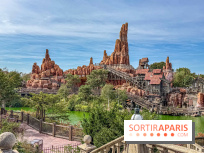
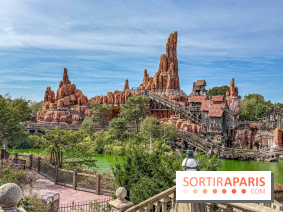
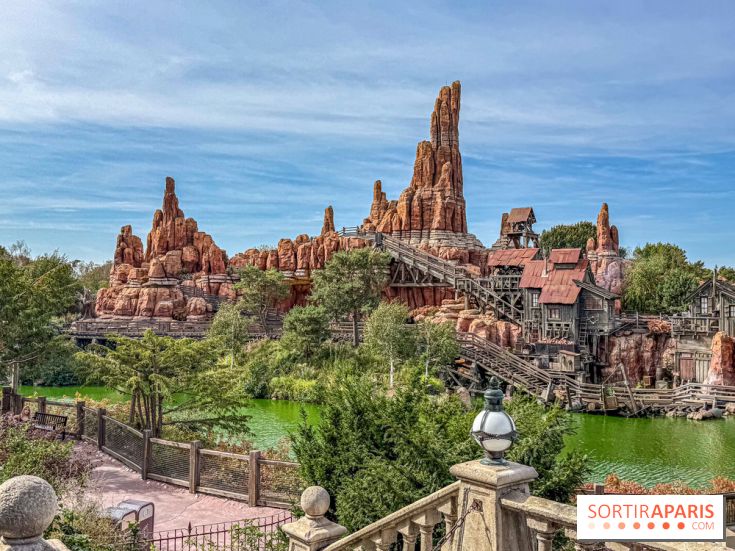
- The attraction tells an original Indiana Jones adventure, rather than recreating a scene from a film. The story is set in the 1940s.
- Indiana Jones is said to have persuaded his university to fund excavations at a lost city in the Indian jungle. The archaeologists then discover a vast ancient temple.
- The coaster tracks have a narrative explanation: they are supposedly a construction railway used to haul away excavated materials.
- Visitors are therefore theoretically riding in the archaeologists’ mine carts.
- The temple’s architecture draws in part on the Vidyashankara/Vidyashankar Temple in India. The temple is said to be dedicated to Shiva.
- The theming features numerous depictions of the Naga, the king cobra. It’s also a nod to Indiana Jones’s fear of snakes.
- Two enormous Naga cobras flank the temple entrance.
- A third, much smaller Naga is hidden in front of one of the camp tents. This one is much easier to miss.
The Vehicles at Indiana Jones’ Camp
- The Jeep and the camp truck are genuine vintage vehicles dating back to World War II, modified by the Imagineers.
- The truck was transformed to resemble the one carrying the Ark of the Covenant in Raiders of the Lost Ark.
- Large horns on the hood are part of the transformation.
Indiana Jones’s whip and hat
- Indiana Jones’s whip is hidden in the queue scenery. His famous fedora is there too: The two props are near a scaffold in the camp.
- They are among the references to Indiana Jones and the Last Crusade, which tells how a young Indy gets these accessories.
Marcus Brody and Barnett College
- A crate near the quay bears the name Marcus Brody.
- It is addressed to Barnett College, the university where Indiana Jones teaches.
- The destination also mentions Fairfield, extending the saga’s fictional university setting.
The Dial of Destiny
- A more recent addition is hidden in the camp: a notebook contains a drawing of Archimedes’ Dial. It’s a nod to Indiana Jones and the Dial of Destiny. This Easter egg was added several decades after the attraction opened.
The loop and the history of the attraction
- The track is approximately 560 meters long.
- When it opened, its 360° inversion was a first for a Disney attraction.
- From 2000 to 2004, the trains ran with visitors facing backward under the name Indiana Jones and the Temple of Peril… Backwards!
A motto hidden in the storyline
- A maxim accompanies the temple’s story: “The treasures of the world await those who dare to climb high”.
- It evokes the riddles and warnings left by Henry Jones Sr. about the quest for the Grail in The Last Crusade.
Pirates of the Caribbean: the outer fort
- The façade depicts an 18th-century Spanish Caribbean fortress.
- The walls deliberately feature large stones and wooden beams. The great white tower looks as though it has been bleached by the sea air and spray.
- Several cannons guard the fort, as if a pirate attack were imminent. The storytelling therefore begins before you even enter the attraction.
- The attraction predates the Pirates of the Caribbean films: the Disney attractions inspired the film series.
- After the films became a hit, Jack Sparrow and Barbossa were added to the Paris version.
- Barbossa briefly turns into a skeleton when lightning illuminates his scene, a direct reference to the pirates’ curse.
- The burning town uses projections and lighting effects to heighten the impression of a fire.
- The famous prisoners’ scene features the dog holding the cell keys. In fact, there are three different dogs to look for in the attraction: the one with the keys, the one who discovers Jack Sparrow hiding in a barrel, and the one who barks along with the musicians.
- The Disneyland Railroad passes above part of the attraction, offering a different view of some scenes. From the train, you can spot Barbossa and Jack Sparrow. A few skeletons have also been placed near the tracks for Railroad passengers.
- The restaurant is integrated directly into Pirates of the Caribbean. Guests seated at the tables can see the attraction’s boats passing by, and passengers on the boats can also see the restaurant’s tables.
- The lighting is deliberately kept very dim to create perpetual night in the Caribbean, even in the middle of the day. The torches and warm lights help create this illusion.
The invisible transitions of Adventureland
Adventureland is not one single, uniform world, but a succession of several imaginary regions.
It begins with Agrabah and the Middle East, followed by African influences. Next, Adventure Isle leads to tropical islands, Peter Pan and Treasure Island. The vegetation becomes more Indian and Asian around Indiana Jones. Pirates of the Caribbean then takes us to the colonial Caribbean. These transitions are made primarily through plants, materials, ground surfaces, music, scents and water, rather than visible boundaries.
This page may contain AI-assisted elements, more information here.