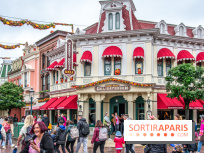
Main Street, U.S.A. at Disneyland Paris is full of secrets and hidden details! Discover quirky stories, nods to Walt Disney and little-known tales about this iconic street in the park.
Do you know the secrets hidden in the Main Street, U.S.A. land at Disneyland Paris ? Behind its pretty Victorian façades and shops reminiscent of old-time America, this iconic street in Disneyland Park is full of little-known stories, hidden details and nods to Walt Disney.
From mysterious names etched on windows to conversations you can overhear through the walls, not to mention dates that are no coincidence and unexpected nods to Paris, the Imagineers have had fun hiding all sorts of surprises in the scenery. And the best part is, we often walk right past them without even noticing! So, next time you head up Main Street toward Sleeping Beauty Castle, keep your eyes peeled… and your ears open. We’re revealing the little secrets of this street that’s unlike any other!




Main Street, U.S.A. as a whole
- Main Street represents a small American town at the turn of the 20th century, drawing heavily on Walt Disney’s childhood memories of Marceline, Missouri.
- The Paris version was designed primarily by Imagineer Eddie Sotto. Before settling on this concept, Eddie Sotto had envisioned a 1920s Main Street for Paris: a more urban setting shaped by jazz and silent films.
- The project even called for an elevated train linking Town Square to Central Plaza. It was never built, but the idea was inspired in part by the sets of the film Hello, Dolly!.
- Hello, Dolly! is indeed one of the main inspirations for Paris’s Main Street, particularly for the advertising posters, trams, Main Street Station staircases and the entrance to Plaza Gardens.
- The street’s colors were deliberately made more vivid than those of the American Main Streets so they would work better in the light and climate of the Île-de-France region. This palette was developed with John Hench and draws in part on the warm tones of Lady and the Tramp, which is also set in the early 20th century.
- The cobbled street is itself a nod to France, as are the two large covered arcades.
- Liberty Arcade and Discovery Arcade are inspired by Paris’s covered passages and galleries, an adaptation conceived in 1992 for the European climate.
- The Main Street music was recorded with a real ragtime orchestra.
- Eddie Sotto even lent his own voice to several unseen Main Street residents, including a patient at the dentist’s, a resident on the telephone and the Disneyland Railroad’s train conductor.
Main Street Station
- Main Street Station is designed as a gateway between the real world and the Park, even before visitors actually enter the street.
- The covered metal staircases are inspired by the entrances to elevated train lines in late 19th-century New York.
- The station also draws on ideas seen in other Disney creations, notably the way the train passes through the scenery at “it’s a small world” in California and the Monorail station at the Contemporary Resort in Florida.
- The station’s stained-glass windows and posters depict the different lands of Disneyland Park, like a trailer for what awaits visitors.
- Eddie Sotto drew inspiration for these images from the paintings in Le Train Bleu restaurant at Gare de Lyon, which depicted destinations served by the Paris–Lyon–Méditerranée train.
- The Paris–Main Street connection is therefore present from the very first minutes of a visit, but remains almost invisible to anyone unfamiliar with the reference.
City Hall
- City Hall is not an entirely fictional American town hall: its architecture is directly inspired by the Western Union Telegraph Building in New York.
- In 1875, this building was the tallest in New York.
- The red, white and blue cockades and the golden eagle on the façade deliberately reinforce its American patriotic character.
Main Street’s windows: probably the Land’s biggest “secret”
It’s one of the longstanding principles of Disney Parks: the names displayed on the windows are generally not those of fictional residents chosen at random, but tributes to people who contributed to the creation or history of Disney.
Eddie Sotto and the School of Dentistry
- Eddie Sotto’s name appears on a window at Dr. Bitz Dental School in Town Square.
- The name “Dr. Bitz” is itself a playful nod to his full name, Eddie Sotto Bitz.
- If you listen near the school, a patient can be heard laughing under the influence of laughing gas. The voice is Eddie Sotto’s own.
- Since 2021, Yves Ben Yeta, former Creative Director at Walt Disney Imagineering Paris, has also joined this “dental team” on the window.
- His name appears alongside those of Jeff Burke, Tim Delaney, Tom Morris, Eddie Sotto and Chris Tietz, all of whom were involved in the original design of the five Parisian Lands.
Sylvie Massara
- Since 2024, Imagineer Sylvie Massara has had her own window above Ribbons and Bows Hat Shop.
- The fictional sign reads “New Century Interiors,” a reference to her decades of work on the Parks’ sets and interiors.
Walt and Roy Disney
- A window above the Boardwalk Candy Palace pays tribute to the two brothers under the name “Two Brothers Inc.”.
- Walt and Roy are presented as “Dreamers & Doers”, a reminder that they founded Disney Brothers Studios together in 1923.
- Roy O. Disney is also honored on the Disney & Co. building, with his date of birth, June 24, 1893.
- Walt’s nephew, Roy E. Disney, also has his own window above Ribbons and Bows.
- The fictional company is Pyewacket Cruise Lines, a nod to his passion for sailing and water sports.
A tribute to all Cast Members
- A “Casting Agency” door has also been added as a collective tribute to Disneyland Paris Cast Members.
The Numbers Hidden in Main Street
- 1901 appears on the facade of Disney Clothiers, Ltd.: it is the year Walt Disney was born.
- You can also find 1901 on some of the metal plaques embedded in the ground.
- The plaques also bear the name Elias, Walt’s father.
- Elias is described there as a “contractor”, a reminder that he worked in construction, among other fields.
- 1892 appears on Emporium and Harrington's Fine China & Porcelains.
- This is obviously not the year the park opened: 1892 is 1992 set back exactly one hundred years to fit the Victorian-era setting of Main Street.
- 1401 Flower Street, the address listed on Walt’s, refers to 1401 Flower Street in Glendale, the historic address of Walt Disney Imagineering’s headquarters.
The Invisible Inhabitants of Main Street
- Main Street is supposed to be a real, inhabited town, and some residents exist only as sounds.
- On Flower Street, you can hear a tap-dancing lesson coming from an upstairs floor.
- On Market Street, you can hear a piano lesson.
- Above Victoria's Home-Style Restaurant, a resident is supposedly brushing their teeth.
- The neighboring Dr. Bitz Dental School obviously extends the tooth-related gag.
- All these sounds are part of a very simple idea: the second-story façades aren't supposed to be empty, but to house the residents of the little town.
Market Street: references to Magic Summer
- The Disney film Summer Magic inspired several details on Market Street.
- A sign mentions Digby's Messenger Service, a reference to the film character Digby Popham.
- A boarding house is named Beulah, after the town where the story takes place.
- Two songs from the film, “Beautiful Beulah” and “Flitterin'”, were also incorporated into the Land’s musical atmosphere.
The Market House Deli phone
- An old telephone lets visitors listen to conversations among the residents of Main Street.
- It recreates the system of the old American “party lines”, where several households shared the same telephone line and could therefore hear their neighbors’ conversations.
- Other interactive telephones have been or are available in several Main Street shops;
Liberty Arcade
- Liberty Arcade is entirely devoted to the Statue of Liberty, its construction and the historical ties between France and the United States.
- The gallery pays particular tribute to the sculptor Frédéric Auguste Bartholdi.
- Main Street also features references to Gustave Eiffel, whose company built the statue’s internal structure.
- The gallery’s architecture is directly inspired by the covered passages of Paris.
- The concept also draws on an idea Walt Disney had considered for Disneyland in California: Liberty Street, a street devoted to American history and values that was never built in this form.
- Photographs, engravings, newspapers and period objects trace the creation of the Statue of Liberty in the display cases.
- A small room behind curtains recreates the 1886 inauguration of the Statue of Liberty in a diorama-like setting. It’s an easy detail to miss when passing through the arcade too quickly.
- Liberty Arcade’s musical backdrop includes Scott Joplin ragtime, performed by Gunther Schuller and the New England Ragtime Ensemble.
- Liberty Arcade is also designed as a passageway to Frontierland, its themes of liberty and pioneers serving as a transition between urban America and the Wild West.
Discovery Arcade
- Discovery Arcade tells the story of technological progress and the future as Americans in the 19th century might have imagined them.
- It is the Parisian counterpart to another abandoned idea by Walt Disney for Disneyland: Edison Square, which was to celebrate progress and invention.
- The columns feature medallions inspired by Leonardo da Vinci’s Vitruvian Man.
- The lighting deliberately combines gas lamps and electric light, embodying the shift from an old technology to a new one.
- The display windows feature 52 patents and invention models spread across seven display cases.
- One particularly interesting point: these inventions are not fake Disney props. They are authentic patent proposals from the 19th-century US patent system.
- Among the items on display are a washing machine, a popcorn machine, a clothes dryer, a sewing machine and even an amphibious bicycle.
- The large posters envision New York, Chicago, San Francisco, Denver, Washington, Los Angeles and New Orleans in the future, as an artist in the 19th century might have dreamed them.
- Their retrofuturistic aesthetic is notably linked to Albert Robida, a French illustrator who was already imagining aerial cities and future technologies.
- These posters gradually create a visual transition to Discoveryland, where Jules Verne, H. G. Wells and early visions of the future become the main theme.
- One display case now features the Opéra Garnier, a further nod to Paris and the arrival of electric lighting.
- Another subtle detail: Main Street Marketplace, at the center of Discovery Arcade, was meant to host other experiences, including a project involving automatons or a market. These projects were never realized.
Walt’s – An American Restaurant
It is probably the building on Main Street with the most historical Disney references.
- 1401 Flower Street is the address of Walt Disney Imagineering in Glendale.
- In the lobby, a bust of Walt Disney greets visitors.
- Many photographs show his parents, his brother Roy and his wife Lillian.
- A zoetrope recalls the optical devices that preceded animated films.
- A cage with a mechanical bird evokes the automaton bird Walt discovered in New Orleans in 1949, which helped spark his interest in what would become Audio-Animatronics.
- The staircase is designed as a metaphor for Walt's professional rise, with photographs tracing his successes along the way.
- The mahogany elevator is topped with an ornate glass dome.
- The windows bear Walt's interlocking initials, adapted from the design created for his New Orleans Square apartment at Disneyland in California.
- The floor is partly inspired by the famous California Club 33, but Walt's was designed from the outset to be accessible to ordinary visitors.
- The lounges feature historically accurate materials, such as lincrusta, invented in 1877, and anaglypta, introduced about a decade later.
- The Adventureland room draws on the Orientalism of the late 19th century.
- The Fantasyland room is decorated in a Gothic Revival style.
- The Frontierland room draws in particular on the work of American sculptor and painter Frederic Remington.
- The Discoveryland room blends Jules Verne with the Art Nouveau of Alphonse Mucha and Hector Guimard.
- Its fireplace was designed by Eddie Sotto after the one Mucha created for the Fouquet jewelry store, now housed at the Carnavalet Museum.
- It is carved from Amazonian walnut.
- An armillary sphere evokes From the Earth to the Moon.
- Inside, a model of the Nautilus, made by Tom Sherman, art director of Les Mystères du Nautilus, floats.
- Another room features one of the earliest concepts for the Disneyland Hotel, itself inspired by California's famous Hotel del Coronado.
- Several authentic attraction models from the Walt Disney Imagineering workshops are on display in the lounges.
Lilly's Boutique
- Lilly's is a tribute to Lillian Disney, Walt's wife.
- The decor reflects her tastes, including porcelain and an elegant residential aesthetic.
- Several photographs show Walt and Lillian traveling in Switzerland and France.
- One photograph also commemorates their 30th wedding anniversary, celebrated on July 13, 1955, at Disneyland's Golden Horseshoe Saloon, just days before the California park opened.
- Since 1999, the shop has occupied former rooms of Walt's.
- The fireplace visible at the entrance is a remnant of the restaurant's former layout.
Harrington's Fine China & Porcelains
- Harrington's is directly inspired by Pollyanna.
- The name comes from Polly Harrington, the heroine's aunt.
- The crystal prisms used in the light fixtures recall a scene in the film in which Pollyanna uses prisms to cast rainbows into dark rooms.
- The store has a large stained-glass window above the cash register, which was specifically noted by Hayley Mills, the actress who starred in Pollyanna, during her visit.
- 1892 appears on the façade, a disguised reference to Disneyland Paris opening in 1992.
- The large central dome creates a “whispering gallery” effect. Two people standing at opposite points beneath the dome can hear each other very clearly thanks to the elliptical acoustics.
The Storybook Store
- The Storybook Store is inspired by the library run by Marian in The Music Man.
- The columns and furnishings echo several elements seen in the film.
- The Music Man is also a recurring Main Street reference, right down to its soundtrack.
The Gibson Girl Ice Cream Parlour
- Part of its scenery was also inspired by The Music Man and the glacier featured in the film.
- The Rumpleheimer's Ice Cream Parlor in Disney's The Happiest Millionaire also served as a reference.
- The theme song “Fortuosity” from the same film is played on Main Street.
Disney & Co.
- The decor at Disney & Co. evokes old American fairs and carnivals.
- Disney cites So Dear to My Heart and Pollyanna among the references used by the Imagineers.
- On the building, Roy O. Disney’s birth date appears as a decorative feature.
Casey's Corner
- The name Casey's Corner comes from the animated segment “Casey at the Bat”, included in Make Mine Music in 1946.
- That's why the entire restaurant is dedicated to baseball, and not simply because hot dogs and baseball go well together.
- A quote about baseball by historian Jacques Barzun is displayed in the restaurant.
- Since 2025, the covered patio has added a new series of little Easter eggs.
- Baseball bats are hidden in the turnstiles.
- You can also spot them in the roof pediments' rays.
- The chair backs are shaped like bats, too.
- Baseballs are hidden in the bas-reliefs.
- The motif even appears on the waste-sorting stations: exactly the kind of detail almost nobody notices.
Main Street vehicles
- The street is traveled by several vintage vehicles: horse-drawn streetcars, a paddy wagon, an omnibus, a fire truck and period automobiles.
- Disneyland Paris mentions an authentic Mercer among the vehicles.
- This Mercer is reminiscent of the one driven in The Happiest Millionaire and also resembles the car belonging to Georges Hautecourt in The Aristocats.
- Some license plates have been altered as tributes to other Disney parks: CA 1955, FL 1971 and CH 2016, referring respectively to Disneyland in California, Walt Disney World in Florida and Shanghai Disney Resort.
Main Street Motors
- Main Street Motors was designed as a genuine early 20th-century automobile garage.
- Many of the automotive objects, posters and accessories are authentic period pieces, not reproductions.
- The shop also reflects the evolution of Main Street: horses gradually share the scene with the first automobiles.
- The garage theme is a distinctive feature of the Paris version.
The little figures on the popcorn carts
- The little animated figures spinning inside popcorn carts are not Disney inventions.
- They descend from the “Tosty Rosty Man”, a character designed by Charles Cretors in the late 19th century to promote his popcorn machines.
- Cretors notably showcased his machine at the 1893 Chicago World’s Fair.
- Walt Disney had already installed similar Cretors carts on Main Street at Disneyland in 1955.
- In Paris, their decorations feature lettering and ornaments typical of the turn of the century.
The new kiosk near Liberty Arcade
- The bandstand added in late 2024 was designed to look as though it had always been part of Main Street.
- Its silhouette is inspired by Victorian park bandstands.
- Stars encircle its roof, a subtle nod to Disney magic.
- It contains a Victorian-style chandelier.
- Most importantly, its verdigris color was no random choice: it references the Statue of Liberty, which makes perfect sense at the exit of Liberty Arcade.
Dapper Dan's Hair Cuts
- This isn't a fake barbershop: Dapper Dan's really does operate as a barbershop.
- The barber takes care of hair, mustaches, and goatees.
This page may contain AI-assisted elements, more information here.