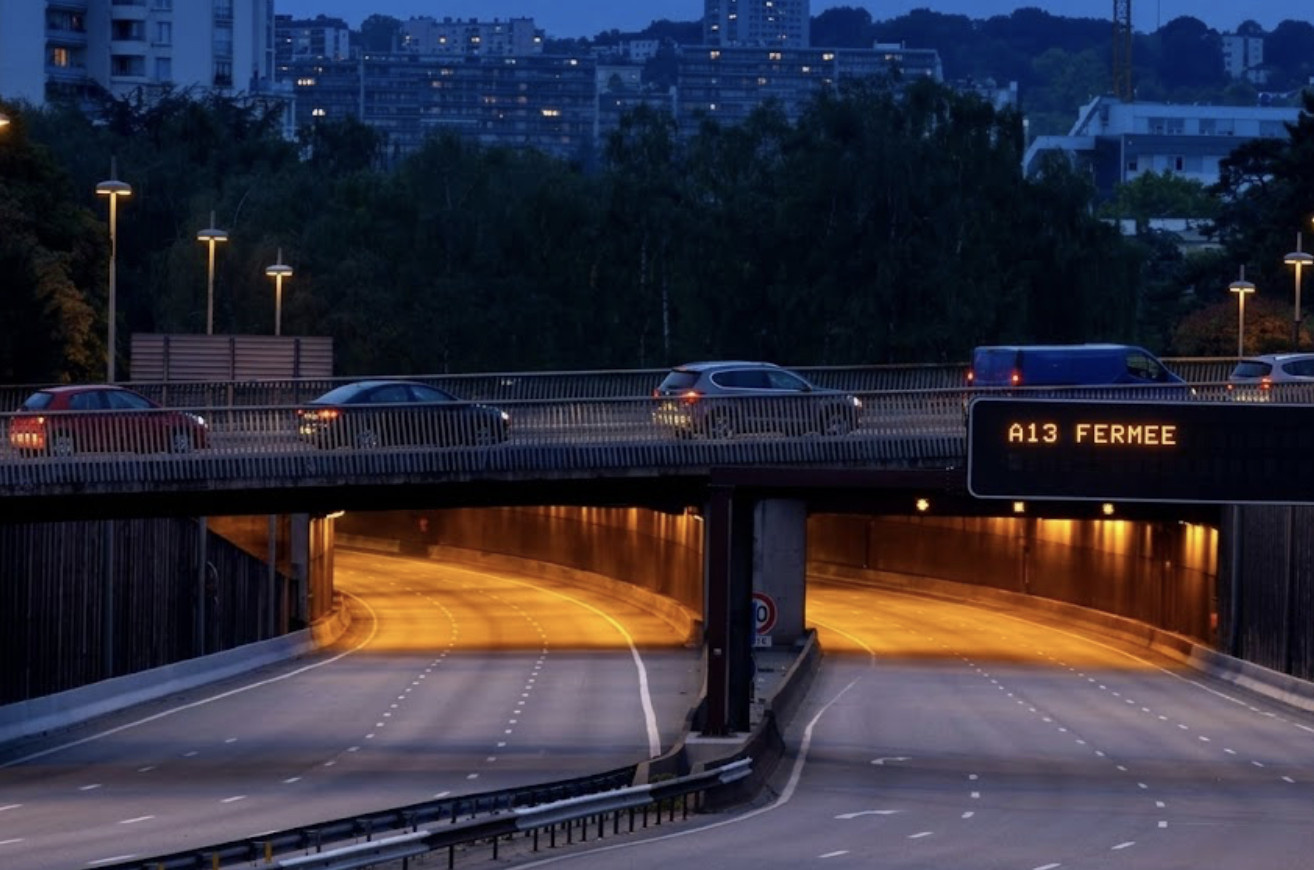
Two accidents in western Paris disrupted traffic on the morning of Monday, November 23, 2026: one on the N385 in Châtenay-Malabry, in Hauts-de-Seine (92), and the other on the A13 in Rocquencourt, in Yvelines (78). They added to the disruption caused by the closure of the Saint-Cloud Tunnel, which has been closed to traffic heading from Paris toward the provinces on the A13 motorway since November 16.
As a result, Sytadin recorded up to 427 km of traffic jams across Île-de-France at 9 a.m., an exceptional level close to that of the previous Monday. Traffic diverted onto the A86 and A14 has made western Paris the morning’s main trouble spot. The closure of the A13 heading out of Paris will remain in place until August 31, 2027.
A look at another difficult Monday, a review of the first week and everything changing during the construction work, from diversions to the A14 being free on weekdays.
The first injury accident involving a car and a motorcycle occurred shortly after 9 a.m. on the N385, on the inner ring, near Châtenay-Malabry (92). At 9:07 a.m., traffic was heavy for 17 km between the Pompadour interchange and Clamart, with the journey taking about an hour instead of the usual 35 minutes.
A second accident involving four cars was reported on the A13 towards Paris, on the carriageway that remained open, near Rocquencourt in the Yvelines. The right-hand lane was closed and traffic slowed over 11 km between Orgeval and Rocquencourt, with a journey time of around 14 minutes compared with the usual 12.
The Sytadin traffic counter, run by the Île-de-France Road Directorate’s traffic information service, climbed throughout the morning. It passed the 400-kilometer mark, peaking at 427 kilometers at 9 a.m.—close to the figure recorded on Monday, November 16, the day of the lockdown.
The pressure then eased. At 10:22 a.m., Sytadin was reporting just 126 km of traffic jams. The same pattern is therefore repeating every Monday morning, with heavy rush-hour traffic followed by a gradual return to normal in mid-morning.
This is the direct result of the closure of the A13. Unable to use the Saint-Cloud tunnel to leave Paris heading west, some motorists are switching to the A14 and the A86. On Monday morning, the A86 was even the most congested road in the entire region.
This shift has been noticeable since work began: road users in western Paris account for the largest share of the total traffic jams. The A86 Duplex, between Rueil-Malmaison (92) and Vélizy-Villacoublay (78), remains a toll road, pushing even more drivers onto free routes.
On Monday, November 16, the first day of the closure, Sytadin was already reporting more than 430 km of traffic jams at 8:50 a.m., as franceinfo noted. By evening, around 330 km of traffic jams had built up across the region, with drivers reporting journeys taking twice as long around Saint-Cloud, according to franceinfo.
The following day, a transport strike pushed the total to 560 km that morning, reports Temps Réel 78. Yet the regional prefecture considered the first day fairly typical on the two diversion routes, with journey times extended by no more than 25 minutes on a few stretches during rush hour.
The structure’s northern tube dates back to the 1930s and was not designed with reinforced concrete. Inspections carried out in 2024 and 2025 revealed slow deformation of the vault. Nothing urgent, according to Georges-François Leclerc, prefect of Île-de-France and Paris, but reinforcement work is considered essential in the medium term. The newer southern tube remains open toward Paris.
The schedule has been brought forward because of the Grand Paris Express: the tunnel boring machine for the Line 15 West must pass beneath the highway in 2027. Crews will therefore pour a new reinforced-concrete lining inside the tunnel, over a 72-meter stretch. The €35 million project is being funded in equal parts by the Société des grands projets and the French state.
The closure, which is in effect 24 hours a day, runs from the Boulevard Périphérique to the Vaucresson interchange, according to the regional prefecture’s press pack. For an overview of the diversions, the DiRIF presentation posted online by Saint-Cloud remains very useful.
Yes, but only on weekdays. Announced on October 21 by Prime Minister Sébastien Lecornu, the free A14 toll on weekdays has been in effect since November 16 for traffic heading from Paris to the provinces. Passing through the Montesson toll plaza is free from midnight on Monday until 11:59 p.m. on Friday, excluding public holidays, for cars and motorized two-wheelers, with no subscription required. Heavy goods vehicles are not eligible.
This measure replaces the 50% discount scheduled for September via Bip&Go. During the full closure of the A13 in July and August 2027, the A14 will be free in both directions, Transport Minister Philippe Tabarot said on November 5.
Saint-Cloud Tunnel closed: when is the A14 free?
The A14 motorway will be toll-free on weekdays during the Saint-Cloud tunnel closure on the A13 in Hauts-de-Seine. Sébastien Lecornu announced it will apply for the entire duration of the works, from 16 November 2026 to the end of August 2027. [Read more]
Not for now. The Duplex A86, a 10-kilometer toll tunnel, is still charging drivers. The Yvelines departmental council is calling for it to be made free or for a reduced fare of 3.50 euros per trip, and Saint-Quentin-en-Yvelines is also waiting for a concession for employees who commute there.
The state fears that a drop in toll rates could worsen the traffic jams that already occur frequently during rush hour. A monitoring committee is tracking traffic during the first few weeks before any decision is made. With the A86 topping the list of congested routes this Monday, the issue is likely to come back to the table soon.
An inter-prefectural order establishes a restricted traffic zone from November 16, 2026, to August 31, 2027. According to the Île-de-France Road Directorate (DiRIF), it covers nine municipalities:
Through traffic is prohibited there, except on certain designated roads. It is therefore impossible to drive through these cities to avoid traffic jams without stopping. Residents, visitors and professionals whose journey starts or ends in the zone can, however, continue to travel within it.
In La Celle-Saint-Cloud, for example, the zone covers the entire municipal area, except for the RD307 and the junction between the RD182 and RD184. The information must also be sent to GPS apps such as Waze and Google Maps so they stop directing drivers onto these shortcuts.
A joint prefectural order requires transit trucks weighing more than 7.5 tonnes to follow a mandatory diversion route, bypassing the Île-de-France region to the east via the Francilienne for the duration of the works, reports InfosYvelines. The aim is to prevent 38-tonne trucks from overwhelming the diversion routes or the narrow streets of neighboring towns.
With up to 80,000 vehicles a day, the A13 is one of the region’s busiest roads. Two detour routes are signposted from the ring road: to the north via the RN13 and then the A14, and to the south via the RD910 and then the RN118, to reach the A86, RN12, A12 and A13 farther west.
As has been clear over the past week, these roads quickly become congested during rush hour. The authorities recommend checking Sytadin or Bison Futé’s dedicated page before setting off, changing your travel times where possible, or switching to public transport. Our daily update on traffic and road conditions in Paris can also help you plan ahead.
Île-de-France Mobilités has adjusted the routes that used the A13:
Route 7815 carries around 1,000 passengers during peak hours: it’s probably the route where the changes are felt most. The safest bet is to check the times in the Île-de-France Mobilités app before setting off.
The RER A and C and Transilien lines L, N, J and U are receiving enhanced maintenance to limit breakdowns, and staff are assisting passengers at several stations, including Versailles, Saint-Quentin-en-Yvelines and La Défense. According to InfosYvelines, citing Transilien, lines N and U are suspended every weekday evening in November between Paris-Montparnasse and Versailles-Chantiers, with replacement buses.
The government hopes to see 20% of A13 users switch to public transport. During the emergency closure in 2024, the figure was just 7%. To plan your journeys, our weekly roundup of disruptions gives you an overview.
That’s not the end of it. The A13 will also be closed in both directions in July and August 2027 while the Saint-Cloud viaduct is renovated. The A14, which will be free in both directions, will serve as a pressure valve, but holidaymakers heading for the Normandy coast will need to plan ahead.
The industry remembers the spring of 2024 and its unexpected closure after a crack appeared. This time, the shutdown is planned. All official orders and practical information are published on the websites of the Île-de-France prefecture and the Hauts-de-Seine prefecture.
Dates and Opening Time
From November 16, 2026 to August 31, 2027













































 Saint-Cloud Tunnel closed: when is the A14 free?