Did you know? The Père-Lachaise Cemetery was originally intended to be crowned by a giant pyramid, serving as the centerpiece of its entrance and identity — an ambitious design conceived in the very early 19th century by one of the architects responsible for its creation.
In the early 1800s, when Napoleon ordered the establishment of a large "out-of-town" cemetery to alleviate Paris's overcrowded burial sites, architect Alexandre-Théodore Brongniart—the mind behind the design of the Paris Stock Exchange—came up with a bold proposal: to construct a colossal pyramid at the heart of the site. His vision was to create a monument that would serve as a ceremonial space open to all faiths—a powerful symbol of unity during a period of rapid transformation for Paris.
Despite its impressive scope, the pyramid was never built. So, what happened? Several reasons have been suggested for why the project was ultimately abandoned:
Financial constraints: Building such a grand structure would have required enormous resources for its time.
Complex religious realities: Hosting all faiths under one roof may have been overly ambitious in a post-revolutionary context still deeply rooted in secularism and religious debate.
Practical priorities: The primary focus was to establish a safe and suitable burial space for Parisians, rather than constructing an impressive monument first and foremost.
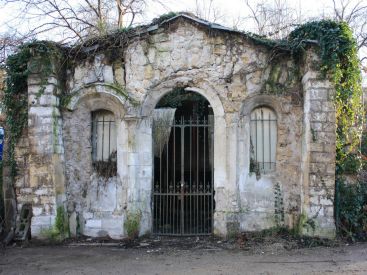
Instead, they ultimately built a more modest chapel, designed by architect Étienne-Hippolyte Godde, between 1820 and 1823. This structure, still visible today at the heart of Père-Lachaise, replaced the original ambitious pyramid plan, signaling a shift towards a more traditional style of funerary architecture.
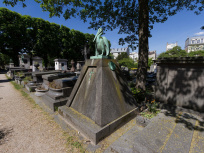
Instead of a grand universal symbolic monument, it was the neoclassical-style chapel that became the spiritual heart of the cemetery. Over time, it was surrounded by pathways, tombs, and mausoleums that now contribute to its worldwide fame.
This page may contain AI-assisted elements, more information here.
Location
Père-Lachaise Cemetery
Cimetière du Père-Lachaise
75020 Paris 20
Route planner
Accessibility info