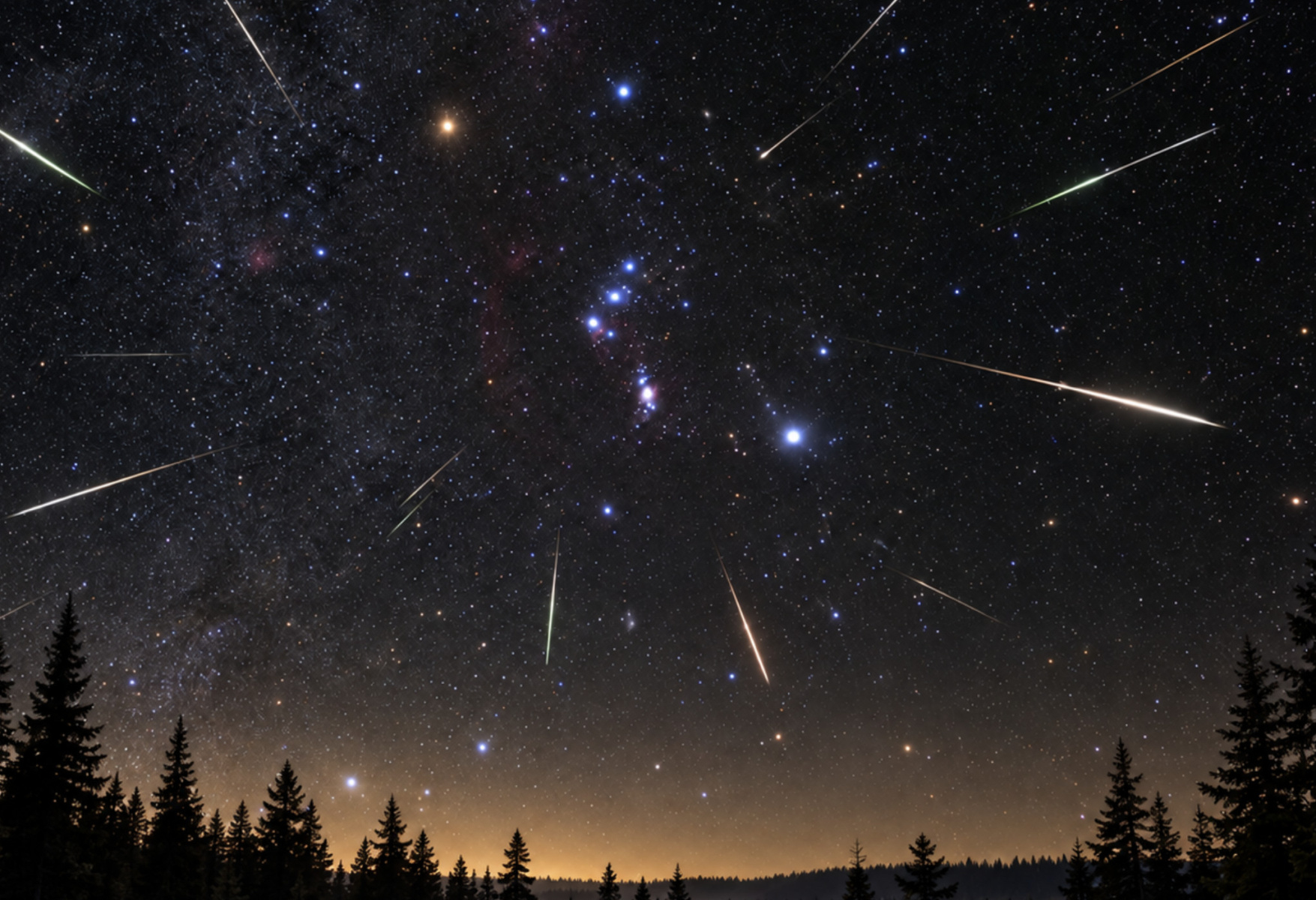
The Orionids are back. This autumn shooting-star shower kicks into gear this Friday, October 2, 2026, and will be visible through November 7 from Paris and across the Île-de-France, with a peak on the night of October 21–22, 2026. The celestial spectacle comes straight from Halley’s Comet, no less.
Before pulling out the blanket and the thermos tonight, a quick update is in order. In the early hours, activity remains modest, with only a handful of meteors per hour at best. The show gathers steam as the days go by, like an orchestra warming up before the main performance.
According to NASA, the Orionids are active from October 2 to November 7. The peak is expected during the night of Wednesday, October 21 into Thursday, October 22, 2026. Good news: this peak is fairly broad—the nights of October 20–21 and October 22–23 will also offer strong activity.
Under a very dark sky, you can expect up to about twenty meteors per hour at the peak. It’s not the August Perseids, but the Orionids have an advantage: their speed. They streak across the heavens at roughly 66 km/s, sometimes leaving luminous trails that linger for a few seconds, or even spectacular fireballs.
A little bonus for the curious: October also welcomes the Draconids, expected around October 8–9, 2026, in the early evening. A lighter meteor shower, but this year it benefits from a nearly moonless sky.
The Orionids are a nocturnal spectacle. Their radiant, that is, the point from which they seem to burst forth, lies in the Orion constellation, near the reddish star Betelgeuse. Orion rises in the late evening and climbs higher in the sky as the night wears on.
The best window of opportunity, then, lies between 3 a.m. and dawn, looking toward the southeast. There’s no point fixating on Orion: shooting stars can appear anywhere in the sky. It’s better to take in a wide swath of the heavens, lying on a sun lounger.
That’s the one caveat of this 2026 edition. At the peak, the waxing gibbous Moon will be about three-quarters full, according to the International Meteor Organization’s calendar. It will light up the early evening sky, washing out the faint meteors.
Fortunately, the Moon sets after midnight. That leaves a dark window before dawn, precisely when Orion is high in the sky. Expect about 5 to 10 shooting stars per hour under decent conditions. The full Moon won’t arrive until October 26, 2026.
Each autumn, Earth plows through a cloud of dust shed by the famous Halley’s Comet. These grains, often smaller than a grain of sand, plunge into the atmosphere at blistering speeds and blaze across the sky: our shooting stars.
The comet itself hasn't swung by the Sun since 1986 and won't return until 2061. In the meantime, it leaves us two yearly highlights: the Orionids in October and the Eta Aquarids in May.
In the heart of Paris, light pollution seriously disrupts stargazing. Parks and high vantage points remain a fallback option, but only the brightest shooting stars reveal themselves there.
To truly enjoy the night sky, it's best to get away from the capital—toward the Parc naturel régional du Vexin français in Val-d'Oise (95) or near the Fontainebleau forest in Seine-et-Marne (77). We’ve also gathered our top spots for stargazing in Paris and Île-de-France.
From an organizational standpoint, the observing is free and done with the naked eye—no telescope or binoculars needed. Before you go, a quick check of the cloud cover forecast from Météo-France is essential, because a cloudy sky can cancel everything. To take things further, the French Astronomical Association and the Astronomical Society of France regularly offer advice and observing evenings.
This event invites curious stargazers, families ready to stay up late (or wake up early), and anyone hoping to make a wish beneath the starry sky. You don’t need to be an astronomer: a little patience will do.
A few tips to tilt the odds in your favor:
And if you miss the boat this time, more meteor showers are still to come. The Geminids light up the December sky at a steadier pace. To keep up with all celestial phenomena, also check out our astronomy pages and Paris sky section.
The best spots to admire shooting stars and the sky in Paris and the Ile-de-France region
Numerous shooting star nights punctuate the year, as do astronomical events, which can be admired weather permitting, in places with less pollution. But where can you find these rare gems in Paris and the Ile-de-France region? [Read more]
Dates and Opening Time
From October 2, 2026 to November 7, 2026





















 The best spots to admire shooting stars and the sky in Paris and the Ile-de-France region