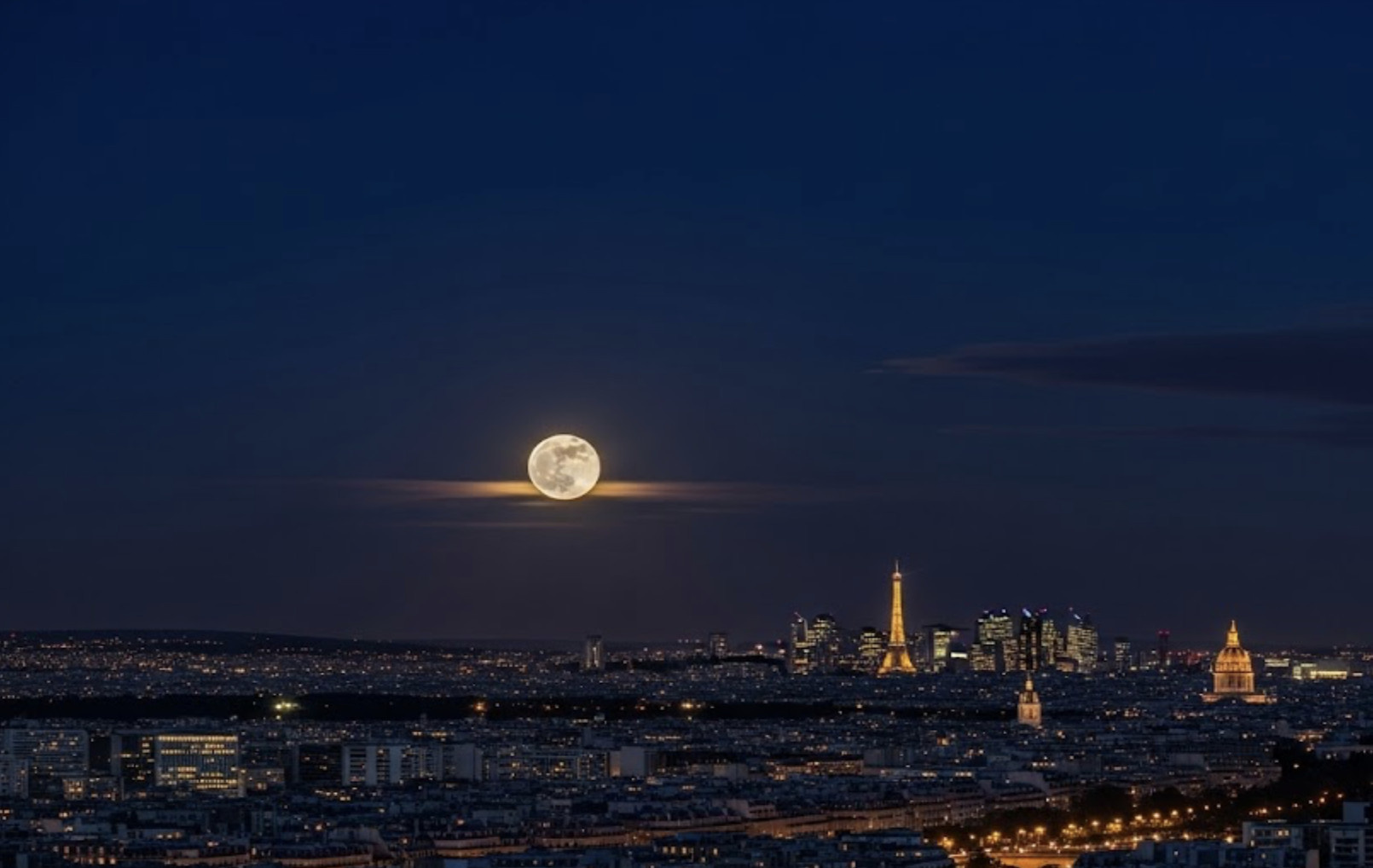
The 2026 Beaver Supermoon will grace the sky on Tuesday, November 24. The full moon occurs at around 3:53 p.m. Paris time, in broad daylight. The real spectacle begins as it rises: according to the ephemerides from the IMCCE at the Paris Observatory, the Moon will appear at around 4:23 p.m. in the capital, about 40 minutes before sunset. It will then remain visible all night in Paris and the Île-de-France region, weather permitting. The Moon will also look almost full on the nights around it.
NASA lists this full moon among the 2026 supermoons. The term refers to a full moon that coincides with the Moon being near its perigee, the closest point in its orbit to Earth. At this time, the Moon appears slightly larger and brighter than it does when farther away. The difference is subtle enough that it’s hard to notice with the naked eye, and you shouldn’t expect a suddenly giant-looking celestial body.
That evening, the Moon is about 360,760 kilometers from Earth, compared with an average distance of 384,400 kilometers. It’s the year’s second-closest full moon, just behind the one on December 24, which will close out 2026 in style.
The best time is moonrise. Just above the horizon, the Moon looks larger and sometimes takes on an orange hue, a well-known optical illusion. Choose a spot with an unobstructed view to the northeast between 4:30 and 5:30 p.m., then follow it as it rises: it reaches its highest point in the sky at around 1 a.m. The exact full moon phase is a single astronomical moment: it does not coincide with moonrise in Paris, nor does it guarantee that the Moon will be visible at that time.
The event is free and visible to the naked eye. Binoculars or a telescope can reveal more surface details, but they are not essential. To plan your outing, locate a sky-watching spot in Paris or the Île-de-France region, and check that it will be accessible at your chosen time.
Then there’s the question of the weather. Météo-France’s forecast calls for mostly cloudy skies in Paris this Tuesday, with temperatures ranging from 2 to 7 °C. So you may get a few sunny spells before the rain returns overnight. If the clouds put a damper on the festivities, don’t panic: another supermoon will rise on the evening of December 24. Dress warmly—the evening is expected to be cold.
The name “Beaver Moon” belongs to the traditional full-moon names circulated by North American almanacs. According to The Old Farmer’s Almanac, it evokes the time when beavers prepare for winter and recalls the old trapping practices used to obtain their pelts. This designation does not describe any change in the Moon’s color or shape.
The next event after the November edition will be the cold full moon on December 24, 2026, which NASA has also described as a supermoon.
This page may contain AI-assisted elements, more information here.