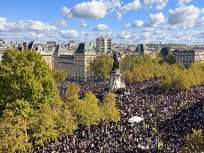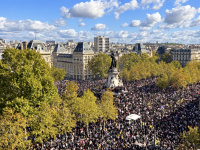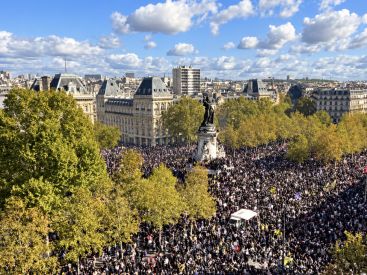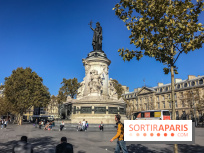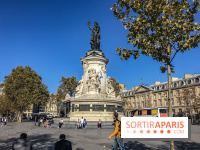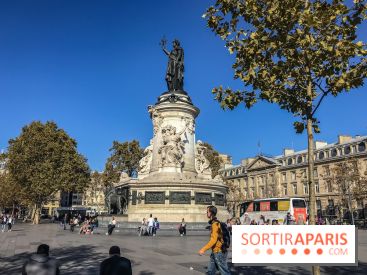
Can you still go out for dinner at a restaurant located in a curfew zone in Paris? The question has resurfaced for many Parisians since the police prefecture barred any presence from 11 p.m. to 6 a.m. in certain parts of the capital, the first time during the night of October 19–20, 2026. That night, the central esplanade of Place de la République (between Paris Centre, the 10th and 11th arrondissements) and part of the Halles district (1st arrondissement) were affected. Other perimeters could be added as of tonight, depending on how the situation evolves after the October 17, 2026 mobilisation.
The answer comes in two parts, whatever neighborhood is involved. On paper, venues are allowed to stay open. In practice, the rule aimed at people makes the evening far more complicated for patrons.
No. No administrative closures were imposed on businesses. When the measure came into effect, the prefecture clarified that bars, restaurants, cinemas, and venues for live performances would remain open. What’s restricted are people’s movements and their presence, not the operation of the establishments.
In practice, a restaurant located within a curfew zone can keep its stoves on and its tables laid after 11 p.m. It’s a bit like a shop whose display window stays lit while the street in front is blocked off: everything’s ready, but no one can come in anymore.
Before the curfew starts, yes, with no special restrictions. After that, that’s where the trouble begins. The premier arrêté préfectoral du 19 octobre provides exemptions for residents who can prove their address, shopkeepers, people who must reach their workplace, and emergency services. Customers are not on that list.
Result: lingering at the table past curfew after 11 p.m. can lead to a ticket. According to accounts collected by RMC and Le Parisien on the first night, venues that stayed open saw their customers disappear once the hour passed. Several restaurateurs regret a measure that doesn't formally close them down, but effectively robs them of their evening service.
As we write, no curfew zone remains in the capital: the Parisian decrees expired at 6 a.m. on Tuesday, October 20, 2026. The streets affected last night have returned to normal daytime traffic.
The first curfew was very tightly drawn. It covered the central esplanade at Place de la République and, at the Halles, Place Maurice-Quentin, Berger Street up to Boulevard de Sébastopol, the portion of Passage des Lingères leading to Rue Berger, Boulevard de Sébastopol up to Rue Rambuteau, Rue Rambuteau up to the André-Breton Alley, and the alley itself. The rest of Paris was unaffected.
A second order also barred unpermitted gatherings from 8 p.m. in broader areas. It isn’t aimed at a simple dinner with friends, but it gives a sense of which neighborhoods are under heightened surveillance:
Nothing is decided yet. Prime Minister Sébastien Lecornu said that new curfews would be declared on Tuesday evening where the situation warrants it, on a case-by-case basis, by the prefects in consultation with the mayors. The police prefecture can therefore extend the perimeters set the day before, adjust them, or add new ones, depending on the disturbances observed during the day.
The timing and the streets involved are still to be confirmed. We’re tracking developments in our piece on the new possible measures for tonight, and the official orders are published on the Police Prefecture site. Before you book, it’s wise to check that your restaurant isn’t in a newly defined perimeter.
The simplest option is to dinner a bit earlier and book in advance, calling the restaurant to confirm its evening hours. Also plan for the return: on the first night, several metro stations near the affected areas closed as early as 10 p.m., one hour before the curfew. Details are in our briefing on the stations of the metro and RER closed during the curfew, and the network’s status is updated daily in our Paris metro, RER and traffic news. For an evening outside the affected zones, our ideas for this Tuesday’s outings can help.
Restaurants, cooks and dishwashers operating in curfew zones are among the exemptions and may travel to work, including after 11 p.m. It remains prudent to carry proof of employment (employer letter or pay slip) in case of a check, especially since police are commonly stationed around the perimeter.
For the restaurateurs involved, these shortened evenings come on the heels of a weekend during which, according to Trade Minister Serge Papin, at least 3,000 shops were looted in France. The government has signaled support measures for affected businesses. In the meantime, eating a bit earlier in these neighborhoods is also an easy way to back venues that, for their part, have not closed their doors.
This page may contain AI-assisted elements, more information here.