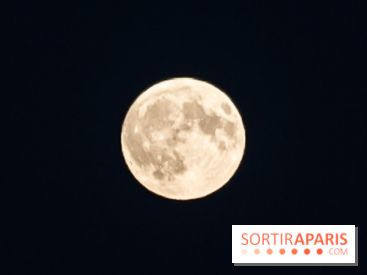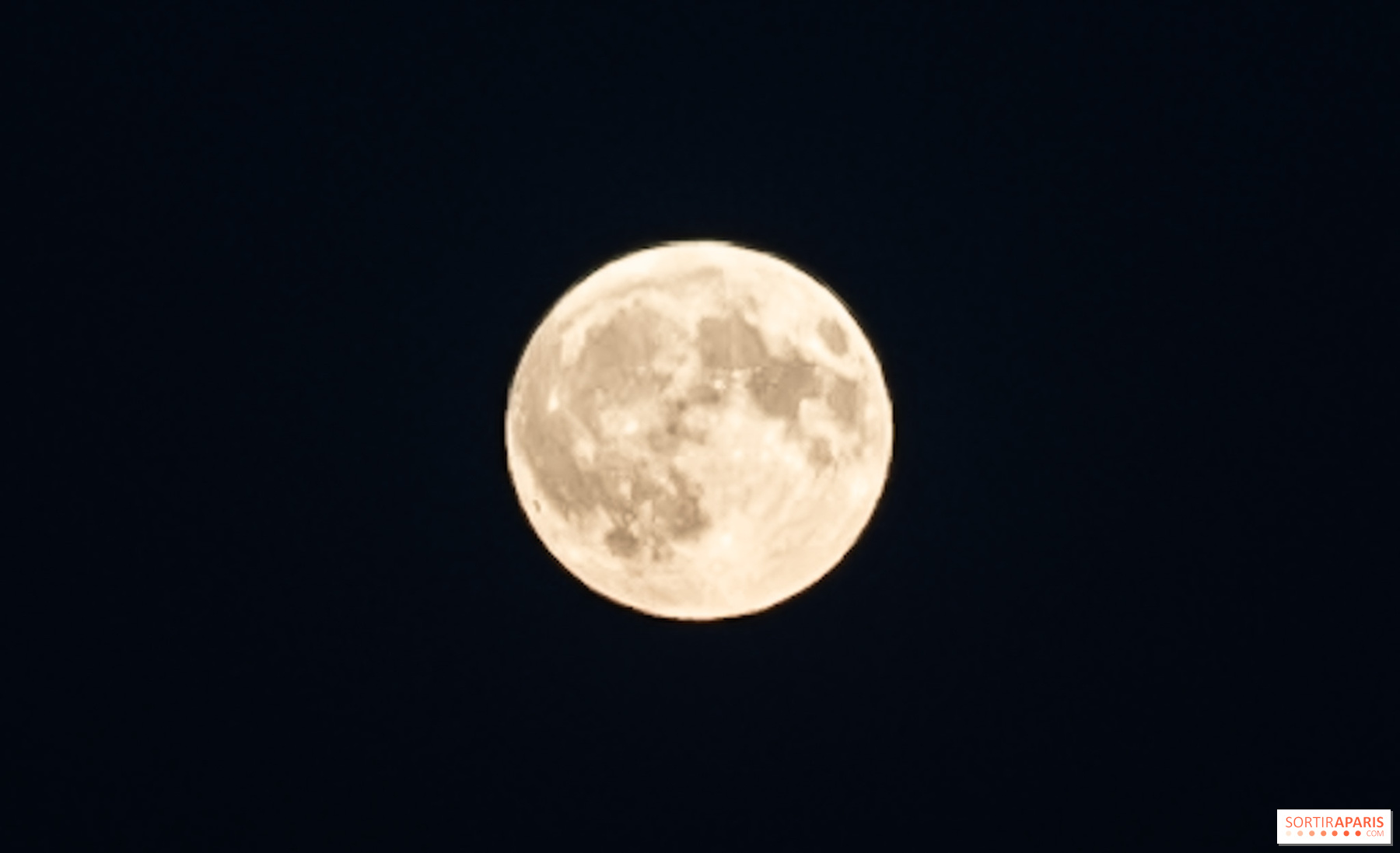
Here we go, tonight's the night. The Strawberry Full Moon is at its full glory in the night of Monday, June 29 to Tuesday, June 30, 2026, with a peak illumination expected around 01:57 (Paris time). From the capital, and across the entire Île-de-France, this celestial rendezvous can be savored without any equipment—just look up. And the good news is that the sky clears just in time.
Following the heatwave peak and the weekend storms that swept across the region, the weather is giving us a genuine window for observation. Clear skies and mild temperatures are forecast for Paris this evening and overnight, offering a prime chance to enjoy the spectacle without a cloud in sight.
This edition also hides a major peculiarity: it’s a micromoon, and it’s the last one of 2026.
Our natural satellite reaches its apogée on June 28, the farthest point from Earth in its orbit (about 406,000 kilometers). As a result, the Moon will look roughly 7% smaller and a touch dimmer than a classic full Moon.
Nothing dramatic to the naked eye, we’ll grant you that. But it’s the exact opposite of a supermoon, and that contrast is what makes this year’s phenomenon a bit notable. A micromoon — you rarely see two in a row.
The name Strawberry Moon, or Strawberry Moon, comes from the northeastern United States. It was popularized in the 1930s by American agricultural almanacs, referencing the Algonquin peoples for whom the June full Moon marked the short strawberry-harvest season. As NASA notes, this nickname has nothing to do with any pinkish color: the Moon does not turn pink as a result.
In Europe, it is known by several poetic names: the Rose Moon, echoing the June blooming of roses, but also the Milky Moon or the Deer Moon among the Celts. The term Honeymoon could also draw its origins there, in a time of year traditionally favorable to weddings and to honey harvest.
It's its position that makes this full moon particularly captivating. As the closest to the summer solstice, it remains very low on the horizon in the Northern Hemisphere. As it passes through a thicker layer of the atmosphere, its light often takes on golden, orange, and sometimes red tones, and the lunar illusion makes it appear much larger than it really is.
In Paris, the Moon will rise this Monday, June 29, around 10:13 PM, just a few minutes after sunset on the east-southeast horizon. It’s precisely the prime moment to observe it. Plan to wait another quarter of an hour for it to emerge above the roofs and the horizon haze, around 10:30 PM. Seek a clear, unobstructed viewpoint and move well away from Paris’s light pollution. Photography enthusiasts will benefit from including a foreground element (a monument, a tree, or a line of rooftops) to enjoy the sight of a giant Moon perched over the landscape.
Our pick for tonight: head to the high ground above Belleville, the Buttes-Chaumont park, or Montmartre as night falls. With a clear eastern horizon and the warmth finally easing, we get our best views to glimpse this orange micromoon through binoculars (or with the naked eye, which works just as well).
To determine the exact Moonrise time for your Île-de-France commune, the Institute of Celestial Mechanics and Ephemerides Calculations (IMCCE) is the go-to reference and offers a free calculation tool. No need to rush out with a telescope, either: this Strawberry Moon is perfectly visible to the naked eye from a balcony, a park, or a rooftop.
Looking to extend your celestial observations over Paris and the Île-de-France region? We’ve pulled together all the 2026 astronomical events you won’t want to miss, and our top spots for watching the stars for free from Parisian parks this summer.
Dates and Opening Time
From June 29, 2026 to June 30, 2026
Location
Paris and the Île-de-France region
Paris
75 Paris