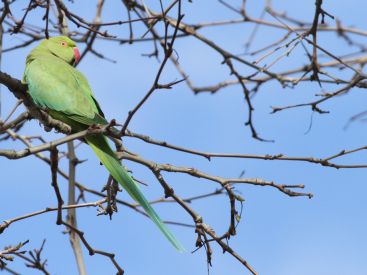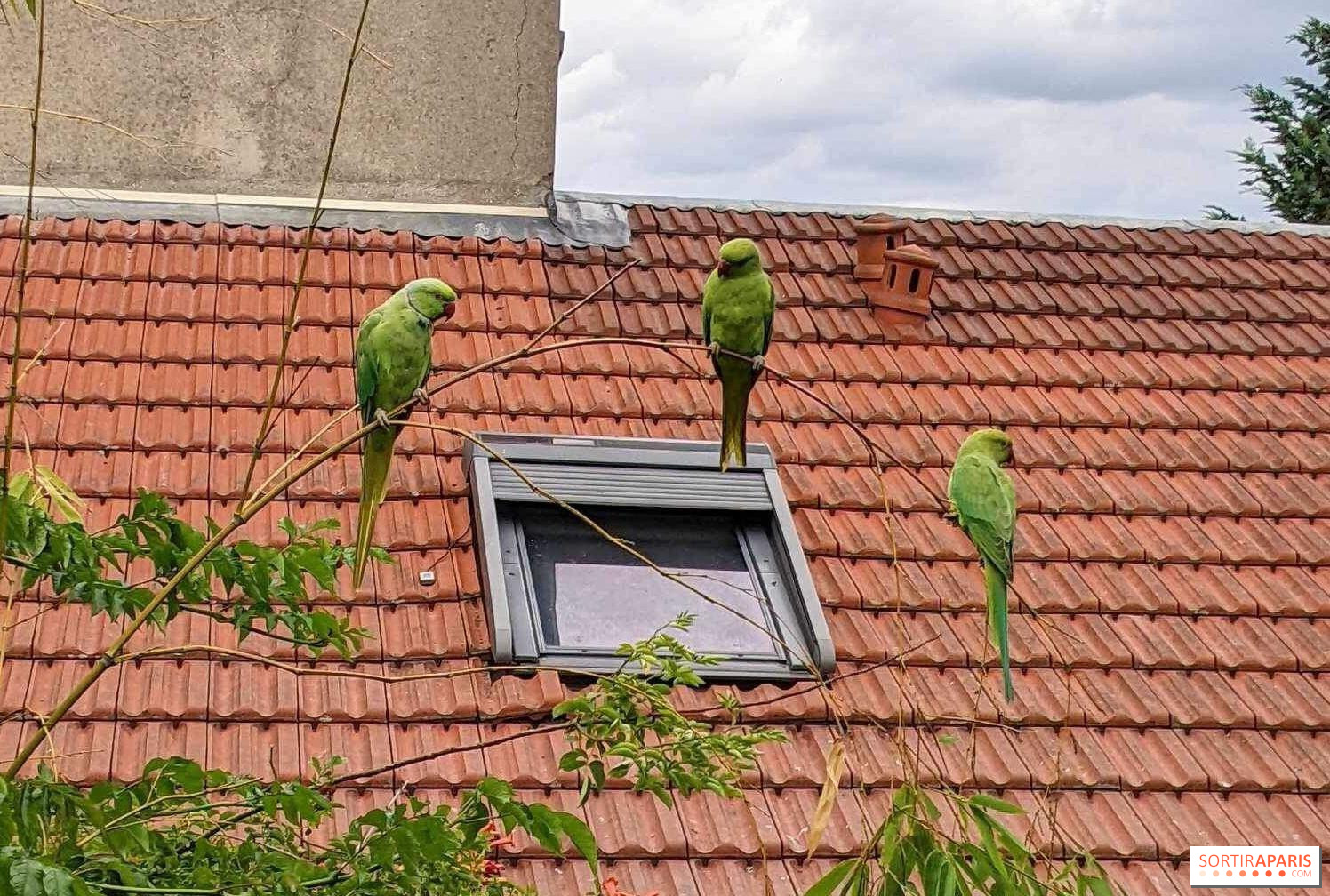
You’ve likely spotted them in a Paris park, on a tree-lined street, or soaring above Île-de-France. With their bright green plumage, red beaks, and powerful cries, the green parakeets are hard to miss. They are more precisely ring-necked parrots, a species native to sub-Saharan Africa and the Indian subcontinent, today found in several major European cities.
In Paris and the Île-de-France region, their establishment is typically linked to birds that escaped from containers used for trade, near Orly and Roissy-Charles-de-Gaulle airports. While breeding cases were reported as early as the 1970s, the defining events for the current population in Île-de-France are mainly linked to the 1990s around these two airports, according to LPO Île-de-France. The species then gradually expanded across the region.
To learn more about how they arrived in the Paris region, also check out our article on the unusual origin of the green parakeets spotted in Paris.
If these exotic birds have managed to establish themselves for the long term, it’s because the city offers them ample resources: trees for nesting, hollows, communal roosts, relatively mild temperatures, and food available year-round. Parks, gardens, cemeteries and tree-lined avenues thus provide favorable habitats for their expansion.
The ring-necked parakeet is now listed among invasive exotic species. A ministerial decree issued on February 14, 2018 bans, in particular, its release into the natural environment in mainland France. This designation does not mean we should panic at every sighting of parakeets, but it signals a monitoring challenge: the species may compete with certain native birds that also nest in cavities.
The precise impact on Île-de-France’s biodiversity remains nuanced. The LPO notes that available studies don’t always allow us to conclude a sweeping, generalized effect on local species. By contrast, their presence can cause noise disturbances, particularly around roosting sites where the parrots gather in large numbers at day’s end.
So why are there so many perruches vertes à Paris? Because an accidentally introduced exotic species has found in Île-de-France an urban setting that suits it well. The result: these birds, once a novelty, are now part of the Parisian and Île-de-France landscape.