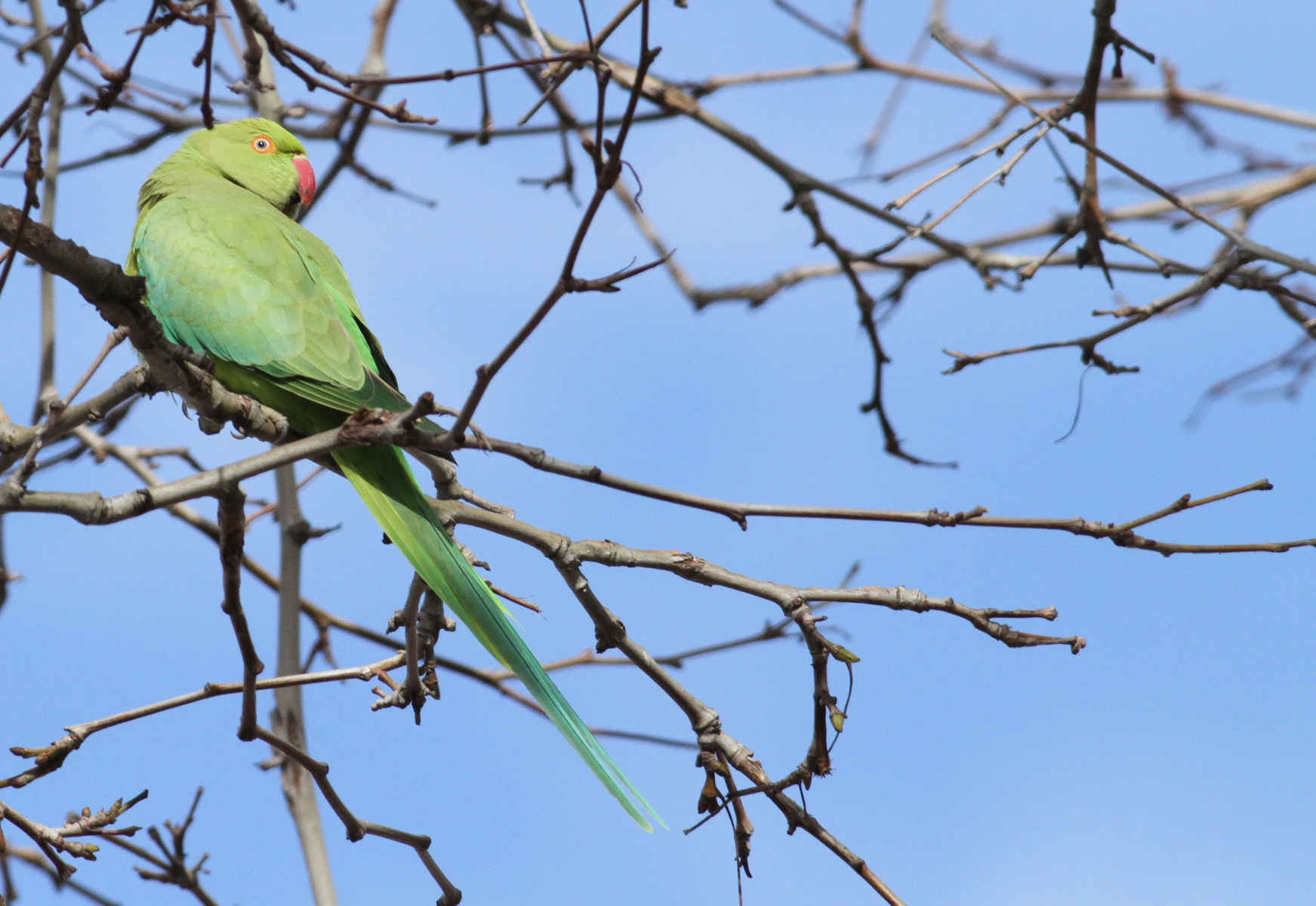
You may have already spotted them darting through the trees of the Bois de Vincennes, the Bois de Boulogne, Parisian parks, or several Île-de-France towns. With their bright green plumage, red beak, and a distinctive call, these birds often intrigue walkers. Yet they are not parrots that escaped from cages the day before; they are ring‑necked parakeets, a species native to Sub-Saharan Africa and the Indian subcontinent that has become well established in many major European cities.
In the Paris region, their presence is regularly linked to a curious tale: birds destined for the pet trade would have escaped from containers near the Paris-Orly airports and then Roissy-Charles-de-Gaulle, before gradually settling in. Reproduction was reported as early as the 1970s, but the events that seeded the current population in Île-de-France are mainly tied to the 1990s around Orly and Roissy. Since then, the ring-necked parakeet has found in urban trees, cavities, roosts, and food resources the means to thrive.
Listed among invasive exotic species, the ring-necked parakeet cannot be deliberately released into the wild. Its spread raises questions about local biodiversity, especially given possible competition with certain cavity-nesting birds. Studies remain nuanced on the true extent of its impact in Île-de-France. One thing is certain: these green parakeets are now part of the sonic and visual landscape of many parks in the Île-de-France region. The next time you spot one in Paris, you’ll likely understand that its local story is tied to the runways of Orly and Roissy.