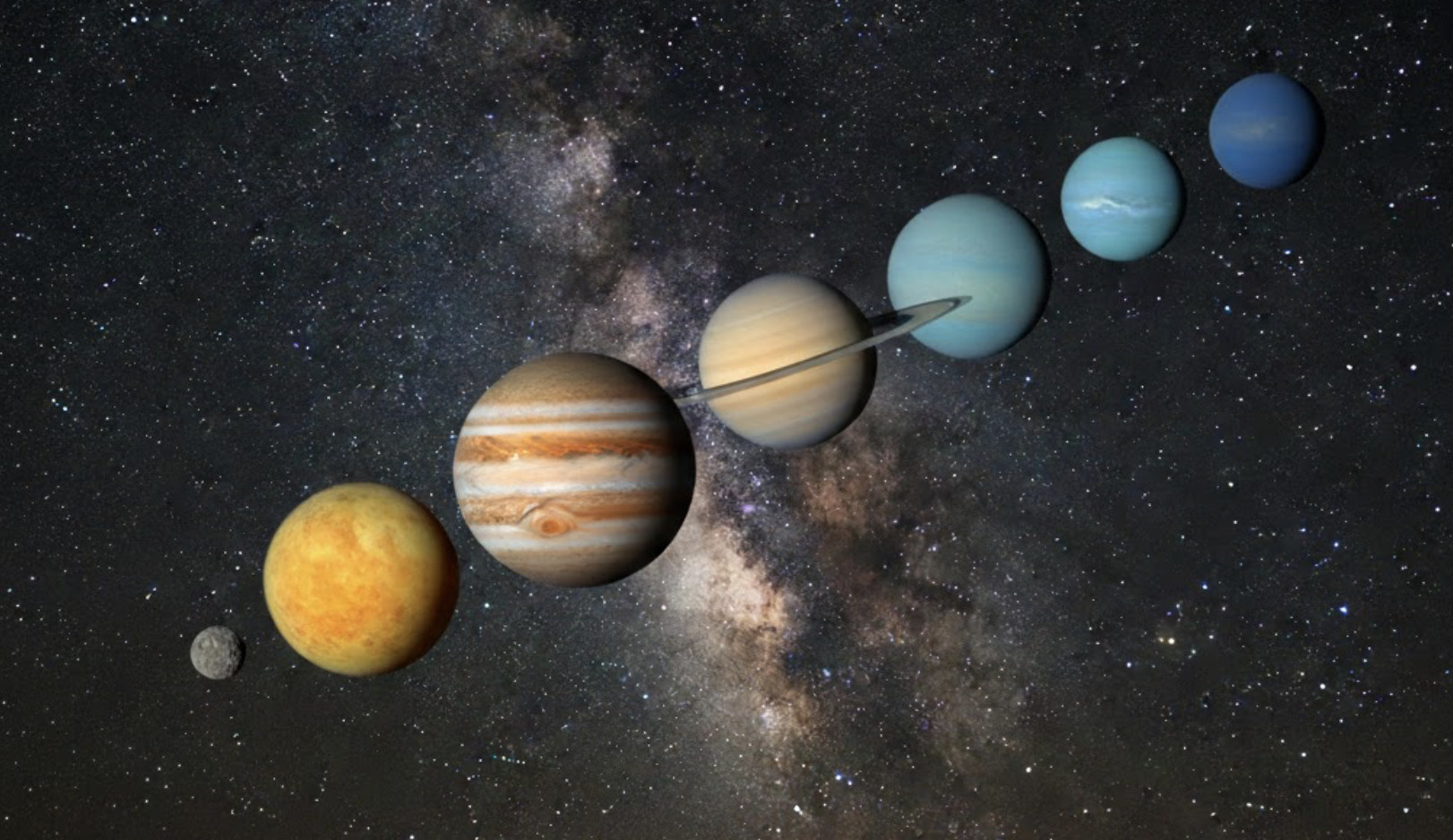
This Saturday, February 28, 2026, the evening sky promises an extraordinary astronomical spectacle. Six planets from our Solar System—Mercury, Venus, Jupiter, Saturn, Uranus, and Neptune—will align in a single patch of sky, tracing a spectacular, sweeping arc from west to east.
For astronomy enthusiasts and the curious alike, this is a rare opportunity to gaze upward without needing to be deep inside an observatory. From Paris and across the Île-de-France region, this planetary alignment phenomenon will be visible—so long as you find a clear spot and look up at the right moment.
Not all planets are equally easy to spot. Venus, shining at magnitude -3.9, is the brightest object in the sky after the Moon — impossible to miss. Jupiter, with its magnitude of -2.4, stands out just as clearly in the eastern part of the sky. Saturn, distinguished by its golden hue and steady glow without any twinkling, appears at mid-height. These three planets are visible to the naked eye, along with Mercury — although this one remains low on the horizon in the west and will only be visible for about an hour in the twilight sky.
As for Uranus and Neptune, you'll need some equipment. A good pair of binoculars can reveal Uranus, positioned higher up in the Taurus constellation and close to the Pleiades star cluster. Neptune, on the other hand, hides just about 1° from Saturn in the Pisces constellation and can only be spotted through a telescope. The Cité de l'espace reminds us that the viewing window is limited and that catching all six planets at once remains a real challenge—especially since some of them are so close to the horizon.
To avoid getting lost among the stars, keep in mind that the free app Star Walk 2 offers a feature called Planet Walk, which can guide you in real time using augmented reality—you just need to point your phone toward the sky. It's a handy tool for telling apart a planet from a star, since planets shine with a steady glow, whereas stars twinkle.
The recipe is straightforward: find a clear western horizon and settle there as soon as the sky begins to darken, typically about thirty minutes after sunset. In practice, from the city center, this might mean heading to the heights of Montmartre, taking a walk in Bois de Vincennes or Bois de Boulogne, or venturing outside the ring road to escape light pollution. The darker the sky, the better Uranus and Neptune will stand out against the darkness.
For those eager to take their passion further, the French Astronomical Society regularly hosts open evenings and observation talks accessible to everyone, and can point enthusiasts toward local clubs. The magazine Ciel & Espace also offers a special issue dedicated to the skies of 2026, providing handy guidance for planning night outings throughout the year. For a comprehensive calendar of upcoming astronomical events, the website of the IMCCE — Institute of Celestial Mechanics and Ephemerides Calculation, linked to the Paris Observatory, is the go-to resource.
As for the timing, not all the planets will be visible at once. Mercury and Venus will set first, followed by Saturn and Neptune, then Uranus, with Jupiter staying up much later into the night. If you want to see them all together, the best time is during the first few minutes after dusk.
On February 28, 2026, the Sun will set in Paris around 6:30 PM. The best time to observe will be between 7:00 PM and 7:30 PM, roughly half an hour after sunset, when the sky darkens enough for the planets to become visible to the naked eye.
This is how the schedule will unfold over time:
In brief: the window to see all six planets together is between 7:00 PM and 7:30 PM at the latest. After that, the view still remains impressive with three or four planets, but Mercury will have vanished from the scene.
According to Star Walk, February 28 marks the peak of the planetary parade: the phenomenon remains visible for several days before and after in most regions. For France and Northern Europe, March 1 might occasionally offer slightly better viewing conditions depending on your exact location.
A final detail that adds drama to the scene: the Moon, illuminated to about 90%, will be just about 4° away from Jupiter that evening. Its bright glow will light up the night, making it slightly trickier to spot Uranus — but for those who look up at the right moment, it will create a truly stunning view from horizon to horizon.
Dates and Opening Time
From February 28, 2026 to March 1, 2026
Recommended age
For all