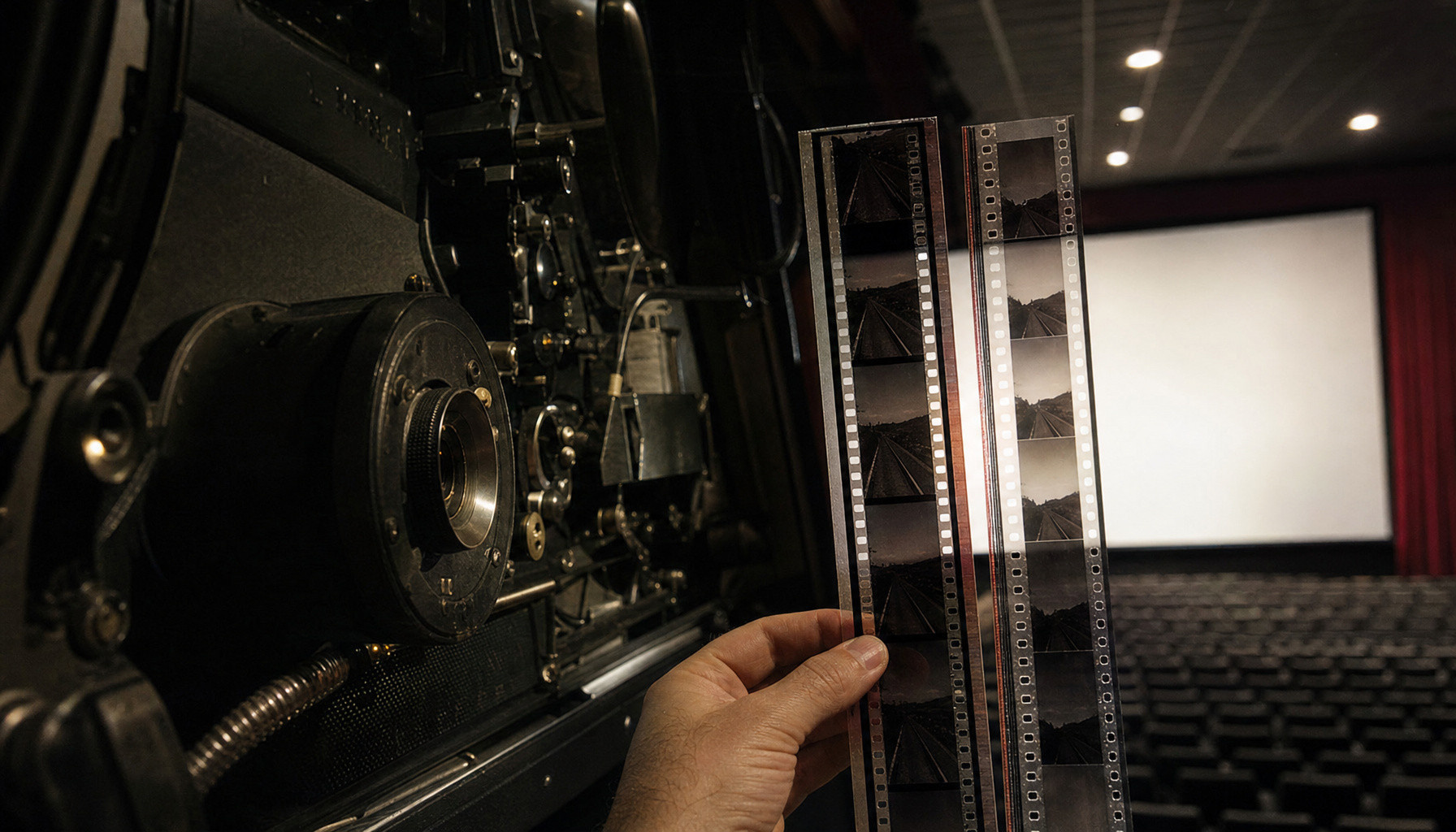
The number 70 indicates the width of the film running through the projector, in millimeters. On this same width, the two formats arrange images differently. The numbers 5 and 15 refer to the number of perforations—the small holes along the edge of the film—that correspond to a single frame.
In five-perforation 70 mm, the film runs vertically. The image spans the equivalent of five perforations in the direction of travel. In IMAX 70 mm, also known as 15/70, the film runs horizontally. Each frame spans fifteen perforations, giving it a larger area on the film. Film formats explained by IMAX Melbourne.
The shooting format and the exhibition format can differ. For Dunkirk, Kodak says the production used 65 mm negative film in both configurations, with five and 15 perforations. The film was then released on 70 mm film prints in both formats, as well as in digital versions, including one intended for IMAX laser projection. The shooting and projection formats of Dunkirk, according to Kodak.
The format therefore depends on the screening you choose. “70 mm” indicates a print on film, with 15/70 generally specified by the label “IMAX 70 mm.” “IMAX laser” refers to a digital projection. In Paris, the Arlequin had announced a 70 mm screening of Marty Supreme for February 2026. The 70 mm screening of Marty Supreme at the Arlequin.
This page may contain AI-assisted elements, more information here.