Now is the time to discover the Brussels 1900 exhibition, on view at the Petit Palais, in the 8th arrondissement of Paris, from November 10, 2026, to April 25, 2027. Twelve sections, more than 250 works—including 150 brought directly from Brussels—and one idea running throughout the exhibition: to remind visitors that, at the turn of the 20th century, long before becoming the capital of Europe, Brussels was one of the continent’s major artistic hubs.

The choice of venue is no coincidence. The Petit Palais was built for the 1900 Exposition Universelle, and it was right across the street, beneath the glass roof of the Grand Palais, that the Belgian section made a splash that year with nearly 150 paintings and sculptures. Following Paris 1900, the museum is now turning its gaze northward, and this outside perspective invites us to rediscover a neighbor we thought we knew well.
The exhibition focuses on a specific period: the years 1890 to 1900, the final decade of the 19th century. This choice is no accident. It was a time when the Belgian and European art scenes were being reshaped, amid the Secessions in Vienna, Munich and Berlin. It was also a decade of sweeping change for this young country, born of the 1830 revolution: a dramatic industrial boom, acute social tensions in the wake of the Belgian Workers’ Party, founded in 1885, and Leopold II’s colonial ambitions in the Congo. In barely ten years, Brussels saw the emergence of Symbolism, social art and Art Nouveau, culminating in their recognition in Paris in 1900.
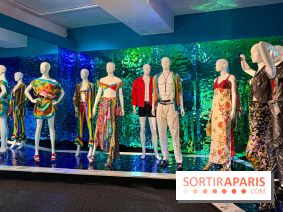
The first thing that strikes you is the variety of what’s on view. Paintings and sculptures sit alongside photographs, posters, jewelry, graphic arts, furniture, architectural models and even clothing. The Petit Palais didn’t choose this mix simply to boost the numbers: it reflects how Brussels artists actually worked.


Around 1900 in Brussels, there was no hierarchy between a painting and a piece of jewelry, or between a sculpture and a poster. Avant-garde circles exhibited applied arts alongside painting, organized concerts and lectures, and encouraged painters, writers, architects, and goldsmiths to work together.
Posters pasted up in the street bring art into public spaces and serve as manifestos for these salons. In the hands of Philippe Wolfers, jewelry becomes a small sculpture worn on the body. As for the architecture of Horta and van de Velde, it dreams of a “total work of art” in which the doorknob matters as much as the façade. Presenting all these genres side by side thus shows the ambition of an entire generation: to bring beauty into every corner of everyday life.
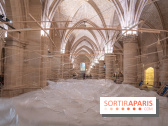
The route is designed as an architectural promenade. Each space has its own shape and the color of its walls, so you always know where you are without having your nose buried in the map.

As soon as we enter, we are greeted by an immense photograph of Brussels in 1900, alongside Louis Ghémar’s spectacular triptych. Here are the twelve sections to explore:
It all begins in the street. In the late 19th century, advances in printing turn the poster into a new playground for artists. An entire wall showcases their diversity, from specialists such as Privat Livemont and Gisbert Combaz to renowned painters such as Jean Delville and Théo Van Rysselberghe. Printed by Brussels workshops such as Veuve Monnom, they serve as manifestos for artistic circles.
These circles are at the heart of the vast “Brussels and the Arts” gallery. With the Salon des XX, founded in 1883, followed by La Libre Esthétique, Pour l'Art and Le Sillon, the city rivaled Paris. While the official salons crammed in nearly a thousand works, these associations displayed only around a hundred, arranged in a single row. It was a small revolution for the eye, accompanied by lectures and concerts organized by figures such as Octave Maus and Edmond Picard. A focus on Léon Spilliaert, featuring his strange 1902 painting Bird of Prey, brings the gallery to a close.
A long gallery then links three sections along a single sightline, and this is probably where the diversity of the Belgian art scene is most apparent. “An art of thought and dreams” immerses us in Symbolism. In the face of a Belgium transformed by industrialization, artists seek refuge in dreams and mystery. The enigmatic women of Fernand Khnopff, who is the subject of a dedicated focus, are shown alongside Jean Delville’s Dead Orpheus (1893), while other works flirt with the macabre or the scandalous.
A change of mood with “Visions of Nature.” Here, the artists favor realism and the countryside, seen as a refuge from the city. Émile Claus’s luminism, with its light-drenched canvases, is on display alongside Van Rysselberghe’s neo-impressionism and the large allegorical paintings of Léon Frederic.

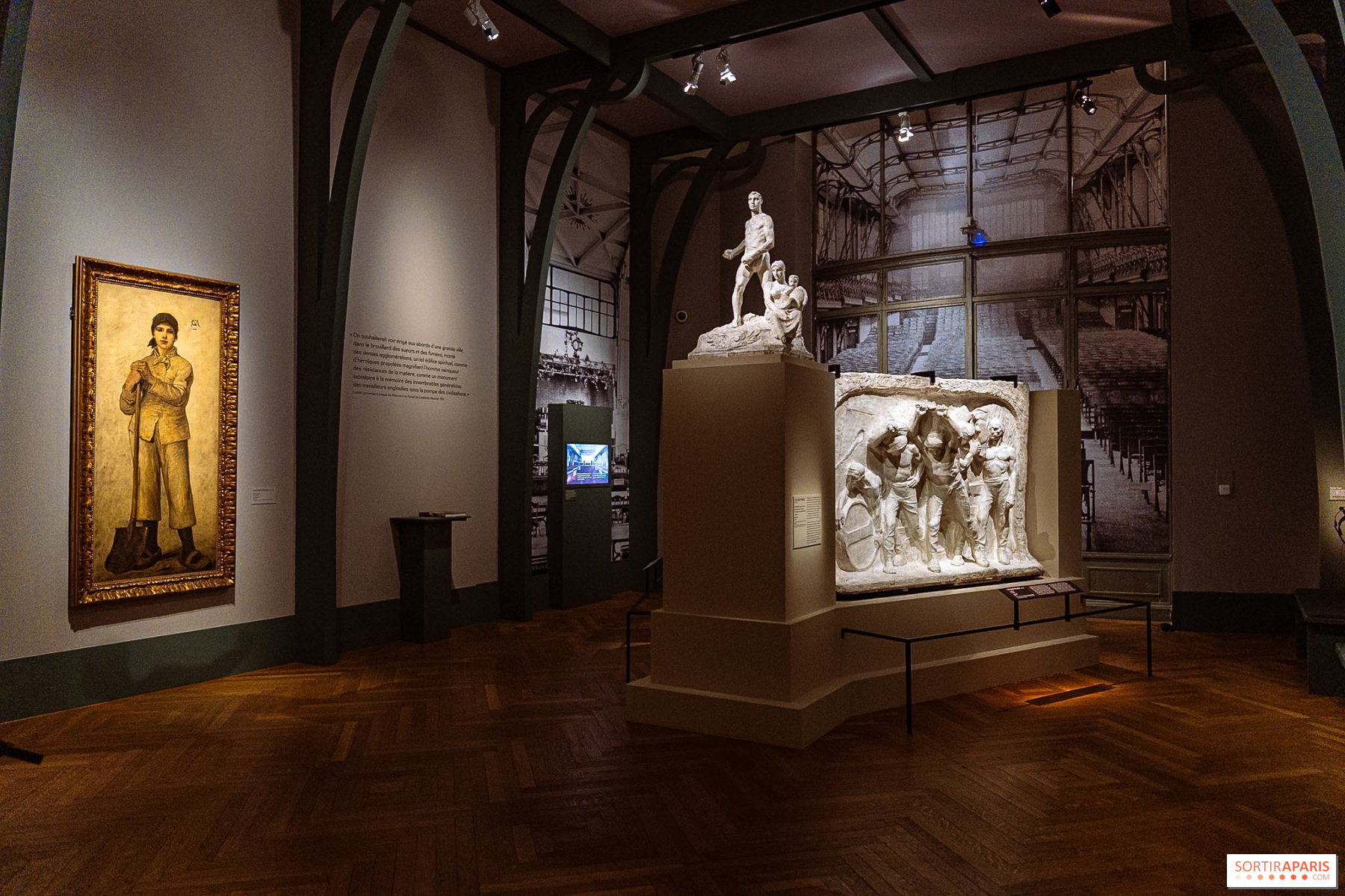
The “Social Art” section is one of the exhibition’s strongest. Its immersive space evokes Victor Horta’s Maison du peuple, demolished in the 1960s. Constantin Meunier casts miners and dockworkers as heroes of Belgium’s economic miracle, while Eugène Laermans’s Un soir de grève (1893) reveals the flip side of bourgeois prosperity without resorting to miserabilism.
As early as 1891, the poet Émile Verhaeren observed that Belgian art, “tired of itself,” was returning to its roots. To break free from French influence, painters and sculptors drew on the Flemish Middle Ages and the legacy of the Primitives. Bruges became the symbol of this past, inspiring triptychs, tapestries and Gothic motifs.

The centerpiece of this gallery is George Minne’s famous Fountain of Kneeling Youths (1898), on loan from the Museum of Fine Arts in Ghent. Its figures of young men curled in on themselves have something of a silent prayer about them. You spend longer here than you expect.
The large section devoted to Art Nouveau spans four spaces. It opens with a chapter the exhibition addresses head-on: the 1897 Colonial Exhibition in Tervuren, conceived as a propaganda tool for the Congo Free State, then the personal possession of Leopold II. The ivory and exotic woods made available to sculptors gave rise to virtuoso works such as Philippe Wolfers’s Caresse du cygne (Swan’s Caress). The exhibition reminds visitors that this beauty was built on violent exploitation, already denounced at the time.
A more intimate room is devoted to Philippe Wolfers, nicknamed the “Belgian Lalique” after presenting sixteen unique pieces of jewelry in 1899. Medusa and Dragonfly pendants, a Birds and Iris comb in tortoiseshell, gold and opal: these enamelled pieces shimmer like insects in the light. A delight for jewelry lovers.
Next comes a large octagonal room, open to the Petit Palais garden, where the leading figures of architecture and the decorative arts are brought together. Victor Horta emerges as the conductor of a total work of art, in which every door handle, stained-glass window and carpet reflects the client’s personality. Alongside him, Liège-born Gustave Serrurier-Bovy championed a more social vision, creating simple, affordable furniture for working-class homes, such as his “Artisan’s Room” of 1895.

The visit culminates in a room devoted entirely to a collection of furniture designed by Henry van de Velde. The painter-turned-designer and his wife, Maria Sèthe, conceived Villa Bloemenwerf, where everything was designed by the couple, from the furniture and cutlery to the dresses Maria wore. It is one of the most delightful parts of the visit.
The story comes full circle with the 1900 World’s Fair. In a final gallery, five works that won prizes in Paris that year are brought together, including Léon Frederic’s triptych Le Ruisseau. Critic Gustave Geffroy spoke at the time of a “renaissance of painting in the land of the Van Eycks, Rubens and Van Dyck.” A little-known fact: Belgian Art Nouveau had kept a low profile in 1900, appearing mainly at the Pavillon bleu, a luxury restaurant conceived by Gustave Serrurier and the French architect René Dulong.
This exhibition will appeal to fans of the Belle Époque, Symbolism and decorative arts, as well as those whose only knowledge of Belgium is Magritte and waffles. The mix of disciplines makes for a lively visit, and the rooms fly by. It is also the first major exhibition devoted to Belgian art in France in thirty years—a wonderful discovery to make this winter.
Allow plenty of time: the exhibition is packed with content, and each section deserves a visit in its own right. Families can follow a route designed for children aged 6 to 10, inviting them to seek out the most astonishing works. The section on the Colonial Exhibition explores a dark chapter in Belgian history, which may be worth explaining to younger visitors.
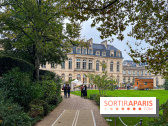
The Petit Palais is located on Avenue Winston Churchill, a stone’s throw from the Champs-Élysées and the Grand Palais, and is accessible via the Champs-Élysées–Clemenceau metro station (lines 1 and 13). The exhibition is open Tuesday to Sunday from 10 a.m. to 6 p.m., with late openings until 8 p.m. on Fridays and Saturdays, except on December 25 and January 1. Tickets cost €17 at the full rate and €15 at the reduced rate; admission is free for under-18s, subject to certain conditions. Booking a time slot is recommended, especially for late openings and weekends.
Brussels 1900 is organized in partnership with the Royal Museums of Fine Arts of Belgium, the Royal Museums of Art and History and the Royal Library of Belgium (KBR), with the exceptional support of the Musée d'Orsay. Enough to make you want to take the train to Brussels and step through the door of the Horta Museum's house and studio in Saint-Gilles.
To stay in the same mood, the Musée d'Orsay, just a few stops away, has some beautiful Art Nouveau decorative arts rooms. Symbolism fans, meanwhile, head to the Musée Gustave Moreau in the 9th arrondissement, a timeless house-studio that resonates wonderfully with Khnopff's reveries.
Want to continue exploring the streets? Our guide to Art Nouveau in Paris and the Île-de-France region features façades, Guimard metro entrances and villas to see. And to plan the rest of your cultural calendar, our guide to the most anticipated exhibitions in Paris has all the details.
This page may contain AI-assisted elements, more information here.
Dates and Opening Time
From November 10, 2026 to April 25, 2027
Location
Petit Palais
Avenue Winston Churchill
75008 Paris 8
Route planner
Accessibility info
Prices
Moins de 18 ans, demandeurs d’emploi, visiteurs en situation de handicap, sous conditions: Free
Tarif réduit, sous conditions: €15
Plein tarif: €17
Official website
www.petitpalais.paris.fr