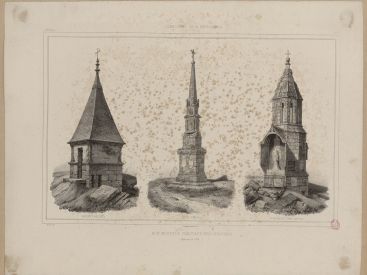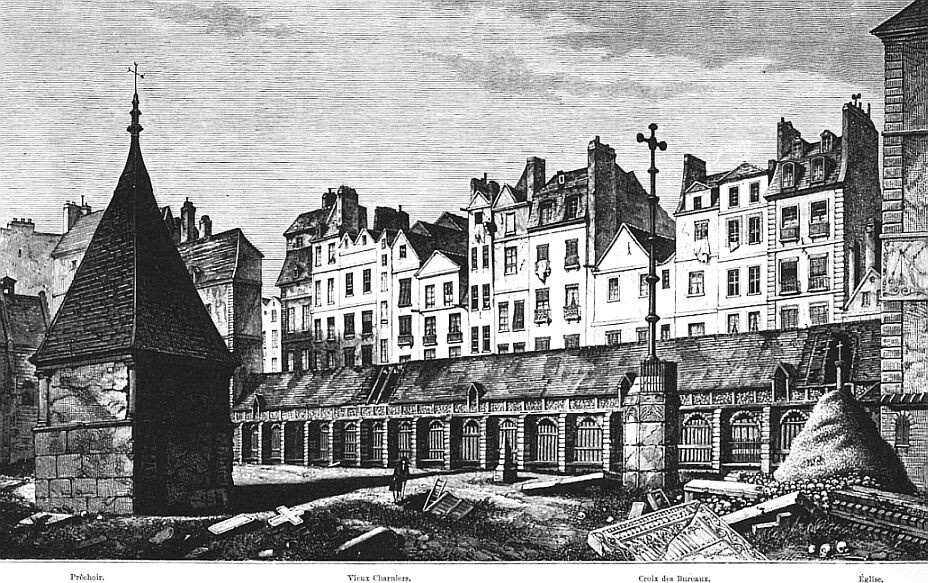
The face of Paris has changed over time, and sometimes we're surprised to rediscover the past of certain places. The Halles district is a case in point. On the site of today's Place Joachim-du-Bellay once stood an essential Parisian cemetery: the Cimetière des Innocents.
The origins of this cemetery date back to the Merovingians, and for almost 1,000 years it housed the remains of Parisians until it was closed in 1780. It is estimated that two million Parisians were buried here. A first chapel in honor of Saint-Michel was built here, before being replaced by a larger church around 1130 by order of Louis VI le Gros. It was dedicated to the Holy Innocents, hence the name.
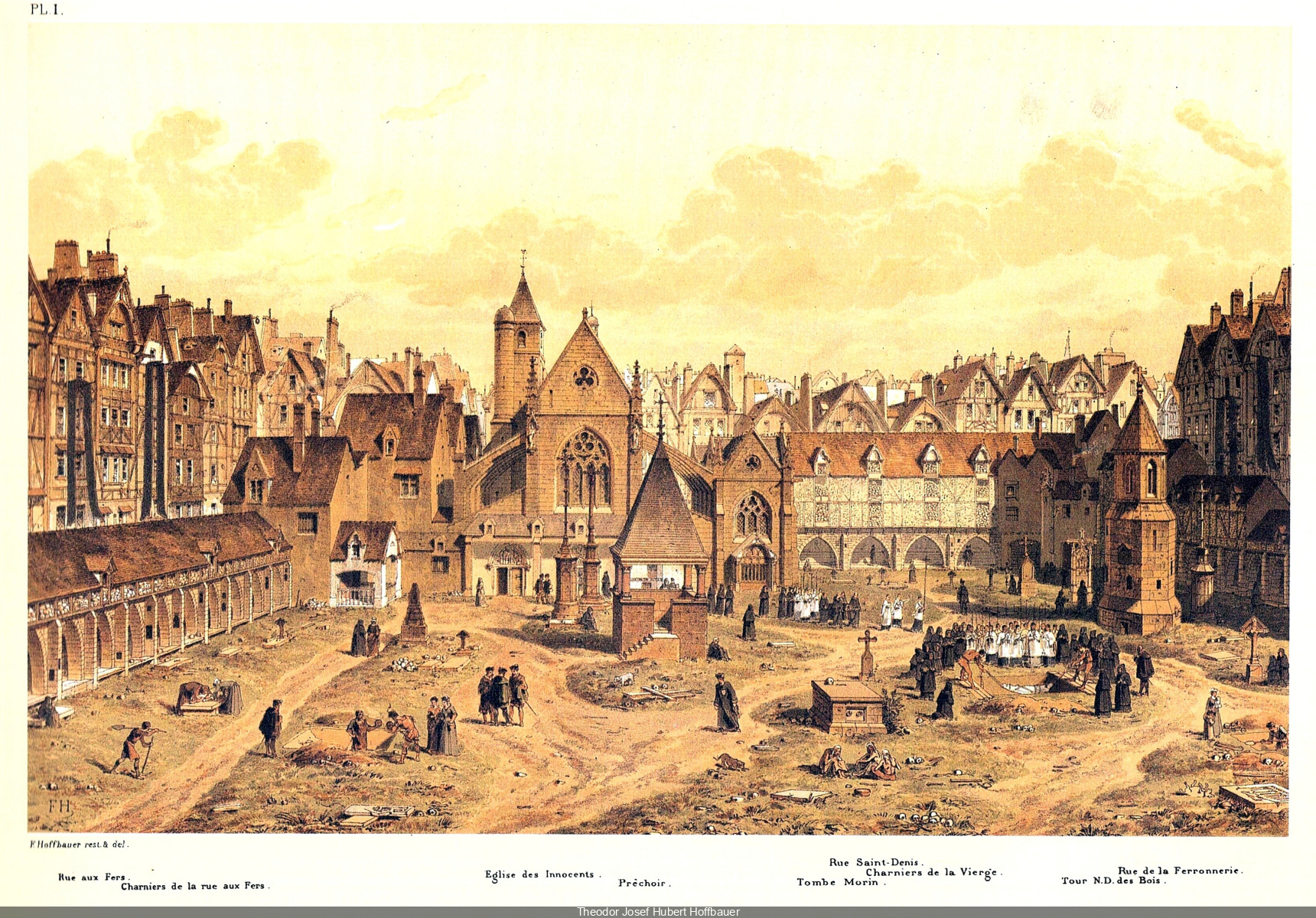
The Cimetière des Innocents, a landmark in the daily lives of Parisians
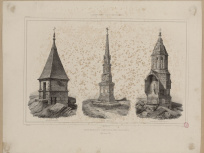
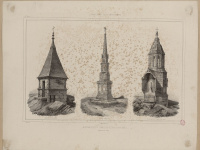
In addition to thechurch, mass graves and a fountain, the Innocents cemetery also included two reclusoirs. These small cells housed male and female recluses, who were then walled in. The first reclusoir des Innocents was the most famous in Paris. It had two grated loopholes, one opening to the outside to allow food to be brought in, and the other to the inside of the church to allow the recluse to attend religious ceremonies.
There are four names of recluses in the Cimetière des Innocents. The first, Alix La Bourgeotte, spent 46 years in her recluse cell. The second, Jeanne La Verrière, had expressed the wish to live as a recluse, whereasAlix La Bourgeotte had already been in her cell for 18 years. A second reclusoir was built. Renée de Vendômois, convicted of adultery and the murder of her husband, was condemned to end her days in a recluse. Finally, the fourth known recluse was a widow named Jeanne Pannoncelle.
To say the least, this cemetery was very popular with Parisians. A lively meeting place, it was frequented by merchants and strollers during the day. At nightfall, however, the cemetery became less frequented. The remains of 22 Parisian parishes were interred here, along with those of the Hôtel-Dieu, the victims of the Black Death of 1348 and the unidentified unknowns from the Cité morgue, including those drowned in the Seine and those who died on the public highway, who were then buried in mass graves.
The end of the Innocents cemetery
That was far too many bodies for too small a cemetery. It was also said that the earth would eat his corpse in nine days. Charneliers were added around the cemetery to accommodate the bones that were removed. The Charnier des Lingères on the south side of the old cemetery, parallel to Rue de la Ferronnerie, featured a fresco depicting a danse macabre. Nobility, religious figures, peasants and even sovereigns were depicted as they were forced to follow the dead, a reminder that no one could escape this fate.
But after a thousand years of activity, the cemetery, located in the heart of Paris, was unhealthy. The ground level was reportedly 2.50 m higher than that of the surrounding streets, as it was so overcrowded. In addition, a law dating from 1765 prohibited cemeteries inside cities for reasons of insalubrity. A decisive event led to the definitive closure of the Cimetière des Innocents in 1780. Under the weight of buried corpses, a partition gave way and the remains of Parisians spilled into the cellar of a restaurant owner. The cemetery was destroyed in 1786.
The remains of the Innocents cemetery
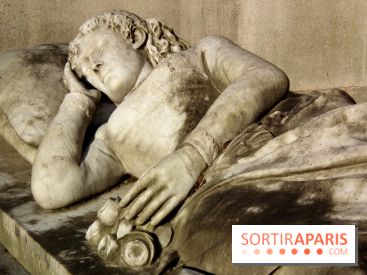
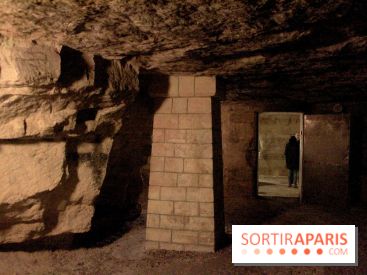
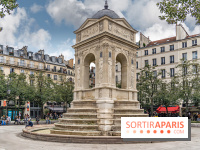
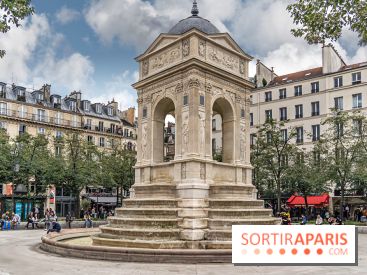
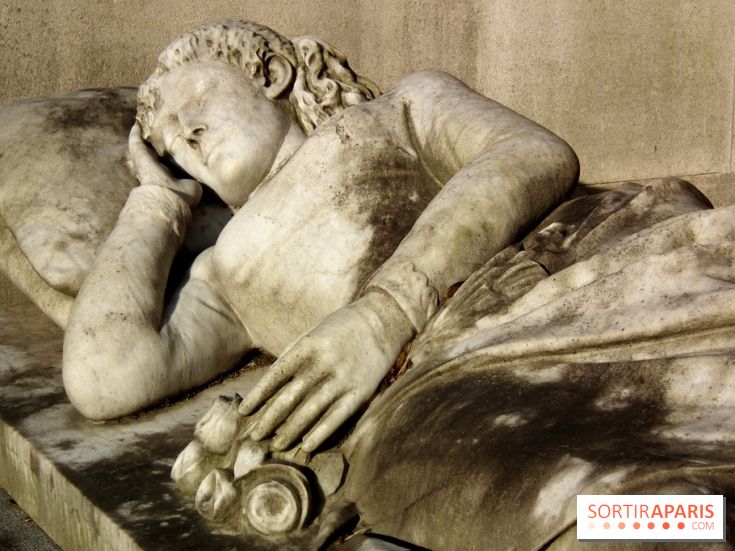
Today, very little remains of this Parisian cemetery. The remains of those who were buried there can now be found in the Paris Catacombs. On Place Joachim-du-Bellay, the Fontaine des Innocents was the fountain adjoining theChurch of the Innocents, now destroyed. At no. 8 rue de la Ferronnerie and no. 15 rue des Innocents, you can see the arches that once supported two of the cemetery's mass graves. Remains are also preserved in the Musée du Louvre and the Musée Carnavalet.
Location
Châtelet-Les Halles metro station
Châtelet
75001 Paris 1
Route planner
Accessibility info
Access
Metro Châtelet (lines 1, 4, 7, 11, 14)
Prices
Free