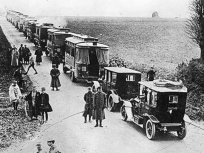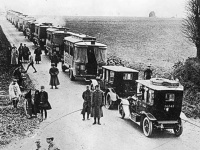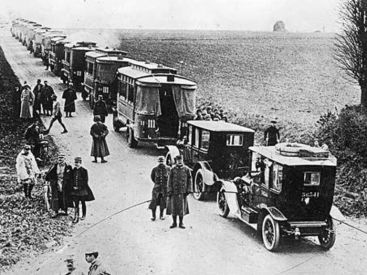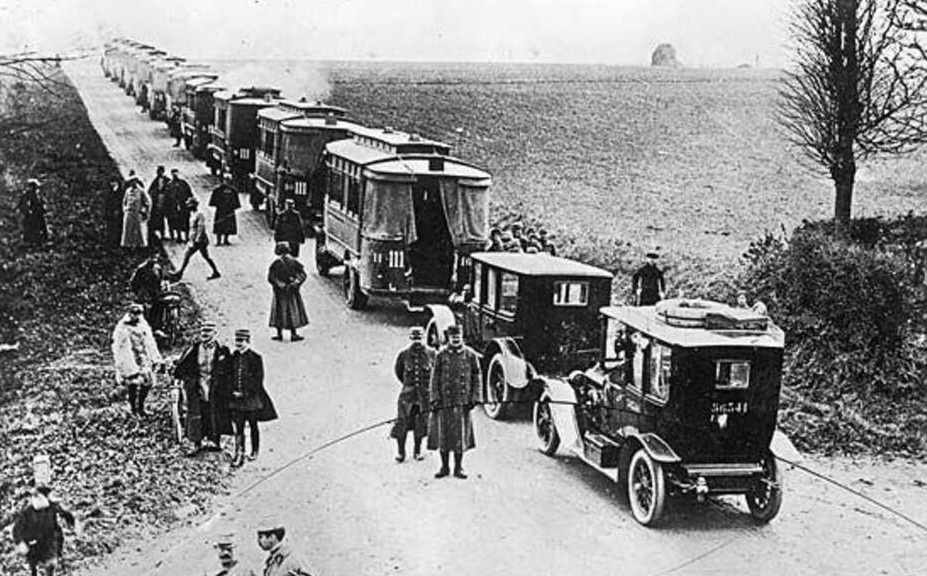
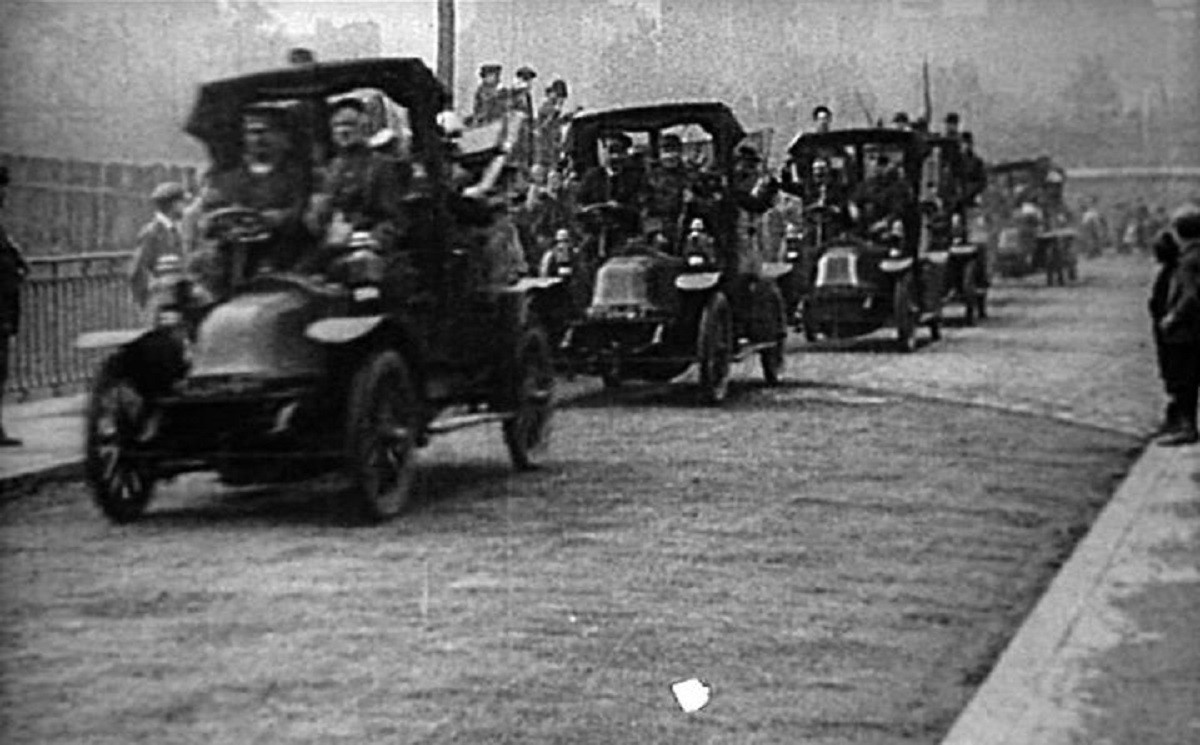
The 6 and 7 September 1914, as the German army crossed the Marne, the French general staff, lacking sufficient trains, requisitioned 1300 Paris taxis to quickly rush infantry to the front and halt the enemy’s advance; this became known as the "taxis of the Marne".
Since the beginning of September, French troops have been struggling at the front, while the enemy has been getting dangerously close to the capital and gaining the upper hand in the first weeks of the First World War. Under threat of bombardment, the government left Paris for Bordeaux.
On September 5, the first battle of the Marne began, northeast of the capital, a clash that could well, if the Allies falter, fall into German hands. On the left bank of the river, French and British forces faced the enemy troops massed on the opposite shore. The front, stretching about 300km, pitted 900,000 German soldiers against a million French and British troops, as five battles were fought simultaneously on the battlefield.
But the situation was critical. General Joseph Joffre , commander-in-chief of operations for the French army, drew up an order of the day on the evening of September 5, to be issued at 7:30 a.m. on September 6: "As we embark on a battle on which the fate of the country depends, it is important to remind everyone that now is not the time to look back. Every effort must be made to attack and drive back the enemy. A troop that can no longer advance must, at all costs, hold the ground it has conquered and be killed on the spot rather than retreat. In the present circumstances, no failure can be tolerated."
Facing the general's resolve, and as German uhlans have been spotted only a few dozen kilometres from Paris, General Joseph Gallieni, military governor of Paris, General Jean-Baptiste Clergerie, as well as André Walewski, founder of the Compagnie française des automobiles de place, have a idea lumineuse to reinforce the 7th Army of General Maunoury, at the far left of the Allied line, facing the 1st Army of the German commander Alexander von Kluck.
So, in order to quickly send French troops to reinforce their position close to the battlefield and carry out a major operation aimed at containing and destroying the German vanguards, the French general staff decided to requisition Parisian cabs , as the rail networks around Paris were insufficient, more or less saturated and often disorganized.
The idea, in fact, is not new. By late August 1914, taxi-cabs had already taken part in resupplying the besieged Paris camp under the initiative of the general intendant Burguet. Since then, General Gallieni has a permanent reserve of 150 taxis available day and night, with the capacity to be tripled in a matter of hours — the capital actually has 10,000 taxis, but 7,000 drivers are already mobilized for the war.
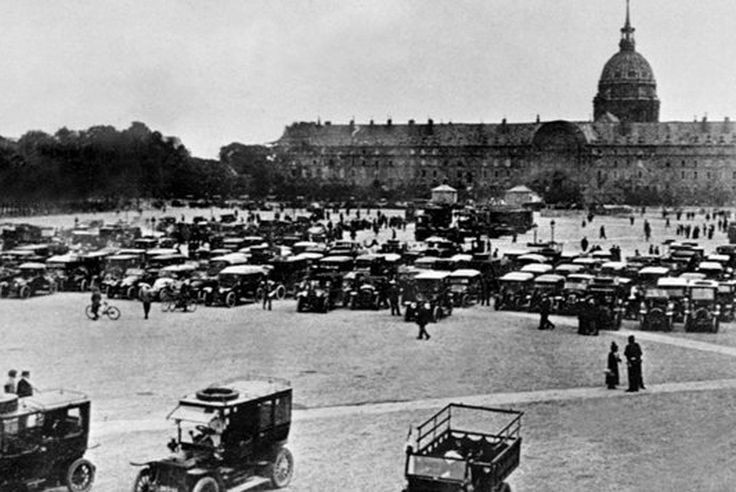
In the night from Sunday, September 6 to Monday, September 7, 1914, 630 Paris taxis, mostly Renault AG-1 Landaulets, gather in the courtyard of the Invalides. Bumping along at 25km/h, each taxi can carry up to five men with their kit. The first convoy heads for Tremblay-Lès-Gonesse and Mesnil-Amelot before reaching Livry-Gargan and Sevran-Livry, while a second convoy of 700 vehicles leaves the Invalides later in the day to head for Gagny.
Arrived at the rallying point, the taxis boarded 6,000 infantrymen from the 14th Brigade of the 7th Infantry Division under General Edgard de Trentinian. On the night of Monday, September 7, the two battalions of the 104th Infantry Regiment landed at Nanteuil-le-Haudoin in the Oise, closely followed by the three battalions of the 103rd Infantry Regiment, who disembarked on the morning of September 8 at Silly-le-Long, south of Nanteuil-le-Haudoin.
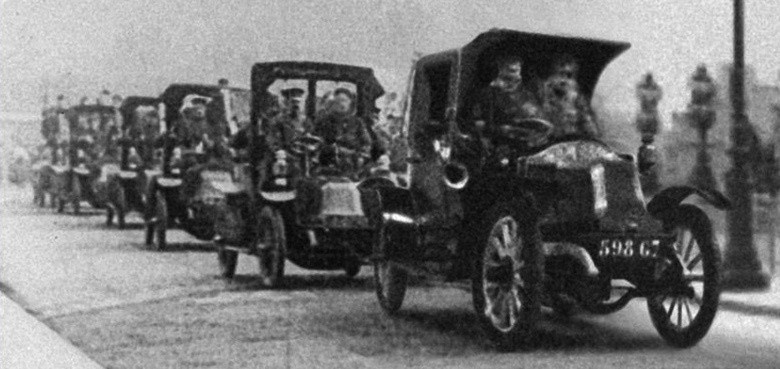
Once the soldiers had been dropped off near the Marne front, the cab drivers returned to Paris, and the companies were paid 70,102 francs by the Ministry of War, the same price as for regular fares.
Although the taxis of the Marne episode was not decisive for the First Battle of the Marne, the initiative nonetheless helped halt the enemy’s advance and left its mark on history and the public imagination more through its psychological impact than its military significance. Through its unprecedented scale and the involvement of the population, the taxis of the Marne enter the legend and quickly become the symbol of solidarity, unity, and national resolve.
For further reading:
Several taxis de la Marne have been acquired to keep alive the memory of this iconic event: two Renault G7 can be seen at the Army Museum, housed in the Hôtel des Invalides, and at the Meaux’s Great War Museum.
Dates and Opening Time
On September 6, 2026
Location
Hôtel national des Invalides
129 Rue de Grenelle
75007 Paris 7
Route planner
Accessibility info