During the night of October 17–18, 1534, several Huguenot placards harshly criticizing the Catholic Mass were posted in multiple towns across France, including Paris. The Affair of the Placards marks the start of the persecution of Protestants under King Francis I and foreshadows the many Wars of Religion to come.
From the very start of his reign, on January 25, 1515, King Francis I pays little heed to the frictions between Catholics and Protestants stirring the country and appears neutral toward the Reformation, which marks the split between the Roman Catholic Church and the Protestant churches, showing a certain openness and not hesitating to forge alliances with Protestants in Germany and Switzerland.
Starting in the 16th century, the Protestant Reformation initially targets only the morals of the clergy; at the court of Marguerite de Navarre, the king’s sister, these new ideas find an audience, and the king shows little concern—going so far as to shield the first Protestants in France from clerical pressure. But between 1527 and 1534, the outlook of the Huguenots takes a different direction.

In the night of Thursday, October 18, 1534, public places in Paris and several provincial towns, such as Rouen and Tours, are clandestinely covered by French Protestants with d'affiches - they were then called placards - with an anti-Catholic aim, for all to see. One placard is even posted on the porte de la chambre du roi at the château de Blois, while the royal court residences in Orléans and Amboise are, too, densely lined with placards.
Criticizing the Catholic Mass in harsh terms, the authors of these pamphlets vehemently reject the doctrine of transubstantiation during the Eucharist—the transformation of bread and wine into the blood and body of Jesus Christ during Mass, one of the pillars of the Catholic faith. The placards read: "True Articles on the Horrible, Great, and Unbearable Abuses of the Papal Mass Invented Directly Against the Holy Supper of Our Lord Jesus Christ, the Only Mediator and Savior."
Brandishing accusations that the rites of the Mass are sorcery and charging the pope, bishops, priests, and monks with lies and blasphemy, the placards are the work of Antoine Marcourt, a French pastor inspired by Calvinism exiled in Neuchâtel, Switzerland, where he had them printed. The Affair of the Placards marks the first overt hostilities between Catholics and Protestants in France.

For Francis I, this anti-papal affront, striking at the ecclesiastical institution and the divine-right monarchy, marks the end of his policy of conciliation toward Protestants and Reform supporters. The king's response to this lèse-majesté that threatens his authority is swift and brutal: determined to keep the realm from drifting into heresy, he launches a radical crackdown on the “malcontents of the faith,” even as he publicly proclaims his Catholic faith.
Many Huguenots, suspected of being behind the placards, are arrested, imprisoned, tried and executed for some, while others flee Paris and France, even as the king promises 200 écus to anyone who denounces the authors of the placards. Between two and three hundred people are arrested, and several are burned alive, among them Antoine Augereau, accused of printing the placards, or Étienne de La Forge, a friend of jurist and reformer Jean Calvin - the latter forced into exile in Basel to escape reprisals.
Several people close to the king, and especially his sister Marguerite de Navarre, sympathetic to reformers and a protector of John Calvin, are suspected. The repression continues in January 1535 with the creation, at the request of Francis I, of a special commission, the chambre ardente, tasked with banning insurrectionary books, while an edict shuts down the printing press and closes the bookstores, marking the first act of censorship since the invention of the printing press. On January 21, 1535, a large public penitential procession through the streets of Paris, organized by the Catholic Church and attended by the sovereign, ends with the execution by burning of six heretics.

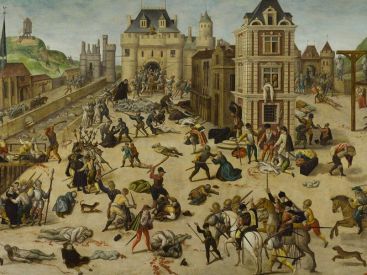
In the twenty-five years that followed, violence against Protestants would be all too common, though the death of François I on 31 March 1547 offers a brief respite from the intolerance. But from 1562, France enters the bloody period of the Wars of Religion.
For further reading:
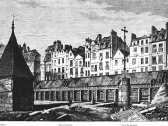
Did you know? Why was Place l'Hôtel de Ville called Place de Grève?
Long known as the Place de Grève, today's Place de l'Hôtel-de-Ville in Paris has seen many uses: as a trading port, a place of public execution, then as the center of municipal power from 1357. Discover its history! [Read more]
Dates and Opening Time
On October 18, 2026
Location
Parvis de Notre-Dame de Paris
6 parvis notre-dame
75004 Paris 4
Route planner
Accessibility info
More information
Iconography: Header: surviving copy of the incriminating plates, preserved at the BNF. Persecution of Protestants during the reign of François I, 1534. Copper engraving by Matthäus Merian the Elder.
Anne du Bourg, conseiller du Parlement de Paris bruslé a S. Ian en Greue le 21. Decembre 1559.






















 Did you know? Why was Place l'Hôtel de Ville called Place de Grève?