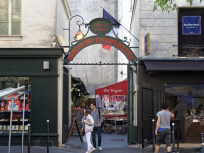
In the night of October 11–12, 2026, a fierce blaze gutted the Marché des Enfants-Rouges, tucked at 39, rue de Bretagne, in the Marais district. Paris's oldest covered food market was far more than a gourmet address beloved by locals and tourists alike. Founded in 1615 and listed as a historic monument since 1982, it stood as a precious witness to old Paris. We take a look back at its history.
Fire in Paris: Enfants Rouges Market badly damaged, fire brought under control
The Enfants Rouges Market, in Paris’s 3rd arrondissement, was struck by a fire overnight between October 11 and 12, 2026. The blaze is under control, but the market is "totally wrecked," according to the mayor of Paris Centre. [Read more]
A market founded in 1615, during Louis XIII’s reign.
To understand the significance of the Marché des Enfants-Rouges, you have to travel back more than four centuries to a Paris with a very different face. It is 1615. Louis XIII rules France, and the Marais district is still reshaping itself. It is in this context that a new market is created to supply the people living in the area.
In those days, the place wasn’t yet known as the Enfants-Rouges, but as the Petit Marché du Marais. The Archives of Paris even preserve documents about its founding, including petitions to the king and letters patent dating from 1615. Over the centuries, the market has seen countless generations of traders and shoppers pass through, enduring the upheavals of Parisian history. A remarkable fate for a neighborhood market, which would go on to become the oldest covered market in the capital.
Behind that striking name lies a history far older than the market itself. In 1536, Marguerite de Navarre, sister of King Francis I, helped inaugurate the creation of an establishment designed to shelter orphans in the neighborhood.
What set it apart? The little residents wore garments cut from red cloth, a color linked to Christian charity. This distinctive mark soon earned them the nickname “the Red Children.” The institution closed its doors in 1772, but its memory remains deeply rooted in the neighborhood. By the end of the 18th century, the ancien Petit Marché du Marais thus took on the name marché des Enfants-Rouges, in homage to these children.
The 2026 fire isn’t the first time the Enfants-Rouges Market has faced a threat to its survival. On March 8, 1982, the market was inscribed as a historic monument, official recognition of its heritage value. But that protection didn’t spare the site from tougher times.
In the 1990s, the market was aging and dilapidated, and it ultimately shut down in 1994. A plan to demolish it to make way for a car park was on the table. Yet the attachment of residents and shopkeepers to this slice of old Paris proved stronger. A grassroots campaign formed to save the hall, with some even sleeping overnight in front of the market to defend its preservation.
Their struggle has paid off. The market is finally renovated under the direction of architect Florence Bougnoux and reopens its doors in 2000, ready to begin a new chapter in its history.
The Enfants-Rouges Market wasn’t prized merely for its age or its status as a heritage site. It mattered as much for what it represented in the daily life of the neighborhood. Sheltered beneath its halls, locals came to buy vegetables, cheese, meat, or fish. But gradually, the market evolved to also host restaurateurs and caterers offering specialties from around the world.
Japanese, Moroccan, Italian, Lebanese—or Afro-Caribbean—cuisine: the old 17th‑century market has become a true mosaic of flavors. Its talent for reinventing itself without losing its identity was its defining feature. Far from a monument frozen in time, the Marché des Enfants-Rouges was a living heritage, animated every day by traders, regulars, conversations and encounters.
The future of the Enfants-Rouges Market remains to be written. But one thing is certain: its 411 years of history are etched in the memory of Paris.
This page may contain AI-assisted elements, more information here.
Location
Marché des Enfants Rouges
39, Rue de Bretagne
75003 Paris 3
Route planner
Accessibility info



























 Fire in Paris: Enfants Rouges Market badly damaged, fire brought under control