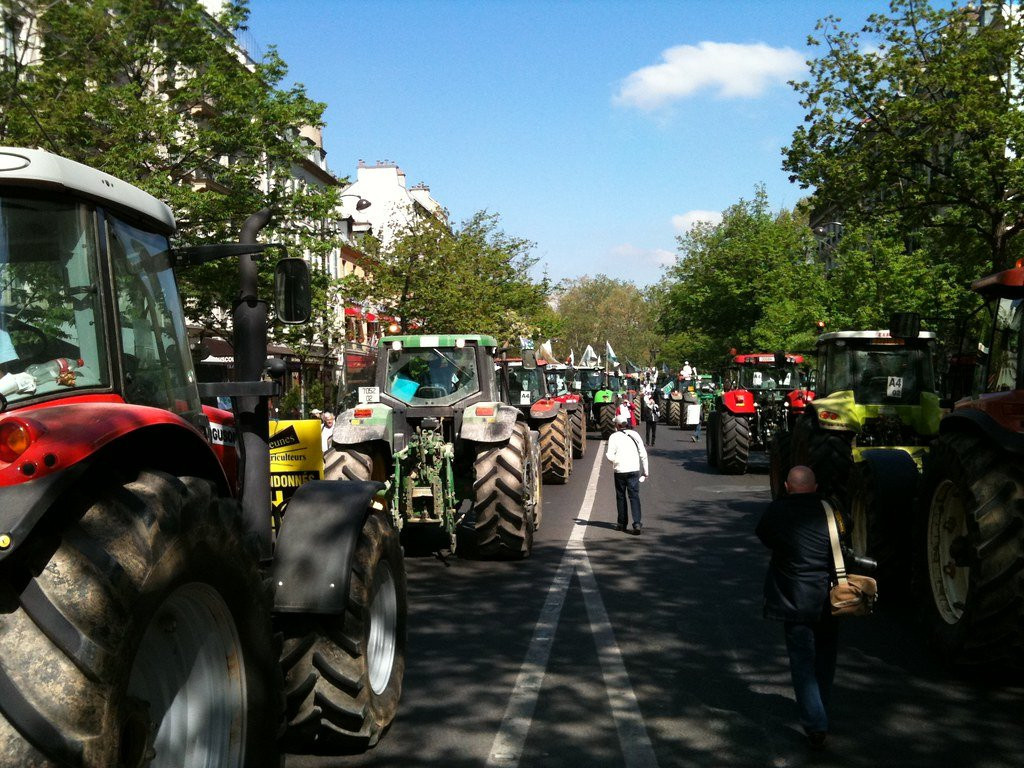
This Friday morning, around a hundredfarmers from the Yvelines andÎle-de-Franceregions took to the Place d'Armes at the Château de Versailles with some twenty tractors. According to FDSEA and Jeunes Agriculteurs organizers, the aim of the action was to highlight the consequences that the "Mercosur" agreement will have on the profession. The action took place at dawn, before the château opened to the public, with demonstrators leaving at around 11:30 a.m. to avoid disrupting visitor access to the historic monument.
The banners hanging from the tractors displayed a clear message: "The peasant revolt resumes in Versailles", in reference to the events of 1789. Olivier Gousseau, a farmer in the Yvelines region of France, said: "We're still in the doldrums", lamenting a farmer "fed up" with "the lack of income, the ever-increasing costs and the ever-decreasing price of wheat".
At the heart of this agricultural anger is the free-trade agreement between the European Union and the Latin American countries of Mercosur, validated by the European Commission in early September. "This agreement remains toxic, incomprehensible and dangerous for French farmers", denounce the FNSEA and Jeunes Agriculteurs in their press releases.
Farmers' unions point to several problematic aspects of this trade agreement. It would facilitate the import of South American agricultural products - meat, sugar, rice, honey, soy - produced under conditions deemed incompatible with European standards. "It is inconceivable that the European Union would authorize the import of products derived from practices that have been totally banned in France and Europe for years, if not decades: use of banned phytosanitary molecules, illegal deforestation, animal mistreatment".
For Arnaud Rousseau, President of the FNSEA, who was present in Place d'Armes, "the purpose of this mobilization is obviously to draw the attention of the Head of State". Farmers are calling for concrete guarantees, not just promises of safeguard measures, which they consider insufficient.
This demonstration in Versailles is part of a wider movement affecting the whole of France. Nearly 70 actions are taking place simultaneously in 65 départements, ranging from snail operations to product checks in supermarkets and demonstrations outside prefectures.
Farmers in the Paris region are also denouncing tariffs imposed by the United States - notably a 15% increase for the wine industry - and, more generally, unfair competition from imports that do not comply with European standards. Pascal Verriele, General Secretary of the Seine-et-Marne FDSEA, refers to "Mercosur, and the duty-free import quotas granted to Ukraine. All this is destabilizing our farms".
Although the harvest period is currently limiting mobilization, as farmers are busy with the grape harvest, corn harvest and silage harvest, the farmers' unions are promising to return with greater force. The demonstrators promise to "come back this winter" if they are not heard.
The FNSEA is already calling for an urgent meeting at Matignon with Prime Minister Sébastien Lecornu. Arnaud Rousseau is also urging Emmanuel Macron to "react" in the face of fears over the signing of the Mercosur agreement, Donald Trump's tariffs and the growing economic difficulties of the French agricultural sector.
This day of action on September 26 could well be just the first step towards larger mobilizations to come. In fact, the Confédération Paysanne has already announced a "tractors in the lead" demonstration in Paris on October 14, a sign that agricultural protest is not about to run out of steam.
For French farmers, the stakes go beyond mere economic considerations: it's a question of preserving the country's food sovereignty and guaranteeing agriculture that respects the strictest environmental and health standards in the world.