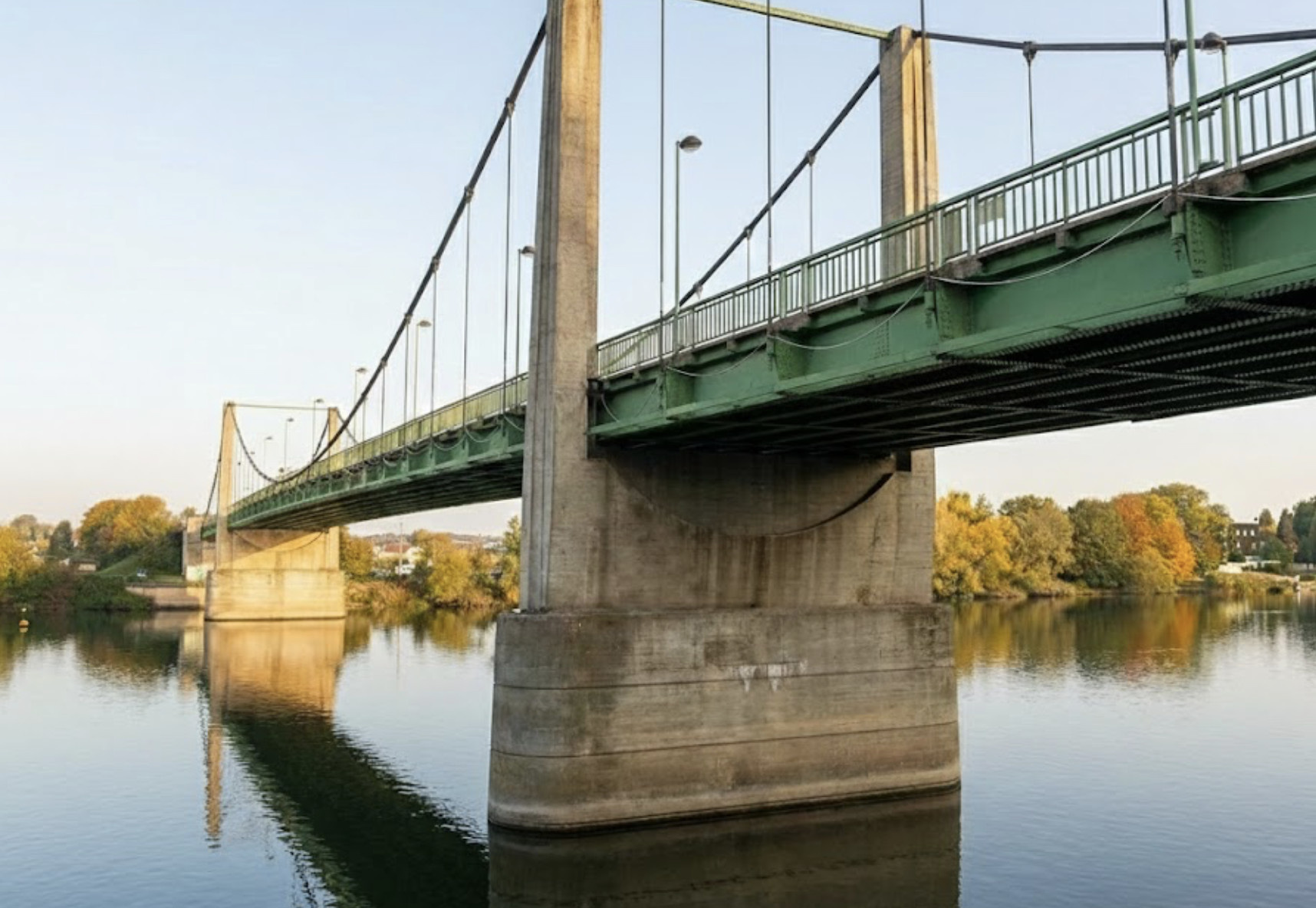
Traffic will be complicated for several days on the Triel-sur-Seine suspension bridge in the Yvelines, an iconic structure used by more than 12,000 vehicles every day. From Monday, November 24 to Friday, November 28, 2025, studies will be conducted on this historic bridge, which dates back to 1956 and is actively monitored by the Yvelines Department. These interventions aim to assess the condition of the supporting structure of this self-anchored suspension bridge, which connects Triel-sur-Seine to Vernouillet via the D2 departmental road.
This bridge, steeped in history, replaced the first suspension bridge in Triel, inaugurated in 1838 by the Seguin brothers, which was destroyed in June 1940 by the French military engineers to slow down the German advance. Its reconstruction, which began in 1951, encountered technical difficulties due to the instability of the ground, leading to the decision to build a self-anchored suspension bridge rather than a conventional suspension bridge. The current structure was finally inaugurated on October 21, 1956, consisting of three spans with a total length of 180 meters.
Contrary to some information that has been circulating in the surrounding municipalities, the bridge will not be completely closed for five days. Cédric Aoun, the mayor of Triel-sur-Seine, who participated in discussions with the Yvelines Department and the Grand Paris Seine & Oise (GPS&O) urban community, has specified the exact schedule of work on his Facebook page.
On Monday, November 24, 2025, alternating traffic will be implemented according to the needs of the construction site, without total closure. Occasional closures and alternating traffic will take place between November 25 and 27, 2025, from 10 a.m. to 3 p.m. Barring unforeseen circumstances, no work is planned for Friday, November 28, 2025. "We are doing our utmost not to close the bridge, and the Department is doing the same. We are trying to do our best without disrupting traffic," explains the mayor, who is aware of the inconvenience during the school year. The machine used for these measures is very specific and was only available during that week.
Throughout the duration of the work, traffic diversions are to be expected in neighboring towns, particularly in Vaux-sur-Seine and Meulan-en-Yvelines. The "new Triel bridge" (D1), inaugurated in 2003, is the most direct alternative. This 3.6-kilometer-long, 2x2-lane viaduct, including a 635-meter crossing over the Seine, connects the RD 154 (left bank) to the RD 190 (right bank) via the Île d'Hernière. Built at a cost of €80 million, it should accommodate a significant portion of the diverted traffic.
For those coming from the northwest or heading up towards Mantes, the 530-meter-long Rhin et Danube bridge between Meulan-en-Yvelines and Les Mureaux offers an alternative, although this route is already congested during rush hour. Downstream, the Poissy bridge allows you to cross the Seine between Poissy and Carrières-sous-Poissy, but the detour is longer for motorists in the area. The Conflans-Sainte-Honorine bridge, at the confluence of the Seine and the Oise, is also an option for reaching Andrésy.
Bus lines 6541 and 6572 will also be disrupted. The stop on the bridge will not be served between 9 a.m. and 4 p.m. A replacement stop is planned on Rue du Pavillon to allow public transport users to continue their journeys despite the works. The Triel-sur-Seine station on the Transilien J line remains fully operational and is a good alternative for reaching Paris or neighboring towns, as mentioned in our article on transport in Île-de-France.
This suspension bridge has been under surveillance by the departmental council for several months. In March 2025, the bridge was already closed at night for a topographical survey. In May 2025, the department explained that "the engineering work carried out on the results obtained had not revealed any obvious malfunction."
These new studies, carried out with the help of the Center for Studies and Expertise on Risks, the Environment, Mobility, and Development (Cerema), will provide a more accurate diagnosis. The results will be known in March 2026. Cédric Aoun indicates that "major work" will have to be carried out on this bridge "over several years." "This cable-stayed bridge is quite rare in France; they are no longer built today, and I think it should be highlighted," concludes the mayor.
In short, if you need to use this route during the week, allow extra time and, if possible, use the new Triel bridge (D1) to avoid occasional closures. Motorists who regularly use this route are well aware of the importance of this historic structure in their daily journeys, so patience and caution will be required.
Dates and Opening Time
From November 24, 2025 to November 28, 2025
Recommended age
For all