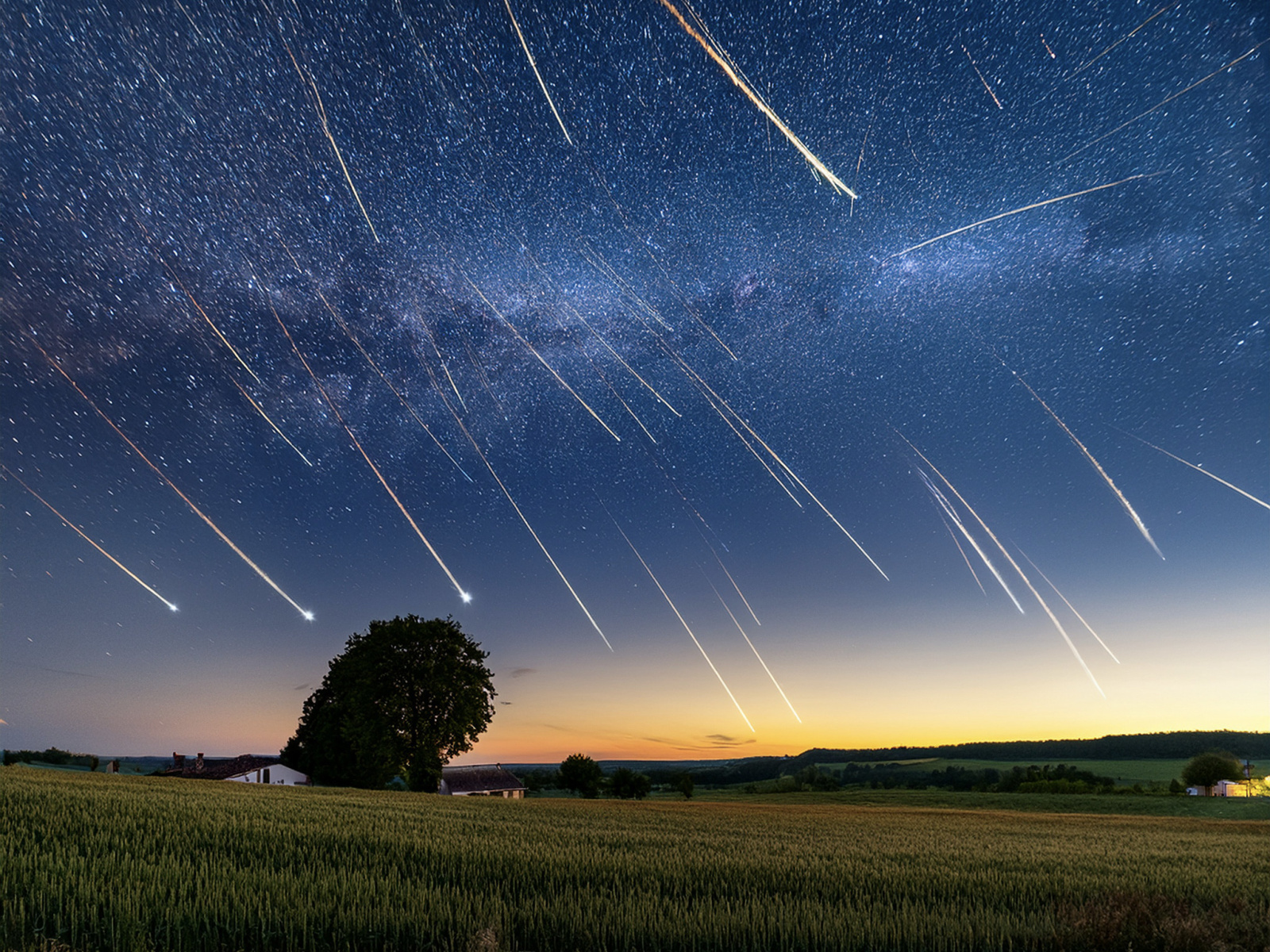
Tonight, Wednesday, April 22, 2026, the Lyrids are at their peak activity over the Île-de-France sky. This meteor shower, visible each year from April 16 to 26, offers a good chance to glance northeast and try to spot these shooting stars born from the debris of Comet Thatcher. Expect about ten to twenty meteors per hour under a clear sky, provided you get far enough away from the city lights.
We call them shooting stars, but that name is a misnomer: they’re tiny specks of dust, the remnants of the comet C/1861 G1 Thatcher, which incandesce as they slam into Earth’s atmosphere at roughly 49 km/s, leaving behind those iconic streaks. Their name hails from the Lyra constellation, the radiant from which they appear to radiate. Thatcher, a long-period comet, completes its orbit around the Sun about every 415 years; in other words, no one alive today will ever see it pass by again, yet we are treated to its faithful legacy each April.
The Lyrids rank among the oldest well-documented celestial phenomena: the first known sighting dates back to 687 BCE, recorded by Chinese chroniclers. Nearly 2,700 years later, we’re still drawn to the same spectacle, which is a mind-boggling testament to the sky’s enduring magic. And if you want to miss none of the year’s astronomical events, the Lyrids are only a first act: the upcoming major celestial milestones will be the Eta Aquarids in May, followed by the famed Perseids in August 2026.
According to the International Meteor Organization, the peak is expected on April 22 at 19:40 UTC, which corresponds to 21:40 in metropolitan France. That timing is fairly favorable for the hexagonal country. That said, there's no point stepping outside exactly at 22:00 to come back ten minutes later: a meteor shower peak is not an instantaneous event, and the maximum could occur a little before or a little after, as noted by Cité de l'espace. The best viewing conditions are between midnight and 3 a.m., when the Lyra radiant climbs high in the northeast.
Good news on the Moon front: in 2026, the Lyrids will peak two days before the Moon’s first quarter, which means moonlight will only slightly hamper visibility. Just hiding the crescent behind a tree or building is enough to noticeably improve the view.
The light pollution remains the number one enemy for amateur astronomers in the Paris region. For the Lyrids, the ideal is to get away from the city center and find an open space with a wide view toward the northeast. To help you pinpoint the least-lit areas, the Avex association publishes detailed maps of light pollution in France, very useful for choosing your spot. Our guide to the best spots to watch shooting stars in Île-de-France also lists the region’s most favorable locations.
The vallée de Chevreuse hosts numerous astronomy associations each year: this wooded part of the Yvelines region, reachable from Paris by the RER B toward Gif-sur-Yvette or Saint-Rémy-lès-Chevreuse in under 40 minutes, remains unusually free of light pollution thanks to the commitments of several municipalities to curb public lighting. A spot worth a detour for dark-sky enthusiasts who don’t want to leave Île-de-France.
Still in the Yvelines, the Parc du Peuple de l'Herbe in Carrières-sous-Poissy has the advantage of being unlit at night, making it a notable site for stargazing. In Triel-sur-Seine, the Parc aux étoiles, housed in the heart of the Château de la Tour park, is a veritable museum of astronomy and astrophysics, featuring France's largest telescope open to public observations – a reference spot for anyone looking to go beyond naked-eye viewing.
For those staying in Paris, a few elevated spots still let you give the experience a try: the Montmartre Hill from the Sacré-Cœur esplanade, the Buttes-Chaumont Park, Belleville Park, or the Mont Valérien in the Hauts-de-Seine. These sites won’t replace a field in Rambouillet Forest, but they’re reachable by public transport and offer an unobstructed view of a good stretch of the sky.
No telescope or special gear is needed: shooting stars are visible to the naked eye, lying on a blanket and taking in the widest possible field of view. Avoid staring directly at the radiant in Lyra – meteors seem to emanate from it, but you’ll see more by looking around. Plan on about 15 to 20 minutes for your eyes to adapt to the dark, and don’t light up your smartphone during the watch — or at least switch to night mode with the brightness down. A red-filtered flashlight is ideal if you need to find your bearings.
To navigate the night sky, the free app Sky Tonight shows in real time where to find the radiant of the Lyrids and flags the best viewing window. Stellarium, available for free on iOS and Android, is another trusted staple for stargazers to locate the Lyra constellation and orient themselves under the stars.
This night is for everyone curious about the cosmos, from the youngest to the most seasoned stargazers. To extend the experience year‑round, the Parc aux étoiles de Triel-sur-Seine regularly hosts family-friendly observing evenings. And if this first gathering sparks your interest in the night sky, already mark your calendar for the peak of the Perseids around August 12, 2026 — a far grander spectacle, this year combined with an exceptional solar eclipse.
Also to read on Sortiraparis:
This page may contain AI-assisted elements, more information here.