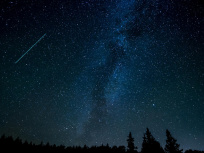
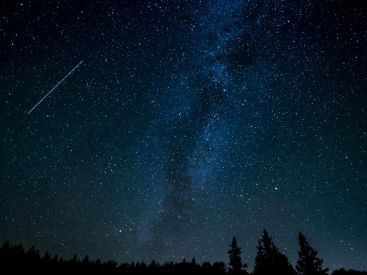
The Draconid meteor shower returns from October 6 to 10, 2026, and skies over Paris as well as the Yvelines, Seine-et-Marne, Essonne, or Val-d'Oise will be favorable for viewing. The Draconid peak is expected on the night of Thursday, October 8 to Friday, October 9, 2026. Good news: the Moon will be nearly invisible that week.
Less famous than the August Perseids, this meteor shower still has a real ace up its sleeve. It can be enjoyed with the naked eye and, above all, without sacrificing a good night's sleep. Here’s how to plan your evening.
The Draconids will be active from October 6 to 10, 2026. According to the astronomy guide Star Walk, the theoretical peak is expected on October 9 around 3:00 a.m., Paris time. The night to watch, therefore, is the October 8–9 window.
The lunar calendar is on our side. The new Moon arrives on October 10, 2026, and our satellite will be only about 1% illuminated at its peak. Result: a truly dark sky, free of the milky halo that usually washes out even the faintest meteors.
This is the hallmark of this meteor shower. The shooting stars seem to burst from the Dragon constellation (hence their name), looming high in the northern sky as dusk fades. Where the Perseids invite stargazers to burn the midnight oil, the Draconids offer their prime viewing window in the early evening.
A real boon for families with children or for anyone who has to work the next day. You can try stargazing after dinner, once night has fallen, and keep it up as long as the sky stays clear.
It's wise to stay realistic. Average activity sits at about 5 to 10 shooting stars per hour, and no uptick is forecast for 2026. This isn't fireworks, more like a fishing trip where every catch counts.
Their appeal lies elsewhere: these slow meteors enter the atmosphere at about 20 km/s, far slower than most other showers. They leave long trails that seem to glide in slow motion, easy to spot with the naked eye.
The Draconids spring from the dust left by comet 21P/Giacobini-Zinner, which completes its orbit around the Sun in just over six years. Their unpredictable nature has long fascinated astronomers: in 1933 and 1946 they sparked storms of more than 10,000 shooting stars per hour. Nothing like that is expected this year, but the history of the meteor shower is detailed by the International Meteor Organization.
In Paris, light pollution mutes the show, and most parks lock their gates at night in October. The high viewpoints remain the best bets, such as Montmartre Hill in the 18th arrondissement or the banks of the Seine a little away from the city lights.
For a much darker sky, you’ll need to head out to the outer bands of the city. The Rambouillet forest in Yvelines, the plains of Brie in Seine-et-Marne, the Gâtinais in Essonne, or the Vexin in Val-d’Oise offer wide, clear horizons facing north. Our Perseids scouting remains valid, and you can find it in our article on the places to watch shooting stars in the Paris region.
No gear is required, and stargazing is completely free. A deck chair, a blanket, and a warm jacket are all you need as October evenings grow chilly. Lie back, face north, and sweep the sky wide: shooting stars can appear anywhere.
Give your eyes about twenty minutes to adjust to the darkness, and put away your phone—the bright screen ruins your night vision. To locate the Dragon constellation, an app like Star Walk or the interactive Time and Date map works just fine. The French Astronomy Association also offers tips and shares details of outings organized by clubs in the Île-de-France area.
A final tip before you head out: take a look at the forecast from Météo-France, because a few clouds can spoil things. If the sky darkens on October 8, the nights around October 7 and 9 could still be interesting. In the forest or countryside, stay on designated parking areas and paths, warn a friend or relative about your outing, and bring a flashlight—ideally with a red light.
And if you miss this rendezvous, don’t panic. The Orionids, born from the dust of Halley’s Comet, have been visible since October 2 and will continue through November 7, 2026, with a peak in the night of October 21–22. Our guide to the sky events not to miss in 2026 gives you all the dates for the rest of the year.
This page may contain AI-assisted elements, more information here.
Dates and Opening Time
From October 6, 2026 to October 10, 2026
Prices
Free
Recommended age
For all