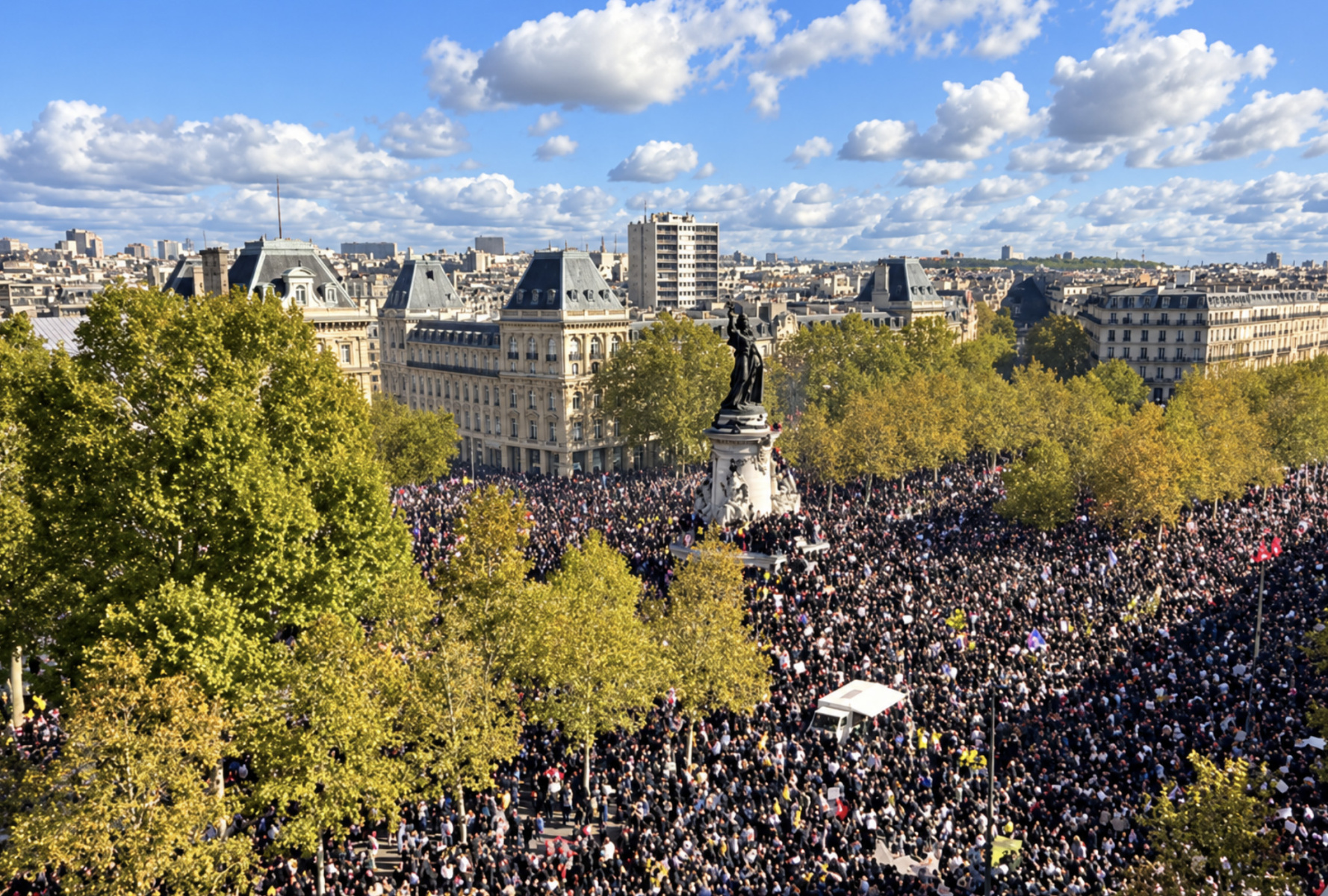
The demonstration on Saturday, October 24, 2026, in Paris is moving along the Boulevards des Maréchaux. The march set off from Porte d'Italie (13th arrondissement) at 2 p.m. and is heading toward Porte de Vincennes (12th and 20th arrondissements), the only authorized route since the Paris Administrative Court rejected the inter-union alliance’s appeal against the order issued by the Paris Police Prefecture on Saturday morning. The Bastille–Nation route (11th and 12th arrondissements), negotiated on Thursday and then banned on Friday evening, is therefore definitively off the table.
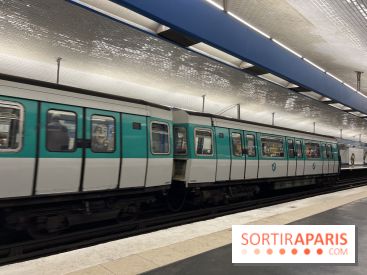
When it comes to transport, it looks set to be a difficult day. At the request of the police prefecture, the RATP closed 24 metro stations from 9 a.m., from the Champs-Élysées (8th arrondissement) to the Latin Quarter (5th and 6th arrondissements), including the Daumesnil area (12th arrondissement). Lines 2, 6 and 12 are partially suspended, as is tram line T3, which will stop running along a large stretch of the Boulevards des Maréchaux from 10 a.m. Fourteen bus routes may also be diverted around noon.
The afternoon brings more gaps in the network map. The RATP suspends service on line 1 between Château de Vincennes and Saint-Mandé, in Val-de-Marne, just a short distance from the procession’s destination, and closes Châtelet and Les Halles stations (1st arrondissement), where connections are no longer available. No resumption of service has been announced for now. We detail these new closures in our article Line 1 suspended, Châtelet and Les Halles closed this October 24.
Trade unions, student organizations and high school groups have backed this route. “We’ll go to Porte d’Italie this afternoon,” CGT national confederal secretary Thomas Vacheron announced on BFM-TV on behalf of the inter-union coalition, Le Monde reports. The Bastille–Opéra route sought by the Yellow Vest coordination remains banned. Under the prefectural order, the march may proceed from 1 p.m. to 7 p.m. along the edge of the capital.
A week after October 17, which saw very large crowds and widespread violence, the government is preparing a “massive” security operation. The broad outlines are known: Sentinelle troops will reinforce the deployment, elite units will be mobilized, marches deemed high-risk will be banned, and staffing will be 20% higher than on October 17, according to Minister Delegate Jean-Didier Berger.
This Thursday, Emmanuel Macron took an even tougher line. Demonstrations not called by unions will be banned wherever possible, and the head of state is urging people not to demonstrate at all over the coming days. He chaired a defense council on Friday morning before meeting student organizations at the Élysée that afternoon.
Here’s an update on the route, transport and venues closed this Saturday. For the wider context, our article Act II this Saturday, October 24: what should we expect? covers the issue.
The list was released on Thursday evening. In its traffic information bulletin, the RATP says that, at the request of the Paris Police Prefecture and for security reasons, numerous stations will close from 9 a.m. on Saturday, October 24. Here are the details, line by line:
October 24 demonstration in Paris: Metro stations closed this Saturday
The Yellow Vests and students are calling for new demonstrations and an “Act II” on October 24, 2026. RATP has announced major disruptions to public transport in Paris and the closure of numerous stations. Nine metro lines are affected. Here is the list of all the stations closed in Paris on October 24. [Read more]
At closed stations, trains pass through without stopping, and connections are unavailable. So plan to change trains elsewhere if your usual route takes you through Concorde, Odéon or Sèvres-Babylone.
On line 2, the closure between Barbès-Rochechouart and Nation includes the section already closed between Barbès-Rochechouart and Père-Lachaise for renovation work. On line 6, service is suspended between Kléber and Charles de Gaulle-Étoile, and on line 12, no trains are running between Madeleine and Notre-Dame-des-Champs. The stations will reopen with authorization from the Paris police prefecture; no time has been announced.
The map mainly outlines a security perimeter around the Champs-Élysées and the Élysée Palace (8th arrondissement), the National Assembly and government ministries (7th), and the Senate and the Latin Quarter (5th and 6th). Four stations on line 6 in the 12th arrondissement have also been added—Dugommier, Daumesnil, Bel Air and Picpus—all near the Bastille–Nation route, which was ultimately ruled out. Porte d'Italie (line 7) and Porte de Vincennes (line 1), at either end of the procession, were not on the morning list. Since then, line 1 has been cut just beyond Porte de Vincennes, on the Saint-Mandé side, showing that the map is changing throughout the day. Check whether your station is accessible before setting out.
This list may change throughout the day. Before heading out, take a look at our Paris metro and RER service updates, updated continuously.
According to the RATP traffic updates, updated in the middle of the afternoon, trains on Line 1 are no longer running between Château de Vincennes and Saint-Mandé. Bérault station, between the two, is therefore no longer served. The transit authority has not given a time for service to resume and is advising passengers to plan an alternative route.
For Paris’s busiest line, the day was already off to a bad start. Since 9 a.m., Argentine, Charles de Gaulle-Étoile, George V, Franklin D. Roosevelt, Champs-Élysées-Clemenceau, Concorde and Tuileries have been closed. With Châtelet also closed, the yellow line is losing many of its busiest stops.
The entrances to Châtelet (lines 1, 4, 7, 11 and 14) and Les Halles (line 4) have now also been closed, and trains are passing through without stopping. When the interchange served by five lines closes, the entire network has to take a detour. Our guide to the metro and RER lines running this Saturday can help you plan a new route.
These two stations were due to close for the evening anyway. As part of the curfew, République, Châtelet, Les Halles and Châtelet-Les Halles will close from 10 p.m. until Sunday, October 25, at the request of the police prefecture. Full details of these new closures can be found in our article, Metro Line 1 disrupted, Châtelet and Les Halles closed.
The route approved by the courts is also shown on the tram map, which runs along the Boulevards of the Marshals. T3a is suspended between Montsouris (14th arrondissement) and Porte de Vincennes, and T3b between Porte de Montreuil (20th arrondissement) and Porte de Vincennes, from 10 a.m. until 6 a.m. on Sunday, October 25. Full details are available in our list of closed stations and lines.
As for buses, the RATP says 14 routes could be diverted or have limited service around midday: 21, 24, 29, 46, 56, 57, 64, 67, 77, 86, 87, 109, 202 and 215. The stops that will not be served have not yet been specified. With a march along the Maréchaux, other routes serving the affected gateways are also worth checking, such as 47, 131, 184, 185, 186 and 193 at Porte d'Italie; 77 and 87 at Porte de Charenton; 46 and 201 at Porte Dorée; and 86, 215 and 351 at Porte de Vincennes. Find all the details in our article on bus diversions this Saturday.
In the evening, bus 27 is also diverted through central Paris, from 10:30 p.m. to 3 a.m., with several stops not served between Palais Royal and Pont Neuf. The easiest way to check your journey is still the Île-de-France Mobilités journey planner, by entering the exact time of your trip.
It’s best to leave the car at home. Along this route, the Boulevards des Maréchaux are expected to be closed to traffic as the procession passes, from Boulevard Masséna (13th arrondissement) to Boulevard Soult (12th arrondissement), via Pont National and Boulevard Poniatowski. Expect traffic to spill over onto the nearby boulevard périphérique and the main roads leading to the Porte d’Italie, Porte d’Ivry, Porte de Charenton, Porte Dorée and Porte de Vincennes.
The Porte d’Italie area is likely to become congested from early afternoon, when the rally gets under way. Disruptions are then expected to move east with the procession, reaching Porte de Vincennes by the end of the day. Parking may also be prohibited along the route. Our article on traffic and parking covers the areas to avoid.
The march set off from Porte d'Italie at 2 p.m., led by Jean-Luc Mélenchon, according to franceinfo’s live coverage. The Police Prefecture’s order authorizes the demonstration from 1 p.m. to 7 p.m., from Porte d'Italie to Porte de Vincennes, along the boulevards des Maréchaux, as Le Parisien explains. On the map, this means following the capital’s southeastern edge along Boulevard Masséna, Boulevard du Général-Jean-Simon, Boulevard Poniatowski and Boulevard Soult, a stone’s throw from the ring road. A long stretch of asphalt, far from the historic squares that Parisian marches usually pass through.

The co-general secretary of the Paris CGT, Karl Ghazi, told AFP on Friday that the new route was “impossible to secure.” In a statement issued on Friday evening, the organizations said they rejected “this dangerous game” and announced that they would go to Bastille. They changed course after the judge’s decision, franceinfo learned from a union source.
It was the Paris Administrative Court that ruled. Hearing an emergency application from the inter-union coalition, which brings together the CGT and student organizations such as the Fage, the judge on Saturday morning rejected the request to suspend the order. Unlike the Interfac march on Thursday, whose ban had been suspended, the unions therefore failed to get their way. The decision has not gone down well: the Unef strongly denounced it in a statement, while the CGT called it a “government tour de force,” according to L'Humanité.
The start did indeed take place at Porte d'Italie, not Place de la Bastille. The Line 7 station is not among those RATP has announced will be closed, while tramway T3a is no longer running in the area. At the other end of the route, the closure of Line 1 between Saint-Mandé and Château de Vincennes is making it harder to get back to Val-de-Marne at the end of the day.
A quick look back: the Paris police prefecture had approved the unions’ Bastille–Nation route at midday on Thursday, October 22. The unions point out that the route had been agreed after two lengthy meetings devoted to the march’s security, and denounce a last-minute U-turn. This route is separate from the three stationary gatherings near the Élysée Palace banned by order No. 2026-01415.
Alongside the unions, youth organizations (Fage, Union étudiante, Unef and Union syndicale lycéenne) are part of the inter-union coalition that petitioned the judge and are now following the approved route. Nationally, the CGT had already called on its 600,000 members to join Saturday’s rallies peacefully.
It remains to be seen whether the yellow vests will follow the march all the way to Porte d’Italie. Also taking part is Interfac Île-de-France, which has joined the Bastille–Opéra declaration. The student collective scored a legal victory on Thursday: Paris’s administrative court issued an emergency suspension of the order banning its march between Pitié-Salpêtrière hospital (13th arrondissement) and Bastille, AFP reports. The students were therefore able to march. As of this update, we have found no official guidance from Interfac for Saturday.
For Saturday, the rule set so far is simple: except for the union march declared by the CGT, all other demonstrations are banned in Paris. A Police Prefecture order has already made this official. It specifically targets the Bastille–Opéra route put forward by the yellow vests and Interfac, and applies in Paris the line laid down on Thursday by Emmanuel Macron, under which only union marches may go ahead. In practice, joining an undeclared gathering on Saturday, even a static one, could result in a fine. The route of the union march has now been set between the Porte d’Italie and Porte de Vincennes.
Not within an authorized framework. The unions’ call to gather at Place de la Bastille has been dropped, and the Bastille–Nation route remains banned. Speaking on BFM-TV, the UNEF lawyer warns that anyone who goes along the original route risks being fined.
The High School Union is backing the inter-union coalition, while regretting that it has come to this. Its federal officer, Philémon Jouglet Marcus, told Le Monde he was concerned that some demonstrators would go to Bastille anyway, risking police and judicial repression. If you plan to march, the only route that is legally safe remains the one along the Boulevards des Maréchaux.
Their position still needs to be clarified following the judge’s ruling. After initially refusing to sign off on the Bastille–Nation route, saying it had no mandate to approve it, the Yellow Vests Coordination announced on Thursday that it would join the protest notified by the CGT. It had already confirmed it would be at Place de la Bastille from noon on Saturday.
This coming together changes the equation compared with October 17, when the large joint march sought by the organizers never materialized. This time, unions and yellow vest protesters plan to set off from the same point and follow the same route. It remains to be seen whether the coordination group, which had called for people to gather at Bastille, will indeed join them at Porte d’Italie. Its co-spokesperson, Azelma Sigaux, also announced on franceinfo that the coordination group would meet at Bastille on Saturday in the early afternoon to decide what comes next for the movement.
Benjamin Ball, the movement’s coordinator and editor of the website mapping the actions, is also promising a major day of demonstrations, when “everyone will be out in the streets”: high school students, university students, trade unions, farmers, nurses and firefighters. Around 340 actions are listed across France on the mobilization map.
A legal issue is also weighing on the balance. In Paris, a demonstration must be notified at least three clear days before the date, meaning by Tuesday evening at the latest for a Saturday event, as a Paris criminal defense lawyer points out. Submitted on Wednesday, the yellow vests’ notification was already technically late.
By Order No. 2026-01415 of October 22, 2026, the Paris Police Prefecture has banned three stationary gatherings registered in the name of the Yellow Vests Union, planned for 35 Avenue Gabriel, near the Élysée Palace in the 8th arrondissement. The registered gatherings were scheduled for Friday, October 23, and Saturday, October 24, from 6:30 a.m., and Sunday, October 25, from 4:30 p.m.
This order does not amount to a general ban on demonstrations in Paris during those three days. It applies only to the three gatherings declared near the Élysée. It does not cover the Bastille–Opéra or Bastille–Nation routes: their status must be distinguished from that of these static gatherings.
Elsewhere in France, authorities have sometimes taken an even tougher line. In Lyon, the Rhône prefecture has banned all demonstrations on Saturday. Marseille and Le Havre are following the same approach, either across the entire city or in the city center, depending on the case. In Bouches-du-Rhône, an order published Thursday evening bans gatherings and demonstrations over specific demands on Saturday from 7 a.m. to 10 p.m., franceinfo reports. This policy was set by Laurent Nuñez, who asked prefects to ban demonstrations over specific demands that could disrupt public order.
In the afternoon, most of the marches are proceeding peacefully, but tensions have been reported in Lyon, Nice and Nantes, according to franceinfo’s roundup of protests across the regions.
Emmanuel Macron confirmed this doctrine on Thursday, after a security council meeting at the Élysée, as reported by Le Monde. Requests to hold demonstrations filed by organizers he considers to have no legitimacy will be banned “wherever possible.” Union requests, by contrast, will be reviewed by prefects, with alternative routes drawn up to protect city centers, businesses and public buildings. This is the approach the Paris police prefecture is applying, rerouting the march onto the Boulevards des Maréchaux, a decision upheld by the administrative court on Saturday.
The defense council announced shortly afterward was held at the Élysée Palace on Friday morning, October 23. At the time of this update, its decisions had not yet been made public.
The doctrine is also being challenged in court. On Thursday evening, the Association for the Defense of Constitutional Liberties (Adelico) and the Magistrates’ Union filed an emergency application to protect fundamental freedoms with the Conseil d'État, franceinfo reports. They argue that no law allows the head of state to reserve demonstrations exclusively for trade unions. Such applications are generally decided within 48 hours, potentially as early as this weekend. At the time of this update, no decision had been made public.
High school students will also be taking part. In a statement published on Wednesday, October 21, the Coordination nationale lycéenne is calling on them to take to the streets this Saturday, October 24, alongside students, apprentices, work-study students and workers. It says it supports all possible next steps in the movement, from demonstrations to blockades and occupations.
This text was adopted at its second meeting, held in Paris on October 18. More than 100 high school students, delegated by their general assemblies, represented 27 cities, from Brest to Strasbourg and Lille to Marseille, as well as delegations from Île-de-France.
As for their demands, high school students are calling for more funding and staff, class sizes capped at 25, the abolition of Parcoursup and an end to inequalities between affluent and working-class neighborhoods. They are already calling for a national day of action on Tuesday, November 3, joining the November 5 strike and planning another meeting on Thursday, October 29.
The government admits that crowd control showed its limits last weekend. In the National Assembly, Sébastien Lecornu acknowledged that the response during Act I was “too static and not mobile enough.”
The Interior Ministry is therefore announcing a doctrine “more focused on responsiveness and mobility,” capable of tracking down small groups that move quickly. Laurent Nuñez, who will personally oversee the operation on Saturday, has already outlined three measures:
Intelligence services fear highly mobile groups of rioters on Saturday, including far-left groups. Expect a highly visible police and military presence, therefore, well beyond the march route.
The precedent set on October 17 is also a reminder that surprises can arise on the day itself. The police headquarters had ordered a route from République to Place de Clichy (18th arrondissement), as we explained in our article on the October 17 march route. Thousands of demonstrators were left stranded on the other side of République, and the large joint march never took shape.
The partial curfew in Paris is now in effect until 6 a.m. on Monday, October 26. Under Order No. 2026-01407 dated October 22, the Police Prefecture has banned anyone, adults and minors alike, from being in the areas around Place de la République and Les Halles each night from 11 p.m. to 6 a.m. The measure therefore also applies to Saturday night into Sunday. As for the metro and RER, République, Châtelet, Les Halles and Châtelet-Les Halles stations close at 10 p.m. on those nights. The exceptions are detailed in our article Can you go home or work after 11 p.m.?
During the day, orders issued in recent days, such as Thursday’s from 8 a.m. to 8 p.m., banned unauthorized gatherings in several areas:
Bastille, the starting point of the route agreed on Thursday and then banned on Friday, is within this zone, as is République, which the yellow vest protesters wanted to cross. The Bastille–Opéra route, meanwhile, has been formally banned. Keep an eye on the Paris Police Prefecture’s website.
The City of Paris is also urging the utmost vigilance. After last weekend’s violence and looting, it fears further damage caused by vandals with no connection to the protest movement.
Starting this Thursday, City Hall is removing from public spaces anything that could be used to break things, such as barriers and movable construction-site equipment. It is asking residents and shopkeepers to bring in their bins, bicycles, terrace furniture and other outdoor furnishings from midday Saturday. So if you park your bike on the street near Bastille, Nation or along the boulevards des Maréchaux, it would be best to put it somewhere safe.
More than 1,000 sanitation workers will be deployed this weekend, alongside mediation teams. Several events planned in public spaces have also been canceled, including activities at Mon Premier Festival, the children’s film festival, in Paris Centre. Before heading out with your family, check that your screening or workshop is still going ahead.
For businesses, the cost of last weekend remains high. Around 3,000 shops were damaged or looted in France, and the government has announced interest-free loans available from Friday, as well as the option to spread out payments. Several retail chains would therefore rather take no chances on Saturday. Benjamin Ball is going so far as to urge shopkeepers to close up and join the protest.
First major name to shut up shop: Apple. The three Apple Stores in Paris—on the Champs-Élysées (8th arrondissement), in Opéra (9th) and at Marché Saint-Germain (6th)—will remain closed all day, as will four other city-center stores in Lille, Bordeaux, Strasbourg and Aix-en-Provence. Stores in shopping centers in Île-de-France, such as Vélizy 2, Les Quatre Temps in La Défense and Parly 2, will remain open, and the Paris stores will exceptionally reopen on Sunday, October 25, from 12 p.m. to 6 p.m. We cover everything in our article on the Apple Stores in Paris closed Saturday.
Apple is not the only one playing it safe. The DJI Store Paris on rue Soufflot (5th arrondissement) has also announced that it is closing. The racing simulator center E-Motion Paris on rue Réaumur (2nd arrondissement) will be closed on Saturday and Sunday. As for nightlife, the 33 Foch club (16th arrondissement) will not reopen on Saturday night. And Japan Fes Paris, a night market scheduled for this weekend at the foot of the Arc de Triomphe, has been canceled. The next event announced on its official website is on November 6 and 7 at Place Saint-Michel.
Culture is also paying the price. Art Basel Paris, the major contemporary art fair held at the Grand Palais (8th arrondissement), will close to the public on Saturday, October 24, and Sunday, October 25. Scheduled to run from October 23 to 25 and feature more than 200 galleries, it will now be open for just one day, this Friday, and will close earlier than planned, at 7 p.m. Organizers cite the safety of visitors, exhibitors and staff. Details of refunds for weekend tickets have yet to be announced.
The major national museums are following suit. On Thursday evening, the Ministry of Culture announced the exceptional closure this Saturday of the Louvre Museum (1st arrondissement), the Musée d'Orsay (7th arrondissement) and the Musée national Picasso (3rd arrondissement). The Grand Palais is also closing all its exhibitions. The ministry cited the safety of visitors and staff, as well as the protection of the artworks. Picasso ticket holders will be contacted by email about a refund or exchange. Our articles provide an overview of the venues closing that day.
Museums, shops and salons: several venues have chosen to close this Saturday, October 24, 2026, ahead of the demonstration planned in Paris. [Read more]
These decisions follow a clear message from the Paris police headquarters. In a letter sent Wednesday evening, police prefect Patrice Faure urged Paris shopkeepers to take "precautions" ahead of the upcoming student protests and protests over the rising cost of living. He recommended, in particular, that they step up security at their premises and adjust their opening hours.
The prefecture goes even further in its advice. It urges shopkeepers to consider “hiring private security guards, accompanied where appropriate by canine units”—in other words, guards with dogs. It also asks them to check their alarms and video surveillance systems.
For the rest, it echoes the recommendations of the Interior Ministry: close earlier, protect shop windows, and leave no furniture or rubbish bins out on the street on the day of the demonstration. These instructions are in line with those issued by the City of Paris.
However, no order requires businesses to close: the decision is up to each shopkeeper. Shops, cafés and restaurants around Bastille and along the boulevards des Maréchaux are most exposed. Although Opéra and République are away from the routes, memories of October 17 could prompt some businesses in these neighborhoods to err on the side of caution. We’ll update the list of closures as soon as another business comes forward.
At the time of writing, the department stores on Boulevard Haussmann have not announced any closures, and the Galeries Lafayette Haussmann website still lists its regular Saturday hours. In December 2018, during Act IV of the Yellow Vest protests, however, Galeries Lafayette and Printemps closed their Paris stores as a precaution, Europe 1 recalls.
Outside Paris, the approach is different. The coordination’s map lists gatherings at roundabouts, outside gas stations, oil depots, train stations and toll plazas. The main demand remains a freeze on pump prices and tighter controls on oil companies’ profit margins.
These actions are often brief and mobile, making them difficult to anticipate. If you’re driving in Seine-et-Marne, Yvelines, Essonne or Val-d’Oise on Saturday, allow extra time, especially near major roads and shopping areas.
The most reliable source remains the Paris Police Prefecture, which publishes its orders on its website and social media: the approved route, restricted areas and any new restrictions. For public transport, the RATP announces station closures, and our metro and RER service updates reflect them throughout the day.
If you live or work near the Porte d’Italie and Porte de Vincennes, or along the Maréchaux boulevards, keep an eye on these sources throughout the day. And if you’d rather spend the day away from the marches, our guide to things to do this Saturday, October 24 puts the spotlight on exhibitions. Just check before you set off, as the Louvre, Orsay, the Grand Palais and the Picasso Museum will all remain closed on Saturday. The movement’s next steps will come on October 31 with Act III, on November 3 with the national high school students’ day of action, and then during the November 5 inter-union strike.
We will update this article throughout the day, particularly if there are any further station closures, bus diversions or a response from the Conseil d'État.
This page may contain AI-assisted elements, more information here.













































 October 24 demonstration in Paris: Metro stations closed this Saturday


 October 24, 2026 demonstration: places that will be exceptionally closed this Saturday