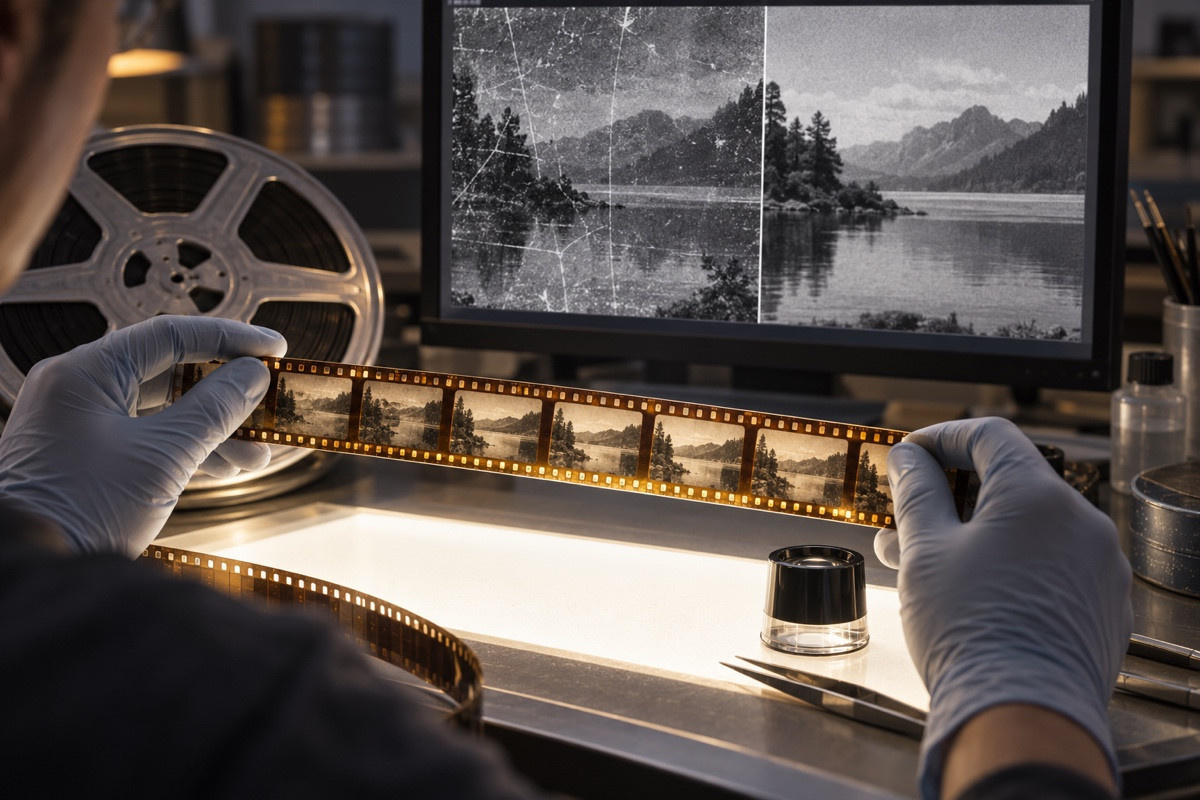
When it comes to reissues, the label restauré en 4K grabs attention. But what does that really mean? To understand the work involved, you have to look at the elements found, the repairs carried out, and the choices made to preserve the film’s picture and sound.
It all starts with an archival dig. The CNC outlines the search for negatives, prints, and production documents that allow the film to be reconstructed. The condition of the medium matters as much as its nature: a reel can carry tears, damaged splices, or missing passages. The available material thus shapes part of the restoration options.
Digital restoration turns the film frames into files that the teams can edit. Scanning can be done in 2K, 4K, or 8K. The chosen resolution is just one step in the process; stabilization, scratch removal, and the adjustment of colors and light—color grading—follow. The single number on the label tells you neither the condition of the original elements nor the full scope of the work.
The case of Merlusse, directed by Marcel Pagnol in 1935, shows how several elements can complement each other. In an interview published by the CNC, Hervé Pichard, head of film collections at the Cinémathèque Française, explains that the restoration relied on the negative and on an internegative to fill in the gaps. The image was digitized in 4K, while the sound was processed in parallel.
Restoring the look of the film also requires a human touch. For this black-and-white edition, director of photography Guillaume Schiffman oversaw the color grading to preserve the original luminance density. Pichard stresses the importance of keeping the film grain and conveying the filmmaker’s craft and the cinematographer’s work. A restored image can thus retain a visible texture.
The same care goes into the sound. For Merlusse, the teams preserved the distinctive traits of the era’s remixing while working to improve dialogue intelligibility. The fragility of 1930s sound recordings is one of the characteristics that this restoration takes into account.
The line between wear and a defect that’s embedded from the factory can demand a judgment call. For Les Maîtres du temps, by René Laloux, Ellen Schafer, head of catalog exploitation at Argos Films and Cite Films, says some coverage issues were kept intact. Fixing them would have wiped out imperfections inherent to the film.
To bring back its colors, the restorers drew on a range of references: celluloid, comic books derived from the film, promotional materials, and testimonies. Schafer acknowledges a degree of subjectivity in this work. The project also tackled English subtitling and audio description: access to a restored work also depends on the texts and the accompaniments that accompany its imagery.
This page may contain AI-assisted elements, more information here.