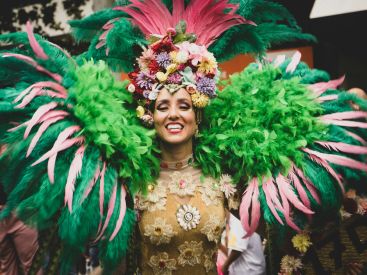
It’s a grand popular celebration that has become an integral part of Paris's history, delighting both young and old: the Carnival of Paris. But do you know where it all began? Explore the story behind this festive tradition, whose roots date back nearly a thousand years!
In the 11th century, the clergy organized the Feast of Fools (or Feast of the Innocents) from December 26 to 28. This lively masquerade, inspired by the bawdy celebrations of the Saturnalia, provided an opportunity for revelers to cast aside social norms, engaging in the wildest and most grotesque games imaginable. In Paris, it was often held in front of the Notre-Dame Cathedral—a scene that famously appears in Victor Hugo's work of the same name. Over time, this festivity gradually fell out of favor and eventually faded away.
Instead, the Carnival comes to life. As a popular celebration, it historically maintained a strong connection with the Church and Christianity, as it is closely linked to Lent. By the 15th century, artisans were the key participants in the Carnival festivities. This celebration is also notably associated with the Bayard’s parade. Additionally, the Carnival has always been a showcase for performers in elaborate costumes, as well as a time when Parisian police took part in the festivities.
Throughout the years, the fate of Carnival has often depended on the changing local leaders and political or religious authorities, leading to periods when the celebration was outright banned due to the disruptions it could cause. When World War I broke out, the festivities were simply put on hold. It wasn't until the early 1990s that the event made a successful comeback.
In 1998, a grassroots civic movement revitalized the Carnaval into the lively celebration we know today, complete with confetti, music, parades, and costumes. From songs and novels to theater, films, and paintings, the Carnaval remains a vibrant cultural event. It’s a spirited tradition that has left its mark through the centuries, inspiring the works of many of France’s greatest artists.
There will no longer be a Paris Carnival or a Women's Carnival running in the capital!
Lacking funds, the organization behind both the Paris Carnival and the Women's Carnival has announced the cancellation of these beloved events, which have long been highlights for Parisians and visitors alike. [Read more]












 There will no longer be a Paris Carnival or a Women's Carnival running in the capital!