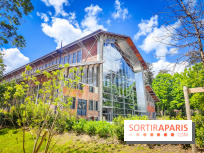
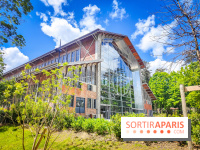
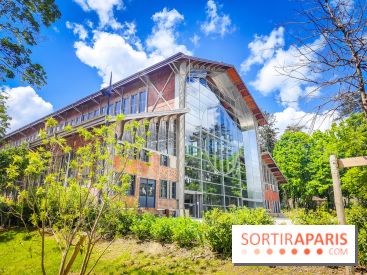
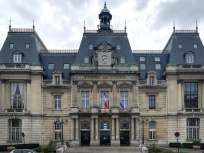
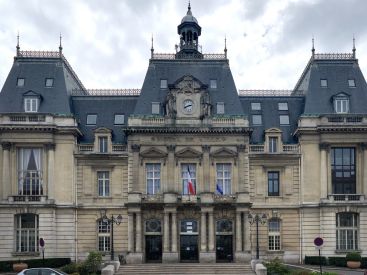
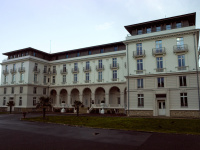
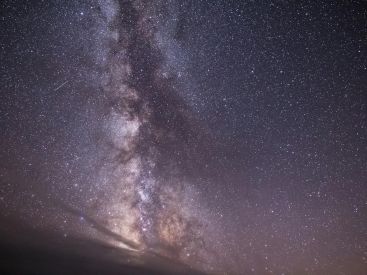
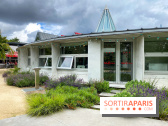
The Science Festival is the ultimate national event to explore the wonders around us. Nature, space, the human body—local scientists are eager to answer your questions and share their extensive knowledge. For those curious to unveil the mysteries of our vast universe, head over to the Paris Institute of Astrophysics on October 15, 2023.
This institute, part of Sorbonne University and the CNRS, is a joint research unit and an Observatory of Earth and Universe Sciences (OSU). It brings together experts in astrophysics and theoretical physics. Their research focuses on a range of topics, including the formation of planetary systems, the search for and study of exoplanets, galaxy evolution, both observational and theoretical cosmology, theories of gravity and the physics of the early Universe, and high-energy astrophysics. This year, embark on a celestial adventure—spot stars, enjoy spectacular film screenings, attend engaging lectures, and explore our Solar System firsthand!
Fête de la Science 2025 in Paris and Ile-de-France: the program of free events
The Fête de la Science is back from October 3 to 13, 2025 for its 34th edition! The idea? A week dedicated to scientific culture, with numerous free events all over France. Experiments, shows, open houses, visits and a host of workshops, open to all and adapted to children, await you in the four corners of Paris and the Île-de-France region! [Read more]
Find out all about the formation of galaxies, gravitational waves and exoplanets; find out how the Euclid satellite works and how its data will be cleaned; find out how an astrophysics laboratory works on a day-to-day basis, and how researchers are supported; find out about the career paths that lead to astrophysics research: a unique opportunity to get direct answers to these questions, by meeting members of the Paris Astrophysics Institute.
Not afraid of black holes? Even when Alain Riazuelo dons a virtual reality helmet and shows you his latest simulations?
20-minute sessions, limited to seven participants (registration at reception).
Continuous from 10:30 a.m. to 1:30 p.m.
We often hear that we know only 5% of the content of our Universe, but how is this possible? Discover the cosmic microwave background, the youngest image of the universe we can obtain, which provides us with information about its structure, both past and present.
On July 1, 2023, the European satellite Euclid left Earth on an extraordinary mission: to map an entire section of the Universe, in order to understand why the expansion of the Universe is accelerating. No fewer than ten French laboratories are involved in this mission, including the Paris Institute of Astrophysics. A series of educational elements (models, posters, kakemonos... and surprises!) will be on display in the hall and basement of the IAP. For more information: https: //euclid.cnes.fr/
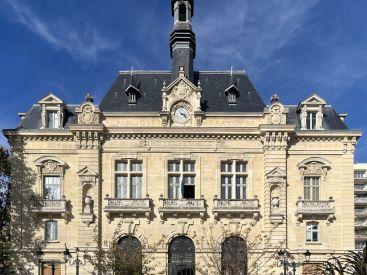
It's hard to get a true sense of distances in the Universe, but as soon as you move into the solar system, the values become astronomical and very difficult to imagine. A temporary new look for the IAP's exterior facade is being unveiled this year to coincide with the Fête de la Science, featuring a model of our solar system in two relative scales: one of distance and one of object diameter. Visitors can explore the solar system and appreciate the immensity of the Universe.
François Sèvre, astrophysicist at the IAP, presents a series of small experiments on light, the basis of modern astronomy. It will be possible to look through a real spectroscope to see emission and absorption spectra. You'll also be able to study the formation of images by reflection, refraction or gravitational lenses. Finally, you can discover the optical content of the Euclid satellite.
New galaxy surveys, such as those obtained with the JWST or Euclid telescopes, offer us breathtaking images of distant galaxies. Their varied and often spectacular shapes encode the memory of their assembly history (mergers, interactions, quiet growth, etc.). But there's more: in reality, these galaxies are also tracers of the invisible: their distribution and the statistical alignment of their shapes also bear the imprint of dark matter and dark energy. What do the shapes of galaxies tell us about the Universe? What is its content and evolution? How did matter come together in galaxies within the cosmic web? And how will the Euclid space telescope survey enable us to explore these questions?
Over the last few decades, astronomers have developed ever more refined and ingenious methods for detecting worlds beyond our Solar System. Transit, radial velocity, gravitational microlensing, direct imaging: this talk takes you behind the scenes of the search for exoplanets. Some revolve around stars, others around brown dwarfs; some even wander in the void without a sun to revolve around. How can we discover planets so far away that we can't see them? Does their diversity tell us anything about their history? How can they help us better understand our Solar System's past? These are just some of the questions that will be addressed in this conference.
"Astrophysics for Little Ones" (approx. 40 min), from 1:00 pm to 2:00 pm: Damien Leborgne, astrophysicist at the IAP, presents the sky, its planets, and the birth, life and death of stars, in a mini-conference for little ones accompanied by their parents. Recommended age: 3 to 7 years. "Astrophysics for the very young" (approx. 40 min), 2:30 - 3:30 pm: IAP astrophysicist Damien Leborgne presents the sky, its planets, and the birth, life and death of stars, in a mini-conference for very young children accompanied by their parents. Recommended age: 3 to 7. "The Universe explained to children" (approx. 1 hr), from 3:30 to 4:30 pm: Alain Riazuelo, astrophysicist at the IAP, invites children on a journey through the Universe, discovering the solar system, stars, galaxies and beyond. Recommended age: 7 to 11. "The Universe explained to children" (approx. 1 hr), from 4:30 to 5:30 pm: Alain Riazuelo, astrophysicist at the IAP, invites children on a journey through the Universe, discovering the solar system, stars, galaxies and beyond. Recommended age: 7 to 11.
In September 2020, with the publication of its latest results, the European satellite observatory Planck, dedicated to recording the cosmological background radiation, delivered its best observations of the Universe just after the Big Bang, and made it possible to build the best model of it. These results, which represent a major improvement in our understanding of how the Universe works, nevertheless confirmed the existence of increasingly significant tensions between the model preferred by observations of the young Universe and observations of nearby supernova explosions, as well as with surveys of the position and shape of distant galaxies.
For the past 5 years, the question of these disagreements has polarized the cosmological community, which has sought, with new data and new analyses, to understand or resolve them. Great progress has been made, with new complementary observations of the background radiation using ground-based programs, with the extension and new analysis of observation programs for distant galaxies, using probes of the near Universe complementary to supernova explosions, and finally, thanks to the creativity of theorists to extend the model representing the workings of the Universe. Researchers are far from having answered all their questions, and have even discovered some new ones!
This conference will therefore provide an opportunity to take stock of the observational and theoretical progress made over the last 5 years, and to look ahead to the next 5.
A multi-disciplinary team comprising a photographer, a researcher and an astrophotographer, working under the banner of the Institut d'astrophysique de Paris (IAP), has just succeeded for the first time in filming the aurora borealis in 3D, in a format suitable for hemispheric screens such as those found in planetariums. This videoprojection presentation in our amphitheater, on a normal screen but with 3D glasses, of sequences filmed in real time, will begin with some background information about binocular vision and the aurora borealis. This project received financial support from Sorbonne University's Labex Plas@Par in 2019.
To find out more, read the article on the IAP website "Ils n'ont pas froid aux yeux et filient les aurores boréales en 3D": http://www.iap.fr/actualites/avoir/2018/Juin/aurora3d-fr.html
Registration required.
Participants use the space-time simulator to discover gravity. They observe how the distance between two points changes when masses are added, and understand that the stretching of fabric represents the stretching of space and time.
Jeun de piste (ages 12 and up) and Chasse aux étoiles treasure hunt (ages 4 and up) concocted by doctoral students at the Institut d'astrophysique de Paris. What is Euclid? Are gravitational waves light? How can we detect ultra-high-energy neutrinos? The answers are scattered across the walls of the Institute. Find them and you could win an astrophysical souvenir.
Presentation of educational panels (including on the history of the IAP); meetings with young researchers from the Institute of Astrophysics whose work focuses on cosmology.
Using never-before-seen digital simulations, astrophysicist Alain Riazuelo takes us on a breathtaking adventure, hurtling towards a black hole at almost the speed of light. After inspecting it from every angle and skimming its surface, we take the plunge: a journey to the very heart of the black hole. Designed with the laws of physics in mind, this virtual experience challenges intuition and confronts us with strange phenomena, all of which are clearly explained in the film: cosmic rear-view mirrors, ghostly images, stars that change color, the celestial vault concentrated into a luminous ball. A journey as educational as it is aesthetic.
The screening will be followed by a Q&A session with Alain Riazuelo.
A film produced by Science et Avenir magazine.
Dates and Opening Time
On October 15, 2023
Location
Paris Institute of Astrophysics
Boulevard Arago
75014 Paris 14
Prices
Free
Official website
www.iap.fr




 Fête de la Science 2025 in Paris and Ile-de-France: the program of free events