At the Invalides, the main trap when visiting with children is to assume you’re here to see only one museum. Behind the famous façade lies a vast complex: the Army Museum, the Plans-Reliefs Museum, and the Museum of the Order of Liberation, to which are added the Dôme des Invalides et le tombeau de Napoléon Ier, the Saint-Louis Cathedral and various historical itineraries.
Good news: the Invalides Joint Ticket grants access to the Army Museum’s permanent and temporary exhibitions, the Dome and Napoleon’s Tomb, the Museum of the Order of the Liberation, and the Plans-Reliefs Museum. The question now is what the kids will actually have time and the energy to explore.
Yes. Small strollers are welcome at the Army Museum. If you’re with a baby, whenever possible use the south entrance, Place Vauban, opposite the Dôme. The museum specifically recommends this route for families with strollers to avoid the cobblestones of the grand avenue from the Esplanade des Invalides.
Once inside, the museum’s main spaces are served by elevators. The historic weapons and armor are accessible on the ground floor, and the Museum of the Order of the Liberation is likewise reachable from the south entrance, with an elevator that connects to the Plans-Reliefs Museum.
One important exception remains: the Dome and Napoleon's tomb.
This is the section you need to plan for when you’re with a toddler. The Dôme des Invalides is not accessible without stairs: there are steps both outside and inside, and no elevator to bypass them.
A compact, easily foldable stroller is far more practical than a bulky model. A baby carrier can also make this part of the visit easier. Under the dome sits the imposing tomb of Napoleon I, positioned at the center of the crypt.
Even with kids who aren’t especially excited by imperial history, the monument’s sheer scale, its dome, and the enormous sarcophagus offer a welcome change of scenery after the museum’s display cases.
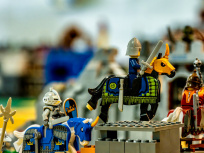
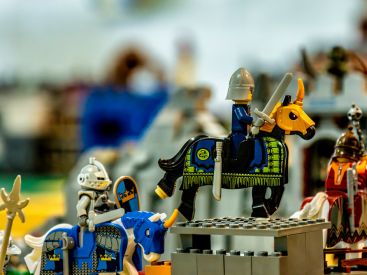
Don’t try to see everything in one go. The Army Museum houses extensive collections spanning from the Middle Ages to the modern era. With a primary-school child, the ancient weapons and armor are probably the most accessible entry point: knights’ armor, helmets, swords, and gear bring the exhibit to life in a much more tangible way.
We can then move on to the Louis XIV - Napoleon spaces, which are especially coherent if you plan to finish under the Dome.
With an adolescent, the rooms dedicated to the two World Wars can echo school curricula. The museum also houses the Historial Charles de Gaulle, built around documents and audiovisual displays.
With kids of different ages, it's best to pick one or two sections of the Army Museum, then switch to a completely different universe.
This is exactly the kind of space families can easily overlook. Located in the heart of the Invalides, the Musée des Plans-Reliefs houses a stunning collection of large historical scale models of fortified towns. Twenty-eight plans-reliefs, drawn from a collection assembled between 1668 and 1875, let visitors study fortifications, topography, streets, and landscapes from above.
The story begins under Louis XIV when Louvois commissions Vauban to produce a scale model of Dunkirk. These models were used, among other things, to think about defense and the layout of fortified places.
For children, there's no need to dive straight into the nuances of military strategy: you can start by spotting houses, ramparts, rivers and other miniature details. The museum then becomes almost a gigantic collection of miniature towns.
Access is included with the Invalides admission, and an elevator takes you up to the museum. For an elementary-age child who loves scale models, it’s a compelling alternative to the long military galleries.
It's the third museum established at Les Invalides. The Museum of the Order of Liberation tells the story of Free France, the internal Resistance, and deportation, mainly through the paths of the Companions of the Liberation. The Order was founded by General de Gaulle in November 1940.
The topic is naturally easier to tackle with children who are old enough to understand World War II. For 8-14 years, a small activity booklet nonetheless lets them explore the collections while discovering the story of the resistance.
The museum also offers a free serious game for 8-12 year-olds, about 1 hour 30 minutes long, as well as family-friendly and theatrically staged tours depending on the program.
With a middle schooler, this museum can become one of the most engaging parts of the Invalides. With a 3- or 4-year-old, you can obviously make your way through, but the suits of armor or the Plans-Reliefs models are generally easier to grasp.
No. That's exactly one of the things you should know before you visit.
The Invalides Museums and Exhibitions ticket provides access to:
The Cour d'Honneur and the Cathedral of Saint-Louis des Invalides are, for their part, freely accessible, with no ticket required.
One important caveat: each area has its own entrance, and once you leave an area you can't re-enter it with the same ticket.
Technically yes. In practice, it’s not always advisable with young children.
The audio tour focused on the Army Museum’s essentials already runs about 2 hours 30 minutes. The Dome tour lasts roughly 1 hour 30 minutes, as does the architectural tour. The Museum of the Order of Liberation also offers an audio tour of around 2 hours 30 minutes.
Visiting the Army Museum, the Dome, the Plans-Reliefs, and the Order of the Liberation can therefore easily occupy a large part of the day.
With a baby, a primary-schooler and a teenager, it's best to tailor a selection. For example: Armours + Plans-Reliefs + Napoleon's Tomb with the younger ones, or World War II + the Order of the Liberation + the Dome with older children.
And there’s nothing to stop you from moving quickly through a space that doesn’t grab the family as much.
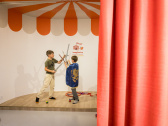
Yes. The Army Museum offers a notably robust family program, with storytelling tours, interactive tours and workshops, especially for children aged 3–6 and 7–12.
Game booklets also let visitors explore certain collections with more independence. The Museum of the Order of the Liberation, for its part, offers its own game booklet for ages 8-14, a digital game for ages 8-12, and a range of family activities.
The digital audio guide included with the combined ticket also covers the three museums and the Dome, at no extra cost.
A diaper-changing table is available in the restrooms in the East Wing of the Army Museum. Additional facilities are spread throughout the site, notably around the Court of Honor.
A free cloakroom is also available for dropping off certain items. Bags accepted at the cloakroom must not exceed 55 × 35 × 25 cm.
With kids, the Cour d'Honneur is mainly a welcome breather between two spaces. Rather than rushing from one museum to the next, use this outdoor pause to switch gears.
moins de 18 ans bénéficient de la gratuité du billet d'entrée sous conditions de présentation d'un justificatif. Translation note: provide proof of eligibility as required. Those under 18 enjoy free admission, provided they show a valid proof of eligibility. The moins de 18 ans... portion stays as is per the formatting requirement.
Attention: even when a child travels for free, they must have their own free ticket. In 2026, the joint ticket is listed at €17 full price and €12 reduced. A family offer also allows adults accompanying a minor under 18 to benefit, under conditions, from a reduced weekend fare.
The Invalides turn out to feel more like a compact museum district than a monument you dash through in an hour. With a baby, a primary-schooler, and a middle-schooler, it’s wiser to treat the shared ticket as a passport to choice rather than a checklist to tick off. Armor, miniature cityscapes, the Resistance, or Napoleon—there’s a thread for everyone to follow without forcing the whole family into a full day of marching through history.
This page may contain AI-assisted elements, more information here.
Dates and Opening Time
From November 18, 2026 to December 31, 2027
Location
Army Museum
129 Rue de Grenelle
75007 Paris 7
Route planner
Accessibility info
Official website
www.musee-armee.fr