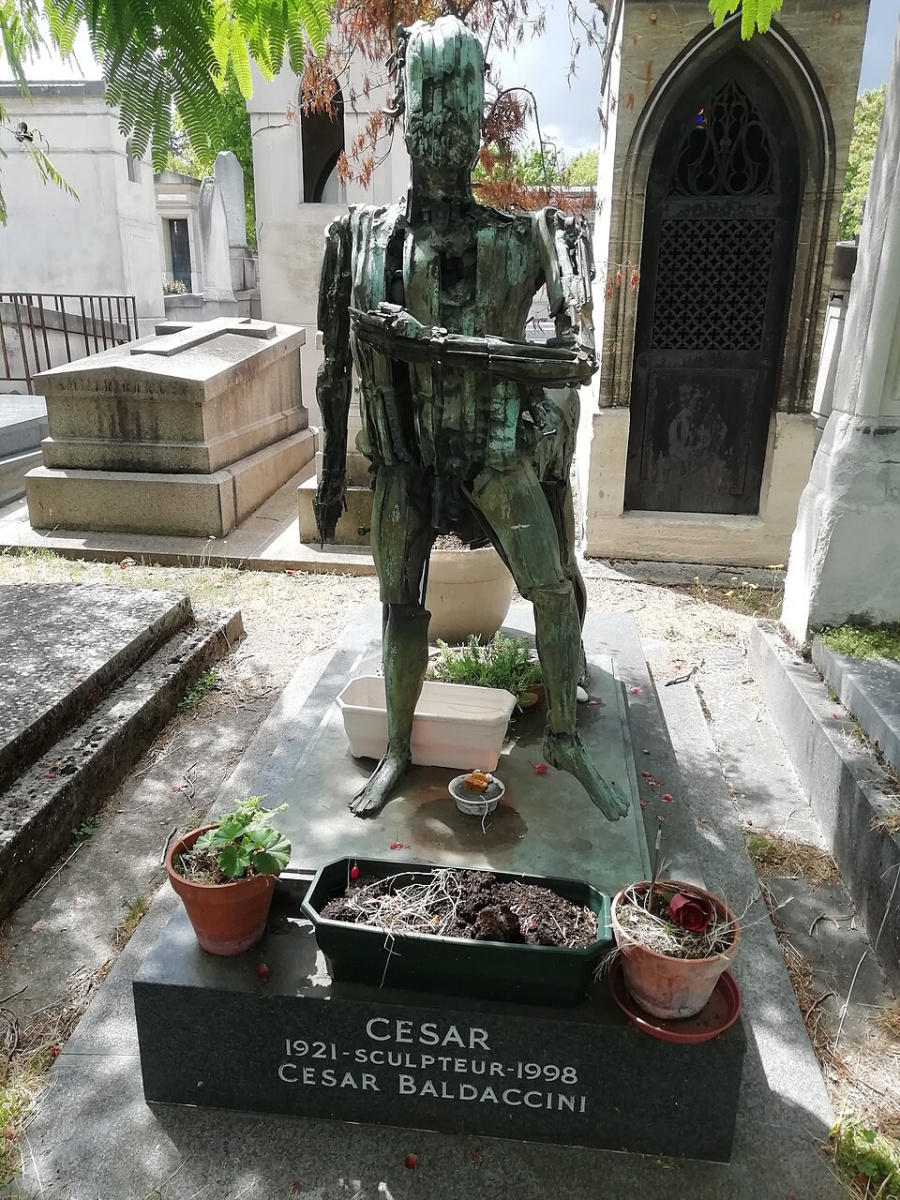
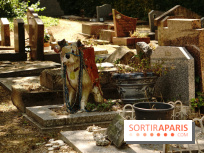
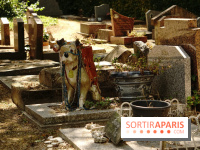
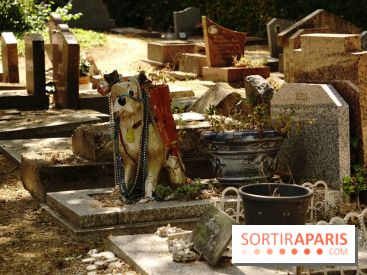
Half man, half horse, this strange guardian looks as though he stepped straight out of Greek mythology! Yet he really is at Montparnasse Cemetery, in Paris’s 14th arrondissement, where he has made his home. Perched atop a tomb, this imposing bronze centaur catches the eye of passersby. And with good reason: this unusual funerary sculpture stands guard over the final resting place of César Baldaccini (1921–1998), better known as César, the artist famed for his car compressions and monumental sculptures. But behind this fantastical creature lies a far more personal story than it might seem…
Amid the traditional funerary monuments, it is hard to miss this striking sculpture. A bronze centaur rests on a black granite plinth, its horse’s body extending into a human torso. In Greek mythology, centaurs are hybrid beings, often associated with a wild, untamable nature. This one, however, seems quite peaceful, as if quietly keeping watch over the grave.
But this is no ordinary creature! It is a scaled-down version of the Centaur, a work conceived by César himself in the 1980s. And on closer inspection, an astonishing detail emerges: the centaur bears the features of its creator!
One way for Caesar to remain forever present beside his own tomb? The idea is appealing, especially since this work held a very special place in his career.
The story of this sculpture began long before César’s death in 1998. In the 1980s, the sculptor set out to create a work in homage to Pablo Picasso, who died in 1973. To celebrate this master he admired, César chose to bring a mythological creature to life.
The choice of the centaur is no accident. Picasso himself had taken a keen interest in the figure of the Minotaur, a creature with the body of a man and the head of a bull. With its human torso and horse’s body, the centaur offers another meeting between man and animal.
But César takes the visual joke even further! Above his own face, he places a mask depicting Picasso, like a raised visor. In the creature’s hand, a dove also evokes the world of the Spanish painter and his famous symbol of peace.
The work thus becomes a meeting of two artists, united in a single character. An artistic tribute that takes on a particularly moving quality when discovered on Caesar’s tomb.
Born in Marseille in 1921, César Baldaccini established himself as one of the leading figures in 20th-century French sculpture. Associated with the Nouveau Réalisme movement, which emerged in 1960, he took part in a genuine artistic revolution. This movement, which also included Arman, Yves Klein and Jean Tinguely, sought to incorporate everyday objects and materials directly into works of art.
This would become César’s specialty. With his famous Compressions, he transforms car bodies and pieces of metal into compact sculptures. With his Expansions, by contrast, he makes the material swell and overflow. Not forgetting his monumental Thumb, which has become one of his most recognizable signatures. Does his name ring a bell? He also created the famous statuettes for the César Awards, presented since 1976!
What is less well known is that the centaur in the Montparnasse Cemetery has a big brother!
A monumental version, nearly five metres tall, stands on Place Michel-Debré, in Paris’s 6th arrondissement, near the Croix-Rouge crossroads. Titled The Centaur – Homage to Picasso, this striking sculpture features the same symbolic elements as the one that watches over Caesar’s tomb.
To see its funerary version, head to the 3rd division of Montparnasse Cemetery, accessible in particular from 3 Boulevard Edgar-Quinet. And if you catch the gaze of this strange creature, take a closer look. For behind its appearance as a mythological guardian, it is ultimately César himself who seems to keep watch over his work… for eternity!
This page may contain AI-assisted elements, more information here.