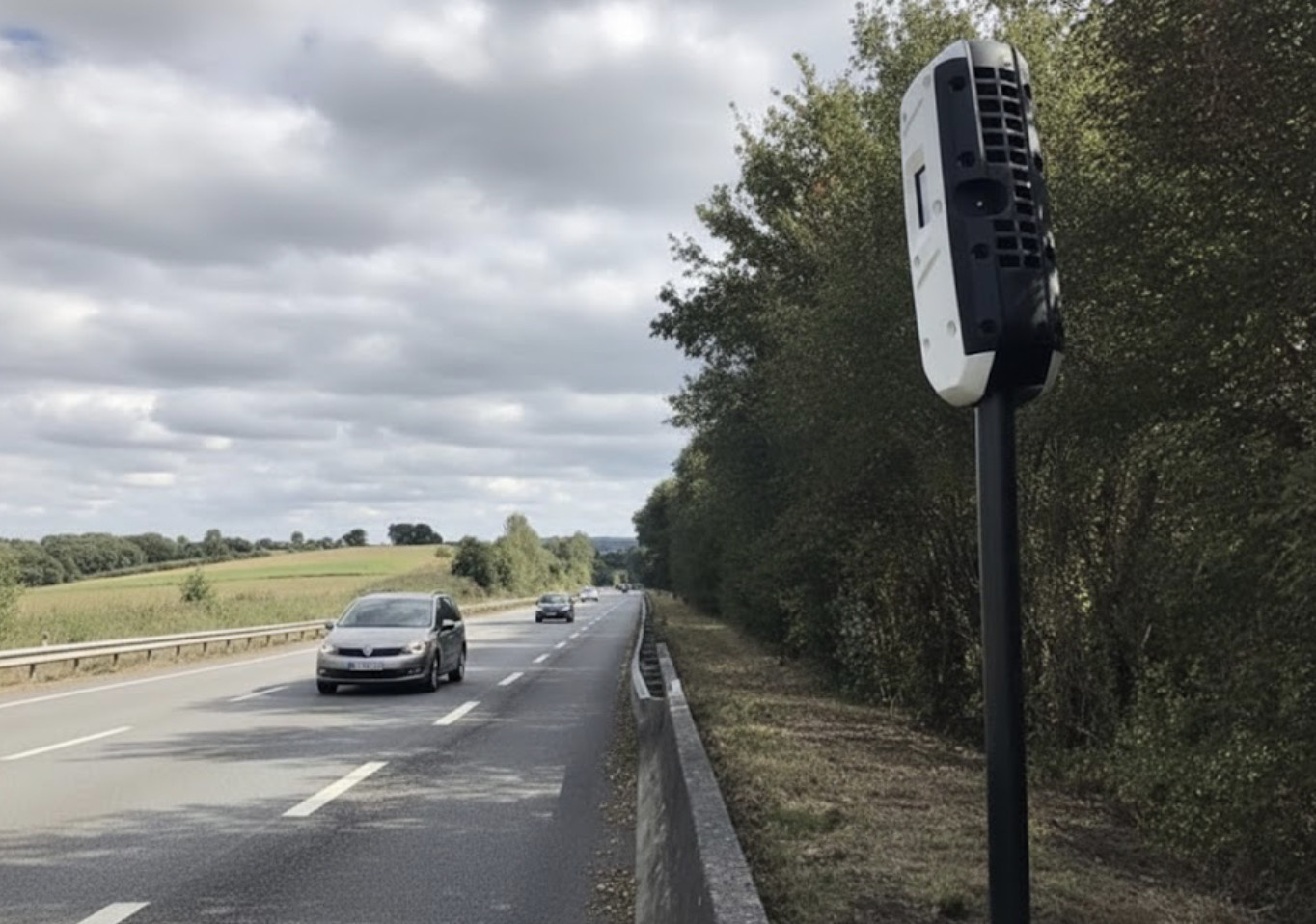
Be alert on the roads of Yvelines! Starting mid-January 2026, four speed cameras with towers in the department will participate in a nationwide trial marking the return of the flashing light. The Yvelines prefecture has confirmed this move, which involves three speed cameras and one red-light camera spread across the area. These next-generation devices, which until now operated invisibly via infrared detection, will now flash like their traditional predecessors — with the aim of educating drivers and improving safety.
Drivers familiar with the roads of Yvelines are well acquainted with these tall, gray towers that line the roadside. Since their introduction, these next-generation speed cameras have been quietly issuing fines—without any flashing lights or warnings to alert drivers. While this discreet approach certainly boosts enforcement effectiveness, it raises questions about prevention. How can motorists adjust their behavior if they only become aware of their infractions days later, when they receive their ticket in the mail? This is precisely the challenge this new pilot program aims to address.
The concept is straightforward: when a radar detects a traffic violation—whether speeding or running a red light—a bright flash goes off. This visual cue instantly informs the driver that they've been caught, while also alerting nearby road users, thereby enhancing overall alertness in the area. According to a survey of motorists, 46% of French people believe that a flashing light on speed cameras is preferable, and this figure rises to 50% among those who have already received a speeding ticket. The main reason cited? For 54% of supporters of the flash, it provides immediate confirmation that they've been intercepted by the radar.
The Yvelines prefecture has pinpointed the four locations involved in this testing phase. Three speed cameras are installed in the towns of Plaisir, Rambouillet, and Le Mesnil-le-Roi. Additionally, a red-light camera has been placed in Mureaux. The municipalities were notified in advance of this initiative, which is part of a nationwide strategy to modernize traffic enforcement.
These four municipalities were selected for their diverse features: major transit routes, accident-prone zones, or key intersections where adherence to traffic signals is often problematic. The turret radars installed at these locations can monitor multiple lanes at once and identify various traffic violations depending on their setup. To find the exact locations of these devices, we recommend consulting the official map of road safety radars.
Rest assured—or perhaps concerned, depending on your perspective—the light notifier does not alter how radar speed checks operate. Enforcement protocols remain exactly the same, the accuracy of the devices is unaffected, and violations are processed just as before. The flashing indicator is purely for informational purposes. It’s not an additional penalty tool, but simply a visual cue designed to promote immediate awareness.
Important to note: as with previous speed cameras, a flash does not automatically mean a fine will be issued. Certain situations can trigger the warning light without resulting in a citation—such as reading errors, minor speed excesses, or specific circumstances identified during data processing. The infrared detection system remains unchanged; only a visual warning has been added to the existing setup.
This test phase is scheduled to last an initial month, starting mid-January 2026. After this period, authorities will conduct a thorough review to assess how well the initiative is working. The evaluation will focus on several key factors: changes in driver behavior in the targeted areas, shifts in average speeds, effects on accident rates, and feedback from road users.
Based on the results collected in the Yvelines and other participating departments like Gard, which is also conducting similar tests, the government will decide whether to roll out the initiative on a larger scale nationwide. If the outcomes are promising, this new flashback system could be extended to all types of turret radars across France, and potentially even to urban speed cameras in major cities.
To stay updated on the progress of this trial and to learn the results of the testing phase, visit the Yvelines Prefecture’s website, where the findings will be published. In the meantime, we advise everyone to strictly adhere to speed limits and traffic signs throughout the department, as these new-generation cameras leave no room for offenders—whether they trigger an alert or not.
Dates and Opening Time
From January 15, 2026 to February 15, 2026
Location
Yvelines
yvelines
Official website
www.yvelines.gouv.fr