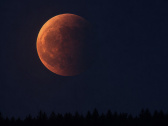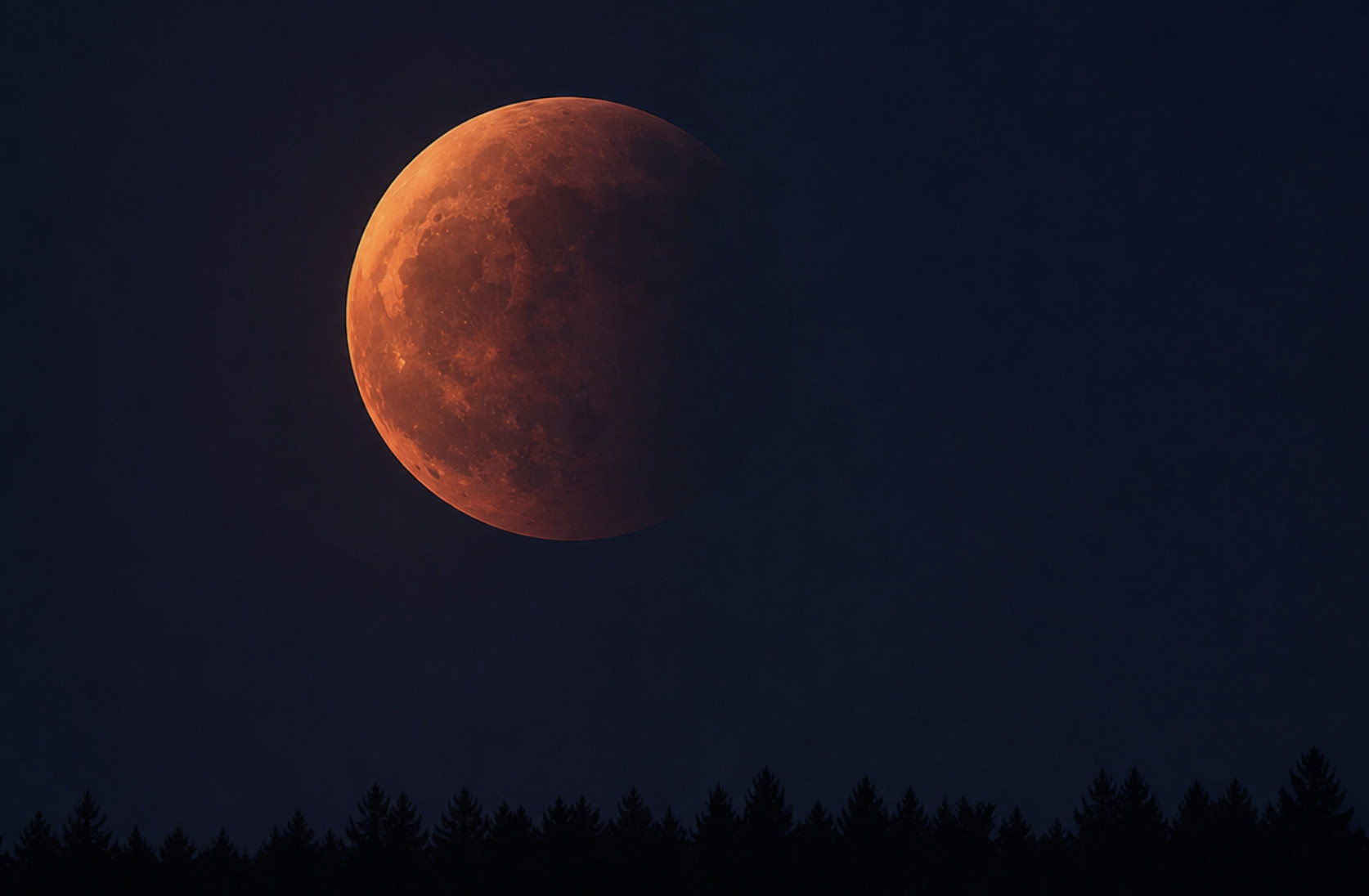
The partial lunar eclipse coincides with the Sturgeon Moon on the night of August 27–28, 2026: visible to the naked eye from Île-de-France, the Moon will take on a coppery-red hue, weather permitting after the storms.
The partial lunar eclipse is the late-summer astronomical highlight. In the night from Thursday 27 to Friday 28 August 2026, the Sturgeon Full Moon slips into Earth’s shadow and takes on a copper-red hue, a spectacle visible to the naked eye across mainland France, Paris and the Île-de-France (75, 77, 78, 91, 92, 93, 94, 95) included. One big unknown remains: the weather, as the region sits under an orange thunderstorm alert this Thursday.
A lunar eclipse unfolds as Earth slips between the Sun and the Moon, casting its shadow across its surface. This time the spectacle is striking: nearly 93 % of the Moon’s diameter will be engulfed in Earth’s shadow, pushing this partial eclipse to the cusp of a total one. These figures are confirmed by the IMCCE of the Paris Observatory and by the NASA.
Deprived of direct sunlight, the Moon doesn’t vanish entirely. Instead, it adopts a coppery red hue, that famous shade that evokes blood moons.
The name of the full Lune de l'Esturgeon comes from North American Indigenous traditions. It refers to the sturgeon of the Great Lakes, once abundant and easier to catch at this time of year.
There can be no mistake about the date: it’s tonight, the night of Thursday, August 27 to Friday, August 28, 2026, and in the dead of night. The first signs of the partial eclipse appear around 4:33 a.m., as a dark notch nibbles at the edge of the Moon.
The peak, meanwhile, is expected around 6h12-6h13, as dawn approaches. At that moment, the Moon will already be low on the western (southwest) horizon in Paris, at about 9 degrees above the horizon, before slipping toward the horizon as the sky brightens. It’s best to be set up a few minutes before 6h, facing west with a clear horizon.
The guiding principle is an unobstructed view to the west (more precisely, to the west-southwest). As the Moon rises only a few degrees above the horizon, even the smallest building, a line of trees, or a hill can hide it. So look beyond crowded city cores for a high point or a wide-open space.
Around Paris, several areas are ideal: the French Vexin, the Rambouillet Forest, the Saclay plateau, or the plains of Seine-et-Marne—these locations offer wider horizons and less light pollution. Be sure to scout your spot the night before and bring a pair of binoculars to better discern the coppery tint.
A reminder nonetheless: you only settle in after the storms have passed and the sky is clear. As long as the thunderstorm cells linger, stay sheltered and call off the outing.
Good news: not at all. Unlike the solar eclipse of August 12, a lunar eclipse poses no danger to the eyes. You can view it with the naked eye, without glasses or filters.
To distinguish craters and relief features, binoculars or a small telescope can make all the difference. And to give yourself the best chance, steer clear of city lights and seek a clear, unobstructed view toward the west.
That's the issue at stake. On Thursday, August 27, 2026, Paris and the entire Île-de-France region were placed under orange thunderstorm alert, according to Météo-France, with a risk of hail and gusts approaching 65 km/h in the afternoon and evening. During the event, stay indoors: this is not the time to go out and watch the sky.
The lull is expected from Thursday night into Friday. The sky should clear as the night wears on, giving a real chance to spot the Red Moon at dawn, once the storms have passed.
Before you set your alarm, keep an eye on the forecast and the local alert level for your area. If the thunderstorm cells linger, outdoor plans will be postponed and staying indoors will be preferred.
To follow real-time developments, the Météo-France Vigilance map remains the reference, alongside Météo-France’s forecasts. You’ll also find the details of the Île-de-France thunderstorm episode in our update on the orange alert for the region. Now we just wait for the dawn sky to brighten, fingers crossed.