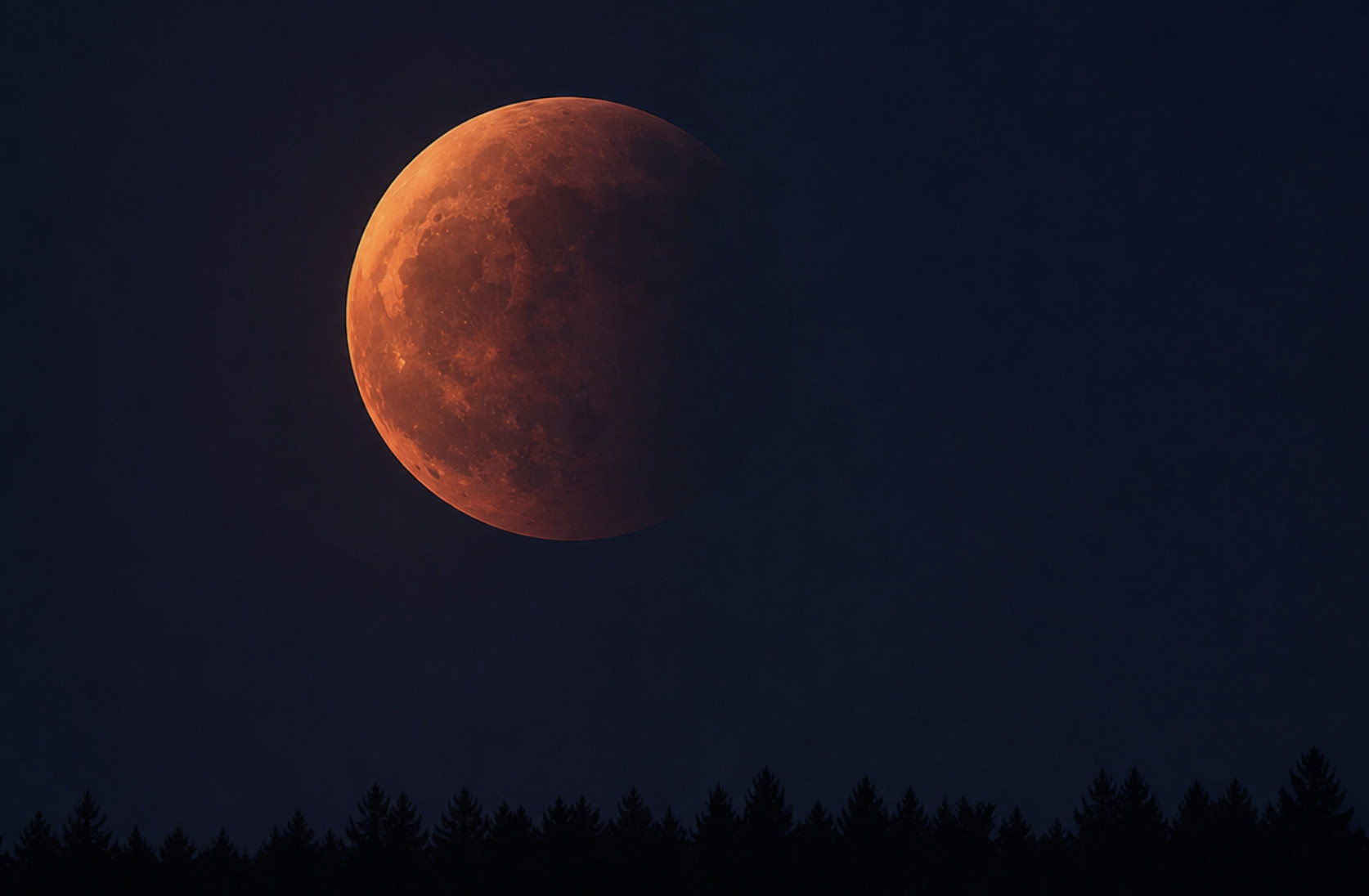
The Sturgeon Full Moon crowns the last major full Moon of summer and, in 2026, will treat observers over Île-de-France to a special sight. The rendezvous is set for Friday, August 28, 2026, with the full Moon peaking at 06:18 (Paris time). That night (from Thursday, August 27 to Friday, August 28), our satellite won’t just shine: it will partially plunge into Earth's shadow and take on a striking copper hue visible to the naked eye.
The name comes from the Indigenous peoples of North America, who lived around the Great Lakes. In August, the sturgeon — that giant prehistoric fish — swam upstream in abundance, and the season was especially good for catching it.
Others refer to the Green Corn Moon, the Grain Moon, or the Blueberry Moon, all nods to the first harvests at the end of summer. Each full Moon on the calendar thus bears a nickname inherited from the almanacs.
The Moon will be 100% full on August 28, 2026 at 06:18, but it already looks quite round by the evening before. For a casual observing session, the night of August 27 into 28 is ideal, with the Moon rising in the east at the start of the night.
The real highlight, though, comes at first light, when the eclipse takes the stage. That’s where the spectacle becomes truly exceptional.
The defining feature of this 2026 edition: the Sturgeon Moon rises straight into Earth's shadow. It yields a partial lunar eclipse that is unusually deep, one of the most pronounced of the decade.
At its peak, around 6:12 a.m. Paris time, more than 93% of the Moon's disc will be swallowed by the shadow, leaving only a thin bright edge on one side. Visually, the effect will resemble a total eclipse, even though technically it is a partial eclipse. The good news: unlike a solar eclipse, a lunar eclipse can be observed with the naked eye, without any protection. These figures are confirmed by the IMCCE of the Paris Observatory and by NASA.
It's the detail that makes the spectacle so fascinating: the hidden portion doesn't disappear into the dark, it shifts to a coppery red. It's sometimes referred to as the "Copper Moon," cousin of the famous "Blood Moon" seen in total eclipses.
The phenomenon is easy to explain. Even in Earth's shadow, a sliver of sunlight still penetrates our atmosphere before it reaches the Moon. Along the way, the air scatters the blue tones and only lets through the reds and oranges. The result: it’s as if the glow of all the planet’s sunrises and sunsets were suddenly projected onto the lunar disk. The more the atmosphere is laden with dust or clouds, the deeper the color shifts toward red.
One small caveat, though: in Île-de-France, it's a race against dawn. The partial phase starts around 04:33, but the Moon stays very low on the western horizon and sets shortly after 06:45, while the Sun rises around 07:01. In other words, you’ll need to rise early and aim carefully. And since the Moon will be grazing the horizon, its coppery hue is likely to be even more pronounced near the edge of the sky.
The guiding principle is a clear view to the west (specifically west-southwest). The Moon climbs only a few degrees above the horizon at the decisive moment: the slightest building, the faint line of trees, or a hill can obscure it. So skip the densely built city centers in favor of a high point or an open space.
Good news: the eclipse will indeed be visible from Paris, but under somewhat demanding conditions. At most, around 06:13, the Moon will be only about 8 degrees above the horizon, very low in the western sky. It’s a race against dawn, since the Sun rises around 07:01 and the Moon sets just before, still largely shrouded in shadow. Practically, to catch everything from Paris and the inner suburbs, you’ll want to be set up from 04:30–05:00 and aim for the 05:00–06:30 window, facing a perfectly clear western horizon.
Around Paris, several spots are well suited: the plateaus and countryside of the outer ring — the French Vexin, the Rambouillet forest, the Saclay plateau, and the plains of Seine-et-Marne — offer broader horizons and far less light pollution. Plan to scout your vantage point the night before, bring a pair of binoculars to better pick up the copper tint, and check the forecast: a few clouds on the western horizon can spoil the view.
Note, to prevent any confusion: a lunar eclipse poses no risk to the eyes. No special eyewear is necessary, unlike the solar eclipse of August 12 yesterday, where certified glasses (ISO 12312-2) were essential. Here, you simply observe the Moon, which reflects a fraction of the Sun’s light: naked-eye viewing is completely safe, and binoculars are only to enjoy more detail.
In the meantime, all we can do is hope for a clear night and set the alarm.