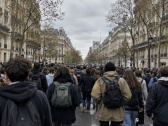
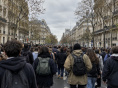
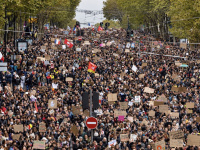
The October 31, 2026 demonstration in Paris will indeed take place along the Boulevards des Maréchaux. In a ruling issued overnight from Friday to Saturday, the Council of State overturned the administrative court’s decision authorizing the union march route between Place de la Bastille and Place de la Nation (the 11th and 12th arrondissements). It ruled in favor of the Interior Ministry, BFMTV has learned.
The gathering is authorized from 12 p.m. to 6 p.m. The inter-union coalition’s march sets off at 2 p.m. from Porte de Bagnolet (20th arrondissement) and heads to Porte de Charenton (12th arrondissement), along the route set by the Paris police prefecture on Friday morning.
On Friday evening, the prefecture initially suffered a clear setback. That morning, it issued an order banning the Bastille-Nation route declared by the CGT’s departmental union, deeming it incompatible with public order requirements, according to Public Sénat. Seized on an emergency basis, the judge suspended the order a few hours later.
The unions had anticipated this scenario. On Thursday, the CGT, FO, FSU and Solidaires, along with Fage, l'Union étudiante and Unef, had taken the prefecture to court in emergency proceedings to obtain the order as soon as possible and leave time to challenge it. They wanted to avoid a repeat of October 24, when the ban came too late to petition a judge.
The decision came during a busy week for the court, which had already suspended the curfew imposed on minors in several neighborhoods of the capital on Wednesday, October 28.
The response was swift. Following the court order, Interior Minister Laurent Nuñez announced that the Paris police chief was appealing. He justified the ban by citing the extensive damage caused on October 17 and the continued high risk of public disorder, reports franceinfo.
In urgent proceedings to protect fundamental freedoms, appeals are brought directly before the Council of State, France’s highest administrative court. After deliberating overnight, it overturns the administrative court’s ruling and rejects the trade unions’ request. The prefecture’s order therefore takes effect again, and the march is rerouted onto the Boulevards des Maréchaux.
For demonstrators, the march therefore starts at Porte de Bagnolet, served by Metro Line 3. The route then follows the eastern edge of Paris, passing Porte de Montreuil, Porte de Vincennes and Porte Dorée before reaching Porte de Charenton, on the border with Val-de-Marne.
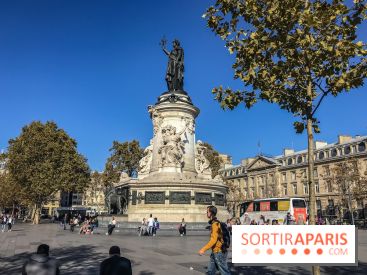
Friday evening’s legal battle concerns the trade union march. The prefect had also banned the route planned by the yellow vest coordination, from the Bastille to the Place de la Concorde via République and Opéra, and no court ruling on it had been made public at this stage.
The coordination had mentioned seeking an emergency court order or filing a complaint if its request was refused, as we explained in our article on the route sought by the Yellow Vests.
The order came from the highest levels of government. On Monday, October 26, in Marseille, Emmanuel Macron announced that marches would be held outside city centers following the looting on October 17, following the model of the routes laid out on October 24.
Police Prefect Patrice Faure was advocating a route along the Boulevards des Maréchaux, which was intended to avoid the city center and vandalism while still giving demonstrators visibility. He also cited the risk of a terrorist attack and the need to protect shopkeepers, according to Citoyens.com.
This decision was not universally popular, even beyond the périphérique. Hervé Gicquel, the LR mayor of Charenton-le-Pont (Val-de-Marne), did not want to see the march disperse at the edge of his town, between densely populated residential neighborhoods, the Bercy 2 shopping center and the Bois de Vincennes, according to Le Parisien.
The saga feels like déjà vu. On October 24, the Bastille–Nation route was approved by the police prefecture, then banned the night before in favor of a route between Porte d’Italie and Porte de Vincennes. We look back on the day in our article about the October 24 demonstration in Paris.
The government remains on alert. An interministerial crisis unit met on Thursday, October 29, ahead of a day that Interior Minister Laurent Nuñez describes as “very high risk.” In a letter to prefects seen by franceinfo, he focuses in particular on the evening, with calls to gather in public squares from 8 p.m. under the guise of Halloween.
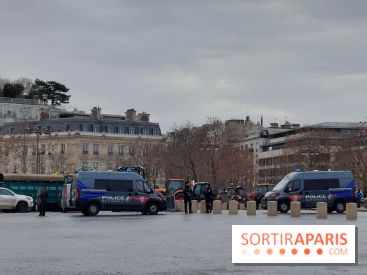
About 70,000 law enforcement officers are being deployed for the roughly 180 demonstrations expected across France, the same number as on October 24, according to franceinfo. RAID personnel will also protect the most vulnerable public buildings.
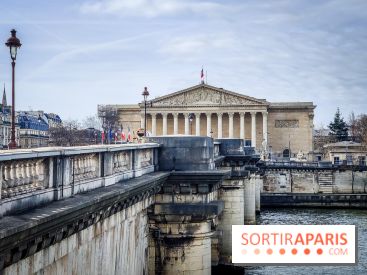
In Paris, all undeclared gatherings remain banned from 8 p.m. Friday to 6 a.m. Monday in several areas, including the Élysée Palace, the National Assembly and the Champs-Élysées, according to ICI Paris Île-de-France. Meanwhile, debate on the budget continues in the National Assembly.
The measure comes as the policing doctrine has come under heavy criticism since the start of student protests and demonstrations over the cost of living. The Lacrymos de sang collective also says it has gathered 9,500 accounts from women reporting menstrual problems after exposure to tear gas.
At the request of the Paris police prefecture, the RATP has announced that 40 Metro stations will be closed on Saturday, from the Champs-Élysées to Bastille, via République, Châtelet and the Left Bank. For a line-by-line and hour-by-hour breakdown, see our article on Metro, RER, tram and Vélib’ stations closed on Saturday. By comparison, on October 24, more than 30 Metro stations were closed.
With the march along the boulevards around Paris, keep an eye on the Porte de Bagnolet, Porte de Montreuil, Porte de Vincennes, Porte Dorée and Porte de Charenton stations. Tram lines T3a and T3b are also suspended from 11 a.m. on either side of Porte de Vincennes. Stations are often closed the night before or on the morning itself, so it’s best to check RATP traffic updates before setting out.
Our guide to the October 31 demonstration in Paris brings together the day’s practical information. The mobilization will continue afterward: Interfac IDF has announced a student march on Tuesday, November 3, from the Panthéon to Medef headquarters (7th arrondissement), ahead of the November 5, 2026 strike, for which the government also wants routes outside city centers.
Dates and Opening Time
On October 31, 2026
Places
Place de la Bastille
75011 Paris 11
Place de la Nation
Avenue du Trône
75011 Paris 11
Route planner
Accessibility info