In celebration of the centenary of Claude Monet’s death, the Orangerie Museum is hosting a comprehensive exhibition exploring how the Impressionist painter examined the concept of time throughout his career — from his early plein air paintings to the sweeping cycle of Water Lilies. The show runs from September 30, 2026, to March 29, 2027. Titled Monet and Time, it features nearly forty works, primarily borrowed from the collections of the Orsay Museum and the Marmottan Monet Museum. Supplemented by loans from both French and international institutions, the exhibition offers a fresh, interdisciplinary perspective on Monet’s work through the lens of temporality.
Recognized from the 1870s as a leading figure of Impressionism, Monet was an early pioneer of painting focused on capturing fleeting moments, characterized by quick brushstrokes, bright harmonies, and plein air techniques. His work reflects the profound changes of the 19th century—a period marked by a faster pace of life, the proliferation of clocks in public spaces, the synchronization of social rhythms, and the rise of transport. In this context, Monet’s paintings serve as a visual attempt to seize the present, to convey the ephemeral nature of light and the rapid transformations in both urban and natural landscapes.
Following his Impressionist exhibitions, Claude Monet deepened his exploration by depicting the same scene at different times of day and under changing weather conditions. This approach led him to develop his iconic series in Normandy, including The Haystacks, The Poplars, Morning on the Seine, and Rouen Cathedral. Created between the late 1880s and the late 1890s, these series exemplify Monet’s pursuit of capturing fleeting moments — pushing the concept of immediacy to the point of fragmenting time itself, in a quest to grasp its very essence through repeated renditions of the same motif.
The exhibition of the Rouen Cathedrals at Durand-Ruel in 1895 marked a turning point, one that Georges Clemenceau described as "a revolution without gunfire." This serial approach, resembling a nearly scientific observation of reality, reflects the era's fascination with the meticulous analysis of visible phenomena. The exhibition highlights this pivotal moment when Monet distills time into perceptible moments, foreshadowing the later works that would culminate in the Water Lilies.

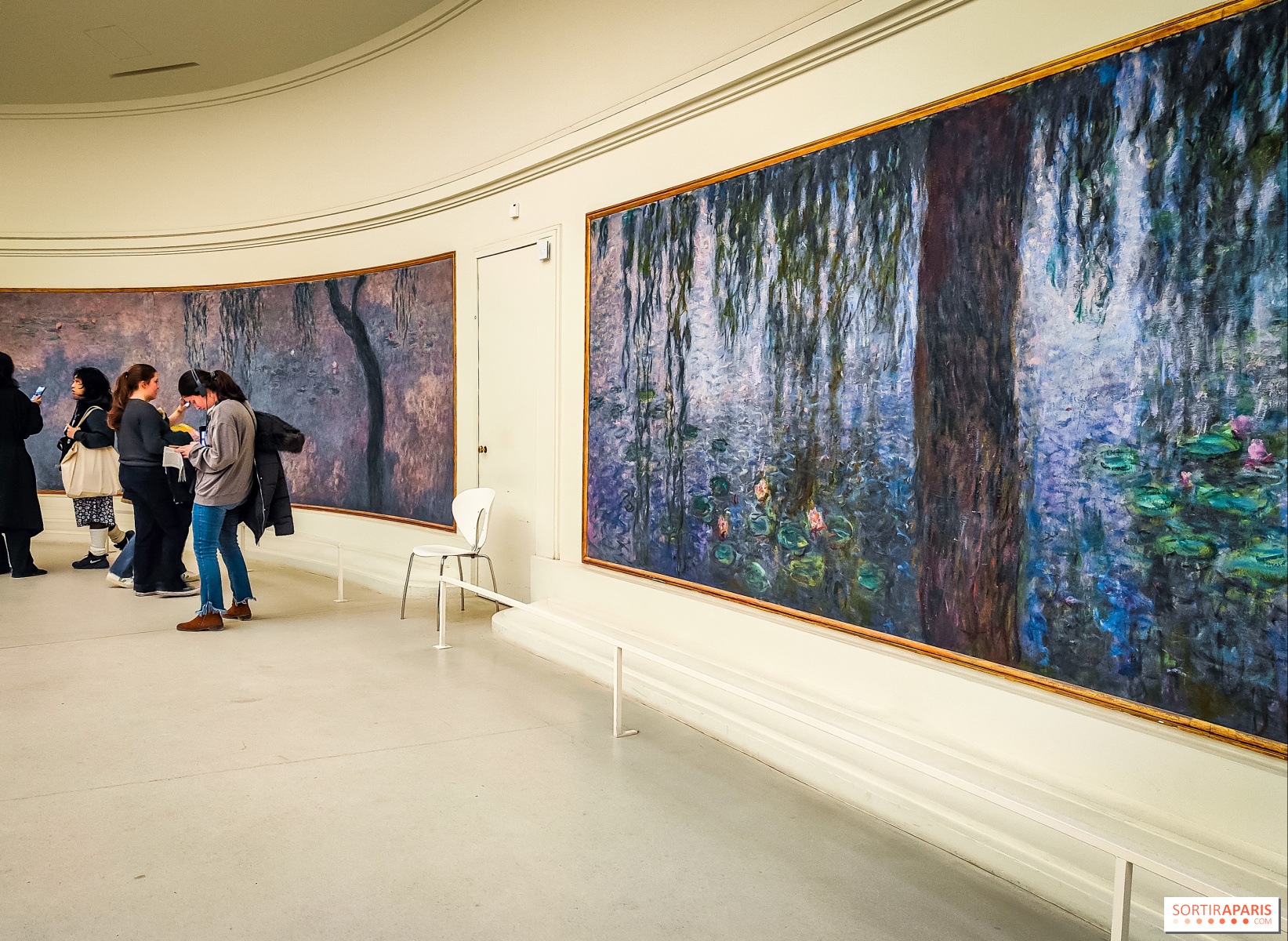
In the 1890s, Monet embarked on what would be the final major chapter of his career: the Nymphéas series. Over two hundred artworks were dedicated to this theme, culminating in the large-scale murals donated to France after the 1918 armistice and installed at the Musée de l’Orangerie. These monumental panels, unveiled in 1927—just a year after the artist’s death—represent the pinnacle of his exploration of time, transcending the idea of a series to create an immersive, flowing pictorial continuum.
The exhibition naturally finds its home at the Orangerie, which houses this exceptional collection—sometimes referred to as the "Sistine Chapel of Impressionism." The display invites visitors to explore the concept of duration, in Bergsonian terms, taking them on a gradual immersion into Monet's final works. No longer confronting a series of fragmented moments, viewers are enveloped in an experience where time appears to stand still.
Alongside the main exhibition, the museum offers a virtual reality experience titled Monet – Flowing Water. Lasting around twenty minutes, this immersive journey builds on the Obsession with the Water Lilies project, which was showcased at the Orangerie in 2018 and again in 2024. Equipped with a standalone headset, visitors are invited to travel from Argenteuil to Giverny, gliding from the Seine to the water lily pond, exploring how Monet sought to capture the fleeting nature of time through changing light, seasons, and water landscapes.
This experience also delves into more personal aspects of the painter's life, such as the creation of his garden in Giverny, his fascination with reflections, and his struggle with blindness — a journey that gradually pushed his work toward the borders of abstraction. Available in both French and English, it offers a unique sensory perspective for appreciating Monet's artistry.
With Monet and Time, the Orangerie Museum presents an in-depth reexamination of Claude Monet's work, highlighting how the painter responded to and questioned the upheavals of his era through the themes of capturing the moment, series, and duration. By bringing together some of his most iconic paintings alongside the large Nymphéas decorations in their original setting, the exhibition offers a richly coherent context to explore the evolution of Monet’s artistic journey. Mark your calendars for late 2026 for a journey through time... and art!
This page may contain AI-assisted elements, more information here.
Dates and Opening Time
From September 30, 2026 to March 28, 2027
Location
Musée national de l'Orangerie
Jardin Tuileries
75001 Paris 1
Access
Metro 1, 8 and 12, Concorde station
Prices
Tarif réduit: €10
Plein tarif: €12.5
Official website
www.musee-orangerie.fr
More information
Open from Wednesday to Monday, 9 a.m. to 6 p.m. Evening hours on Friday until 9 p.m.