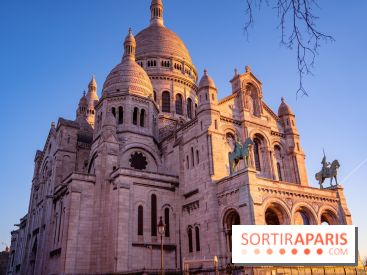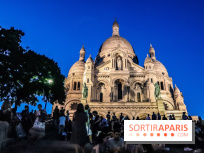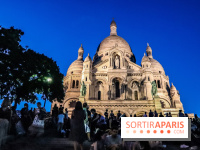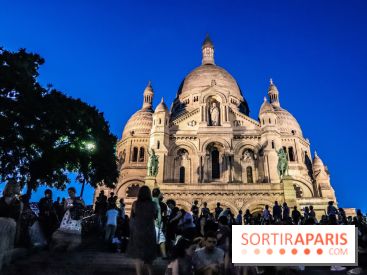
On Thursday, October 16, 1919, the church of the Sacré-Cœur de Montmartre was consecrated by Cardinal Amette, the Archbishop of Paris, in the presence of Cardinal Vico, papal legate, and elevated to the rank of basilica. The religious building, perched on the heights of the Montmartre hill, began in 1875 and would not be completed until 1923.
Throughout history, the Montmartre hill has been regarded by peoples as a place of worship, from the presumed earliest Gallic rites to the construction of the Saint-Pierre Church in the 12th century, an integral part of the royal abbey of Montmartre, passing by the beheading of Saint Denis in the 3rd century and the Gallo-Roman temples erected in honor of Mercury and Mars. For a bit of trivia, the name of the hill "Montmartre" would derive from Mons Martis ("mount of Mars"), reinterpreted over the years as Mons Martyrum ("mount of the Martyrs") and then Mont de Martre (martre meaning "martyr" in Old French).

September 4, 1870, the day the Third Republic was proclaimed, with France under the grip of the Prussian armies and Paris poised to be besieged any moment, a number of churchmen proposed building in the heart of the capital a sanctuary dedicated to the worship of Jesus Christ, intended to atone for France’s sins and put an end to what they saw as divine punishment in response to a century of decline that began with the 1789 Revolution.
The initiative, championed by philanthropist Alexandre Legentil, strikes a national chord, and together with his brother-in-law, the painter and Parisian notable Hubert de Fleury, Legentil sets in motion the plans for a edifice in tribute to Christ. The two gentlemen enlist the help of the National Assembly at the close of 1872, seeking official recognition of the church as being of public utility so as to secure the land needed—properties belonging to the city and numerous private owners.
In large part royalist, conservative, and Catholic, the National Assembly, elected in February 1871, votes by a majority for the public utility law on July 24, 1873. For many, this decision was taken to atone for the crimes committed during the Paris Commune and thus to establish the new "moral order" of a clerical France promoted by conservatives.
Indeed, the Montmartre hill is considered the starting point of the insurrection populaire de la Commune, from March to May 1871, with the famous "cannon affair." Even today, many Parisians believe that the Sacré-Cœur was "built on the blood of the Communards". Hubert de Fleury, himself, stated during the laying of the cornerstone of the building : "It's where the Commune began, where Generals Clément-Thomas and Lecomte were murdered, that the church of the Sacré-Cœur rises! We recall this hill dotted with cannons, traversed by drunken ruffians, inhabited by a population that seemed hostile to any religious idea and that the hatred of the Church seemed to fuel above all."
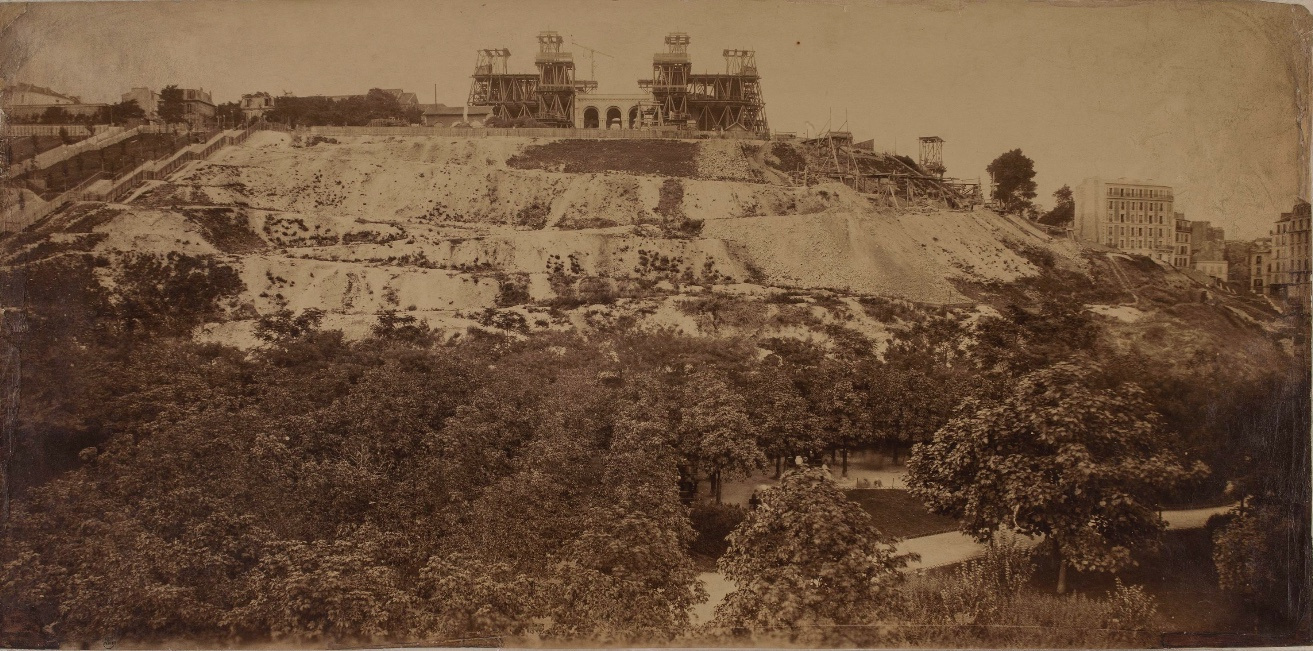
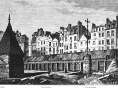
The law of July 24, 1873 thus opens the door for Monsignor Guibert, the Archbishop of Paris, to acquire the land on the Montmartre hill by means of expropriation, if necessary. Until then, the parcels behind the Saint-Pierre Church were occupied by guinguettes, small gardens, and a fairground. That same year, the committee of the Œuvre du Vœu National and the Archbishop of Paris organized a competition to select the architect for the project.
Candidates are faced with a set of requirements: the site on Montmartre hill, a budget capped at 7 million francs, the inclusion of a crypte, and the display of a statue monumentale du Sacré-Cœur that can be seen from afar and is positioned outside the building. It is architecte Paul Abadie who wins the competition over 77 other proposals, some led by renowned architects and previous Grand Prix de Rome laureates. Abadie envisions a basilique romano-byzantine featuring all the traditional splendor—dome, cupolas, and a campanile—in order to distinguish it from the neo-Baroque style then in vogue.

Honoré Daumet took over from Paul Abadie following his death in 1884; and he was himself succeeded by Charles Laisné, who brought in the painter-glazier Émile Hirsch to craft the stained glass windows. A succession of architects would follow, including Henri-Pierre Rauline, Lucien Magne, and Jean-Louis Hulot.
The construction of the building was made possible by the generosity of numerous worshippers, notably through the Souscription des Pierres which invites families to contribute the amount needed to purchase a stone, a column, or a chapel, on which the donors’ full name, initials, or coat of arms are engraved. In total, nearly 46 million francs were raised in half a century thanks to gifts from around 10 million worshippers.
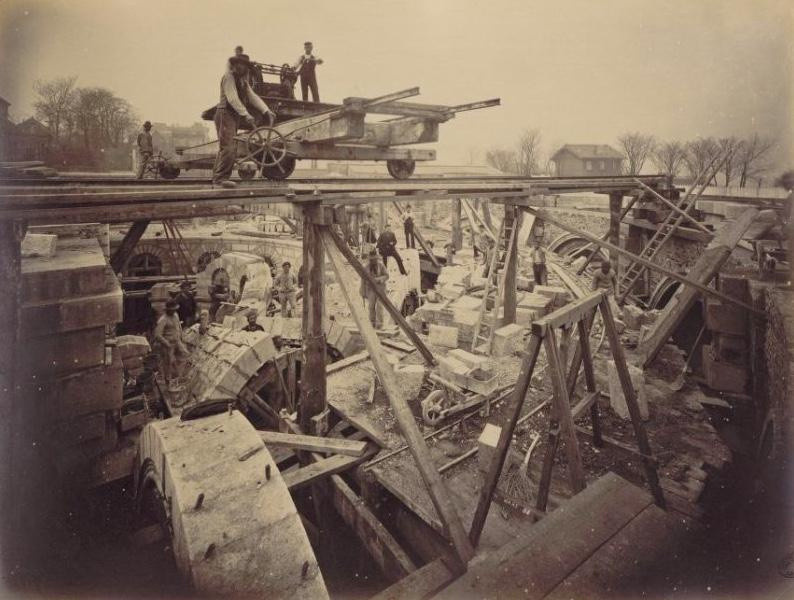
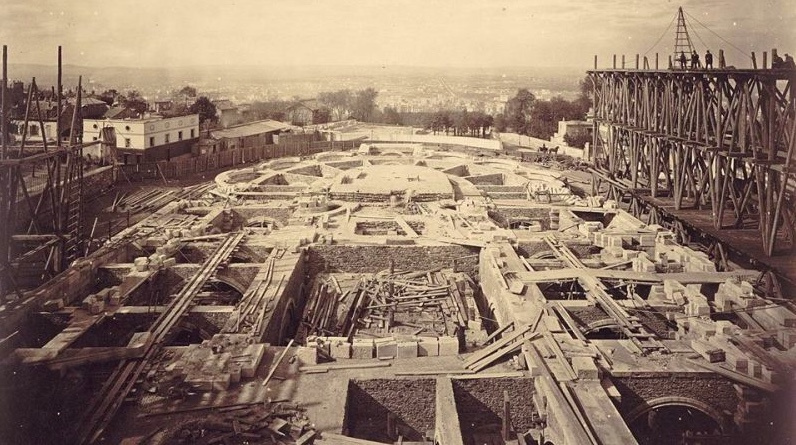
The first travertine stone, a white rock with an extremely fine grain that lightens when wet, was laid on June 16, 1875 by Cardinal Guibert, Archbishop of Paris, just a stone’s throw from the old Moulin de la Galette. Eighty-three wells, each 33 meters deep, were filled with concrete to shore up the foundations, while 35,000 cubic meters of loose earth were replaced with stone and cement. Less than a year later, a provisional chapel was inaugurated beside the works.
Construction of the crypt begins in 1878, and in 1881 that of the basilica follows. The interior of the nave is inaugurated on June 5, 1891, at a moment when the Third Republic, fundamentally anti-clerical, seeks to turn the religious building into a house of the people or a theatre. Straying somewhat from Paul Abadie's initial plans, architects Rauline and Magne add Neo-Renaissance elements to the whole, such as elongated cupolas and slender domes.
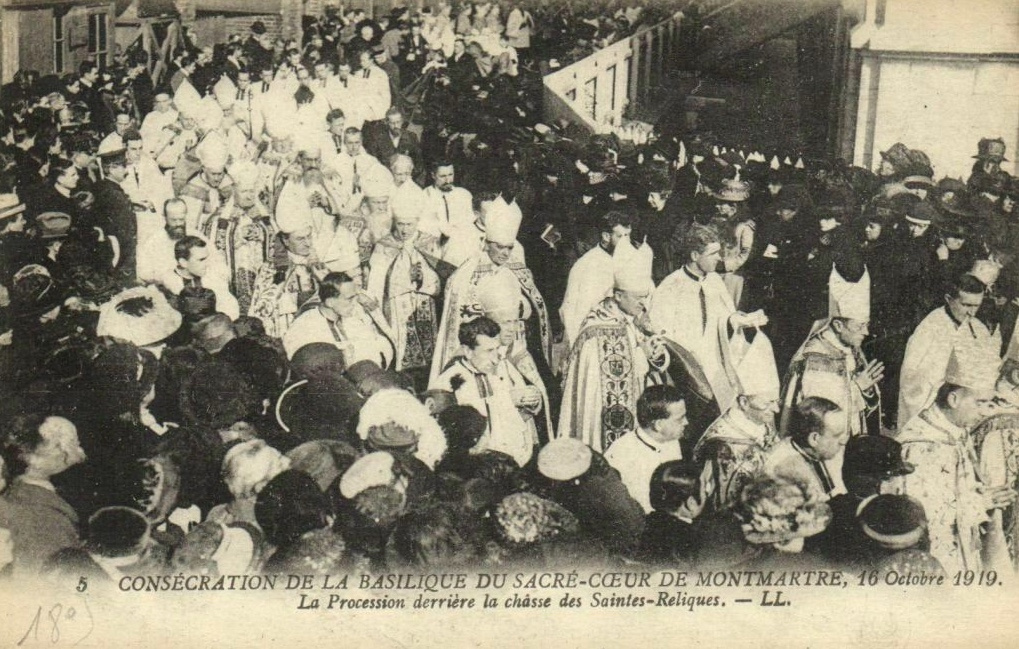
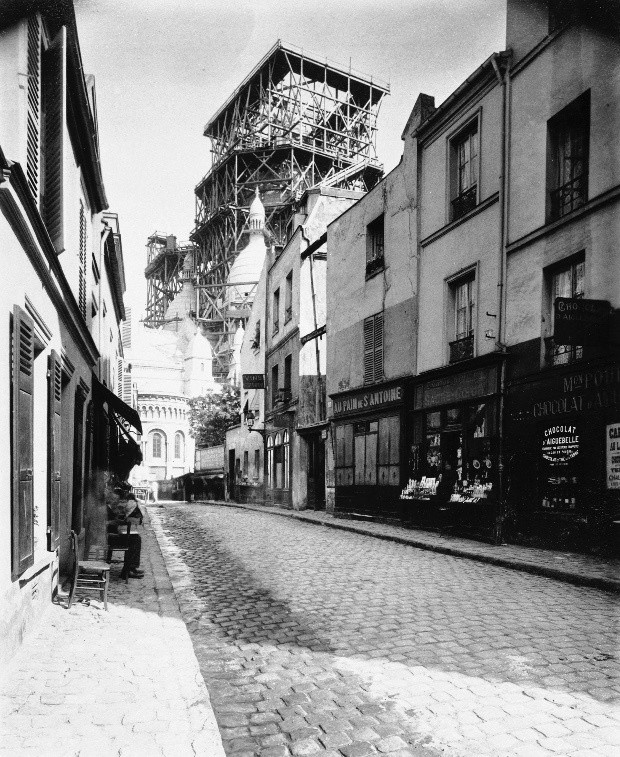
As the church's consecration was due to take place on October 17, 1914, France's entry into the war postponed the event. Moreover, the work was far from finished. It wasn't until 1912 that the campanile, towering 91 meters high, was completed, and 1914 for the entire façade to be finished.
It was on Thursday, October 16, 1919, that the Sacré-Cœur church was consecrated by Cardinal Amette, archbishop of Paris, with Cardinal Vico, the papal legate, presiding, and in the company of numerous bishops, church dignitaries, clergy, civil authorities and ordinary faithful; and raised to the rank of basilica.
Officially completed in 1923, the construction of the Sacré-Cœur continued into the 1930s with the addition of annexes, offices, dormitories, and the sacristy. The stained-glass windows, installed between 1903 and 1920 and destroyed during World War II, were later replaced with contemporary glass.

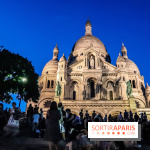
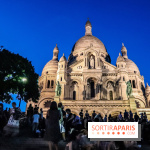
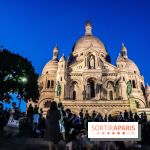
Outside the Sacré-Cœur, passing tourists and Parisian revelers can still glimpse a Romanesque- and Byzantine-inspired architectural style, a central dome rising 83 meters high that, until the Eiffel Tower was built, was Paris’s tallest point, the campanile housing France’s largest bell, and several statues including Joan of Arc, the Christ statue with the Sacred Heart on its chest, and Saint Louis, sword in one hand and the crown of Christ in the other.
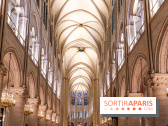
Inside the basilica, the choir vault catches the eye with its decoration: the largest mosaic in France depicting the Sacred Heart of Jesus, surrounded by the Virgin Mary and Saint Michael, and kneeling, Pope Leo XIII and Joan of Arc, created in Briare enamels by the Parisian mosaicists of the Guilbert-Martin Workshop between 1918 and 1922. More than a dozen chapels line the nave, while the great organs, installed in 1919, remain in place. In the basement, the crypt houses tombs, several chapels, as well as statues of saints and the Virgin.
Further reading:
Sacré-Cœur de Paris, the must-see basilica atop Montmartre hill
The Basilique du Sacré-Cœur is one of Paris's must-see monuments. But how much do you know about its history and treasures? We'll take you on a tour of this edifice perched atop the Butte Montmartre, and take a look at what's happening there at the moment! [Read more]
The Sacré-Cœur Basilica in Montmartre is open free of charge every day and hosts several daily masses. The services are accessible to all, believers and non-believers alike, but they should not be seen as a way to bypass the visitors’ wait. Here’s what you need to know before you push open the basilica's doors. [Read more]
Dominating Paris from the Butte Montmartre, the Sacré-Coeur dome offers one of the capital's most spectacular panoramas. A spiritual and architectural symbol, it is as captivating for its history as it is for the 360° view it affords visitors ready to climb its 300 steps. [Read more]
Can you visit the Sacré-Cœur with a stroller? How to avoid the stairs to reach the basilica, and can you climb the dome with small children? A family outing to Montmartre requires a few precautions, especially with a baby. Funicular, stroller, 280 steps to the dome, no elevator, and free access to the basilica: here’s what you need to know before you go. [Read more]
The Sacré-Coeur is the jewel of Montmartre, fascinating visitors with its colossal dimensions and distinctive architecture. But how much do you really know about it? We reveal three unusual facts about the Sacré-Coeur. [Read more]
The Sacré-Coeur, the emblematic monument that dominates Paris from the top of the Butte-Montmartre, is distinguished by its astonishing architecture and dazzling white stones. And do you know the secret behind the Basilica's whiteness? [Read more]
Since 1885, the Basilica of Sacré-Cœur in Montmartre has been offering hostel-style overnight stays starting at just 15 euros in Paris’s 18th arrondissement. This unconventional experience is available year-round—except on Good Friday—and comes with a surprising twist: guests take part in an hour of nocturnal prayer. [Read more]
Dates and Opening Time
On October 16, 2026
Location
Basilica of the Sacred Heart of Montmartre
35 Rue du Chevalier de la Barre
75018 Paris 18
Route planner
Access
Metro Jules Joffrin (Line 12) Pigalle (Lines 12 and 2) Anvers (Line 2)
Official website
www.sacre-coeur-montmartre.com
More information
Iconographies :
Header: Louis-Emile Durandelle, 1882
Square Saint-Pierre, Louis-Emile Durandelle, 1877
Louis-Emile Durandelle, 1882
Construction of the Sacré-Cœur, circa 1884, Anonymous, Musée Carnavalet
The scaffolding of the Sacré-Cœur from Place Saint-Pierre, Hippolyte Blancard, Musée Carnavalet
The construction of the Basilica of the Sacré-Cœur in Montmartre, view taken from Rue du Chevalier-de-la-Barre, Eugène Atget, Musée Carnavalet
Consecration of the Basilica of the Sacré-Cœur
Basilique du Sacré-Cœur de Montmartre. View taken from 53, Rue du Chevalier-de-la-Barre, Eugène Atget, Musée Carnavalet























 Sacré-Cœur de Paris, the must-see basilica atop Montmartre hill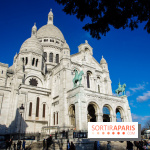
 Can you visit the Sacré-Cœur without waiting in line? Yes—provided you respect the site.

 The Dome of the Sacré-Coeur Basilica: the view from the Butte Montmartre, practical information


 Visiting the Sacré-Cœur in Montmartre: everything you need to know to discover it with your family
 Did you know? 3 unusual facts about Sacré-Cœur


 Did you know? You can actually sleep close to the Sacré-Cœur in Paris for just 15 euros… but there’s a catch.