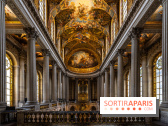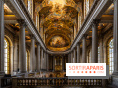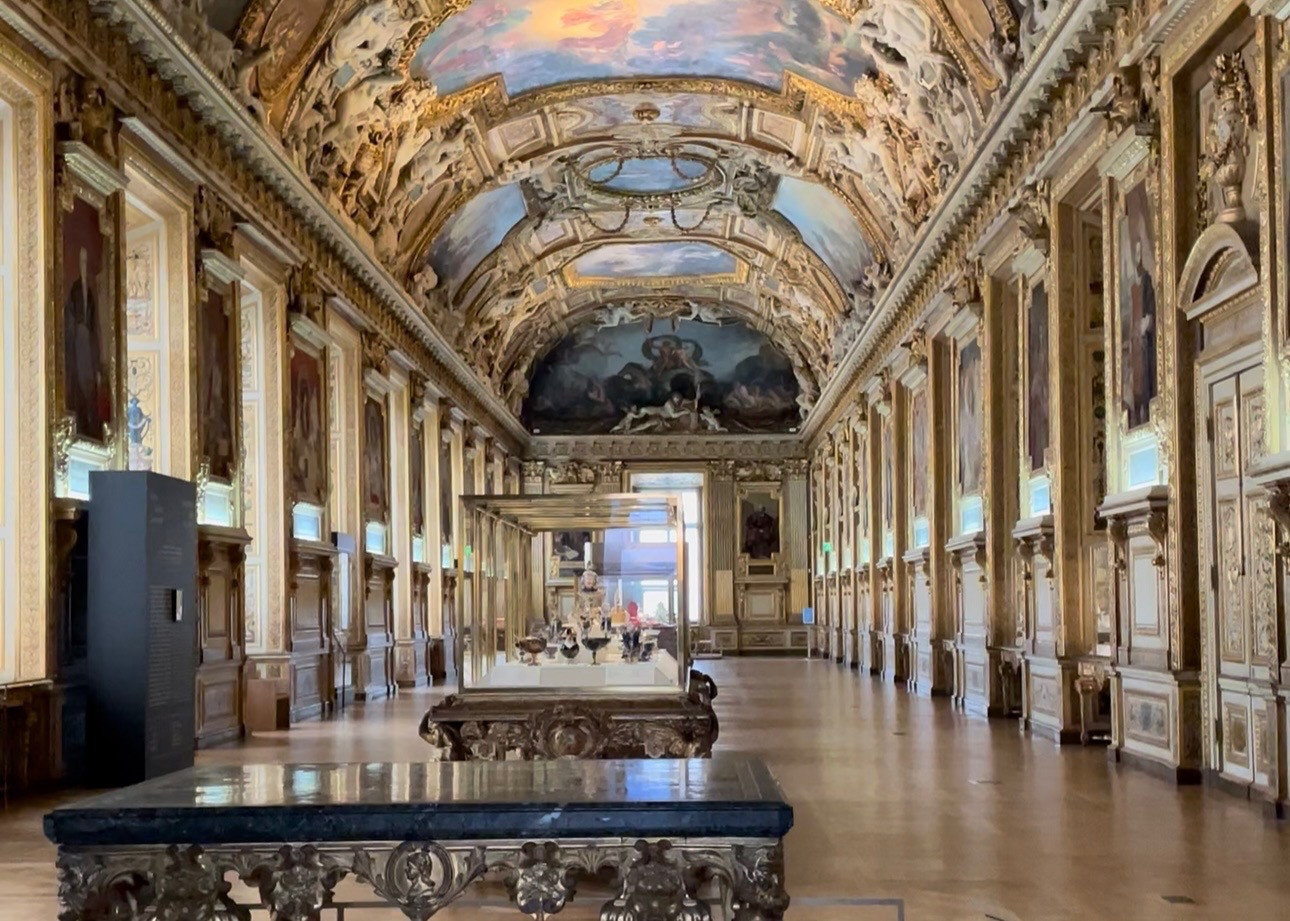
When people speak of Louis XIV’s splendor, the Gallery of Mirrors at the Palace of Versailles is the image that immediately comes to mind. Yet few visitors realize that this iconic room has a Parisian elder sister. Long before Versailles, the young Sun King had the Museum of the Louvre host the Gallery of Apollo, a masterwork that laid the foundations for what, a few years later, would become the kingdom’s most famous decor.
The story begins in 1661 when a fire destroys part of the Petite Galerie du Louvre. At just 23, Louis XIV decides to turn the disaster into an opportunity. He entrusts the reconstruction to architect Louis Le Vau, while Charles Le Brun, the King’s First Painter, envisions an entirely redesigned setting.
The sovereign has just chosen the sun as his personal emblem. The motif emerges naturally: the new gallery will be dedicated to Apollo, the Greek god of the Sun, light, and the arts. In mythology, Apollo embodies order, harmony, and radiance. By aligning himself with this deity, Louis XIV asserts his aim to place his reign at the heart of the political and artistic universe.
The Apollo Gallery is much more than a ceremonial reception hall. It marks the first grand staging of Louis XIV's power. Charles Le Brun conceived an immense decorative program in which the ceiling chronicles Apollo's daily journey in his chariot across the heavens. Around this central scene revolve the seasons, the months, the hours, the continents and the zodiac signs. The whole ensemble extols the sun's grandeur, on which the order of the world depends… a transparent metaphor for royal authority. This fusion of architecture, painting, sculpture and gilding was entirely innovative at the time. For the first time, all the arts dialogue to serve a single political narrative: to glorify the king.
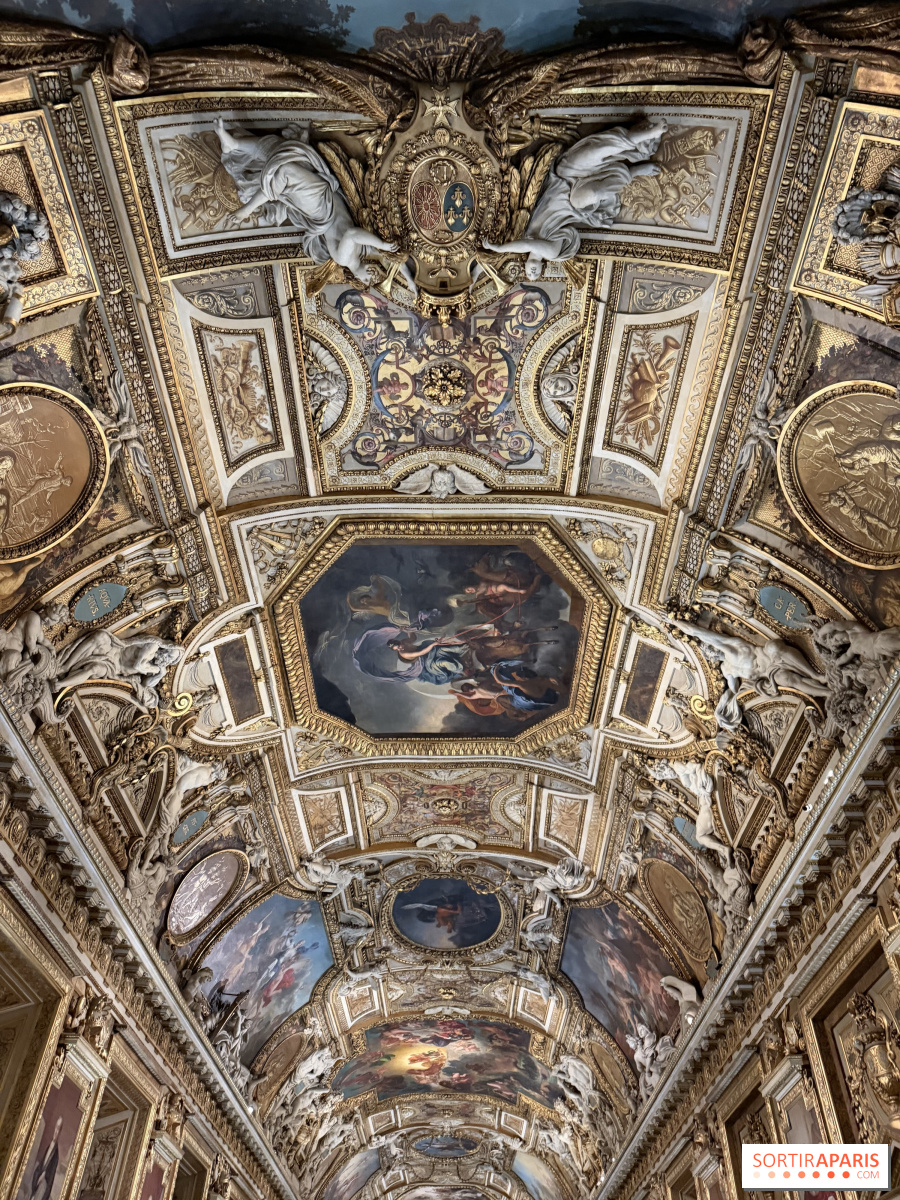
That is why the Apollo Gallery is considered the ancestor of the Hall of Mirrors. The artists who work at the Louvre would then accompany Louis XIV to Versailles. Louis Le Vau, Charles Le Brun and several sculptors and decorative artists would reuse the principles tested in the Apollo Gallery to design the future Hall of Mirrors. The Louvre thus becomes a true laboratory where the language of French classicism is developed.
When the court makes Versailles its permanent home, work on the Apollo Gallery is halted. All efforts are redirected to the construction of the new royal palace, where the ideas developed at the Louvre take on an even more spectacular scale.
The two galleries immediately strike with their decorative richness: painted vaults, abundant gilding, monumental sculptures, and a clear aim to wow visitors. Yet they tell two different stories. In the Apollo Gallery, Louis XIV still chooses to express himself through myth, letting the figure of Apollo—the Sun incarnate—stand in for him.
In Versailles, a few years on, that caution fades away. In the Hall of Mirrors, Charles Le Brun gradually abandons allegory in favor of a much more direct celebration of the sovereign’s political and military victories. The ceiling now portrays the real successes of Louis XIV’s reign rather than a mythological tale.
This evolution marks the rise of the Sun King: from a young monarch still shaping his image, he becomes a sovereign whose deeds are enough to convey his grandeur. Yet the fate of the Apollo Gallery experiences a long hiatus. When Louis XIV finally leaves Paris for Versailles, the project remains unfinished for nearly two centuries.
It was only in the 19th century that architect Félix Duban revived the project. He enlisted Eugène Delacroix, a towering figure of French Romanticism. This movement, which prizes emotional expression, bold color, and dynamic composition, stands in sharp contrast to 17th‑century classicism. Delacroix then painted the spectacular central ceiling titled Apollon vainqueur du serpent Python, now regarded as one of his monumental masterworks. This meeting between Louis XIV’s classicism and Delacroix’s Romanticism endows the gallery with a unique artistic richness.
This page may contain AI-assisted elements, more information here.