Paris, September 27, 1822. Before the members of the Royal Academy of Inscriptions and Belles-Lettres, one of the five academies that today comprise the Institut de France, Jean-François Champollion presents the results of a body of work to which he has devoted a large part of his young life. He does not bring a simple alphabet that would mechanically replace a hieroglyph with a letter: what he is beginning to uncover is far more complex. The writing of the ancient Egyptians can involve phonetic signs, but also figurative or symbolic signs.
That day, Champollion unveiled the foundations and the core elements of his système, based on an initial text accompanied by tables of correspondence. His demonstration would lie at the heart of the famous Letter to Mr. Dacier concerning the alphabet of phonetic hieroglyphs, published a few weeks later. Egyptology as a scientific discipline was crossing one of its foundational milestones.

The problem Champollion set out to solve is enormous. Knowledge of the hieroglyphic writing had gradually vanished after the end of antiquity, and for centuries European scholars often treated Egyptian signs as mysterious symbols that conveyed ideas directly. The landscape changes with the Bonaparte's Egyptian expedition, and especially with the 1799 discovery of the Rosetta Stone! The fragment bears the same decree in three scripts: hieroglyphic, demotic, and Greek. With Greek being perfectly readable, the stone offers an exceptional point of comparison. Yet it provides no immediate solution: first, we must understand how the two Egyptian scripts actually function.
Champollion was, in fact, neither the first nor the only one to tackle the challenge. Silvestre de Sacy and the Swedish Johan David Åkerblad broke ground on Demotic, while English scholar Thomas Young made decisive strides. In studying the Rosetta Stone, Young showed that some signs in the cartouche of King Ptolemy carry a phonetic value. Champollion was aware of these efforts, studied them, and gradually built on them. The rivalry between the two men would later fuel a long controversy over who deserved credit for the decipherment, but reducing history to a Franco-British duel would be misleading: the breakthrough of 1822 rests on a chain of investigations that Champollion ultimately cast in a far more universal light.

His greatest strength lies in his command of the Coptic, the language that stems from ancient Egyptian and is mainly written with the Greek alphabet. Champollion is convinced that this Egyptian Christian tongue preserves the traces of the language spoken by the pharaohs’ subjects. This hunch lets him do more than map graphic equivalents—he strives to uncover behind the signs a true language in its own right, with its sounds and vocabulary. By 1821, his work on hieratic and demotic scripts had already brought him closer to the overall workings of the Egyptian writing system. The following year, freshly accessible documents unlock a whole new level of progress for him.
Among them is a replica of an inscription from the Philae Obelisk, of which a cartouche can be linked to the name Cleopatra. Champollion thus has two royal Greek names, Ptolemy and Cleopatra, sharing several common letters. By comparing the signs placed at identical positions in the two names, he progressively verifies their phonetic values. Other cartouches of Greek and Roman rulers (Alexander, Berenice, Caesar, Tiberius, or Trajan) reinforce his demonstration. What might still look like a string of coincidences becomes a coherent system. The Letter to M. Dacier will be precisely devoted to this "alphabet of phonetic hieroglyphs" used to transcribe the names and titles of the Greek and Roman rulers.

But one snag remains: do these results apply only to foreign names? If the Egyptians were slow to invent phonetic signs to spell “Ptolemy” or “Cleopatra,” the discovery still isn’t decisive. Champollion must show that the principle goes much further back. He then turns his attention to the cartouches of pharaohs predating Greek domination. In September 1822, studying reproductions, notably from Abou Simbel, he is able to identify royal names such as Ramsès. The phonetic signs were not added to Egyptian writing simply to transcribe the names of Greek conquerors: they belong to the système hiéroglyphique itself.
Around this breakthrough was born one of the most famous scenes in the history of science. According to the account passed down by the Champollion family, the savant is said to have rushed to his brother Jacques-Joseph at 28 Rue Mazarine, crying out: "I’ve got it!", before collapsing from exhaustion and staying in bed for several days. The episode is traditionally dated September 14, 1822, but historians today urge caution: it belongs in part to the legend that grew up around the decipherer. What is certain, however, is that Champollion completed the outline of his results a few days later. The Letter to Mr. Dacier is dated September 22, 1822.

Five days later, the showdown with the scholars is underway. On September 27, Champollion appears before the Académie des inscriptions et belles-lettres. The scene is often told as a solemn reading of the Lettre à M. Dacier (named for Bon-Joseph Dacier, historian and perpetual secretary of the Academy). The Academy’s archives offer a more nuanced picture: in keeping with the institution’s customs, Champollion presents a first draft of roughly eight pages, largely made up of tables of correspondence, which the members had been able to examine in advance. Thomas Young is then in Paris and attends the session, lending the day a special resonance as the two scholars are closely tied to the history of decipherment.
Champollion’s breakthrough, however, does not unlock all the mysteries of the hieroglyphs in a single afternoon. His 1822 letter focuses mainly on the phonetic signs used in royal names. He still has to understand and lay out the entire mechanism of Egyptian writing. This is what he elaborates in his A Precise Outline of the Hieroglyphic System of the Ancient Egyptians, published in 1824. In it, he asserts the deeply mixed character of this writing, capable of linking signs that represent objects or ideas, signs bearing phonetic value, and determinatives that clarify a word’s meaning. The hieroglyphs are therefore neither a purely symbolic script nor an alphabet like ours, and it is precisely this combination that had made them so hard to decipher.

The discovery rapidly reshapes the study of the Ancient Egypt. Inscriptions on temples, tombs, statues and papyri gradually stop being viewed as mere decoration or as esoteric puzzles; they become historical documents that can be read, cross-checked and dated. Names of rulers, titulatures, religious and administrative texts begin to reconstruct a civilisation through its own writings.
Champollion himself drives this project forward: appointed in 1826 as curator of the new Egyptian monuments division at the Louvre Museum, he finally heads for Egypt in 1828, where the direct reading of monumental inscriptions lets him test his system on the ground. In 1831, a chair in Egyptian archaeology is created for him at the Collège de France. Yet his career would be short-lived: worn out and ill, he dies in Paris on March 4, 1832, at the age of only 41.
Further reading:
Can you enter the Académie française? How to visit the Institut de France and admire its dome
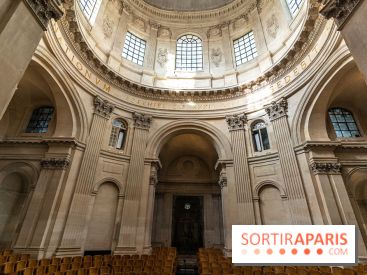
Installée sous le célèbre Dôme de l’Institut de France, l’Académie française figure parmi les institutions les plus prestigieuses du pays. Derrière ses portes se cache une histoire de près de quatre siècles, une bibliothèque exceptionnelle, des traditions immuables et des séances où se dessine l’évolution de la langue française. Découvrez les coulisses de ce lieu emblématique... et les rares occasions de le visiter ! [Read more]
This page may contain AI-assisted elements, more information here.
Dates and Opening Time
On September 27, 2026
Location
Institut de France
23 Quai de Conti
75006 Paris 6
Route planner
























 Can you enter the Académie française? How to visit the Institut de France and admire its dome