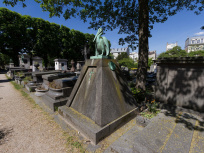
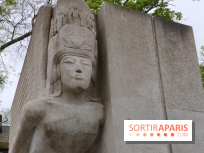
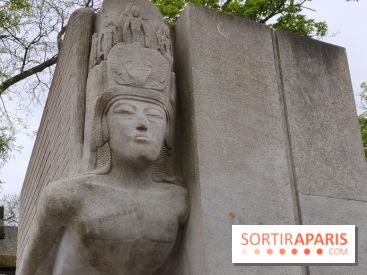
Could a ghost be haunting the graves of Père-Lachaise? In the 18th division of the famous Parisian cemetery, a strange figure wrapped in a shroud looks as if it has stepped straight out of a gothic tale. Its face hidden beneath a long veil, this marble apparition reaches desperately toward a barred window. But rest assured, there’s no need to call in a ghost hunter! This striking sculpture adorns the tomb of François-Vincent Raspail, the renowned 19th-century scientist and politician. And behind its eerie appearance lies a particularly poignant love story, in which even death seems unable to part two people.
If the name Raspail rings a bell, it may be because it belongs to a famous Parisian boulevard—and a metro station, too! Born in Carpentras in 1794, François-Vincent Raspail wore many hats. A chemist, botanist, self-taught doctor and fervent republican, he is best known for his scientific work and his commitment to making medicine accessible to the poorest people.
But his political convictions also land him in serious trouble with the authorities. Arrested several times, he spends part of his life behind bars. In 1848, his revolutionary activism leads to another arrest, followed by a prison sentence. It is during this period of detention that his life takes a dramatic turn.
In 1853, François-Vincent Raspail was imprisoned in Doullens, in the Somme. His wife, Henriette-Adélaïde Troussot, who was deeply devoted to him, was with him at the time. But on March 8, 1853, Henriette died at the age of just 53.
A death that devastates the prisoner, who is deprived of the woman who stood by him through his many struggles. To immortalize their separation, sculptor Antoine Étex created a particularly striking funerary monument in 1854. A life-size woman, entirely covered in a shroud, reaches her arm toward the bars of a prison cell.
This spectral figure represents Henriette Raspail, symbolically returned from the dead to bid a final farewell to her imprisoned husband. The most moving detail? Her hand seems to reach for her husband’s, invisible behind the window. A gesture suspended for eternity, as if love were making one last attempt to cross the prison walls… and the boundaries of death.
With its long drapery, almost unreal silhouette and completely concealed face, the ghost of the Raspail tomb is one of the most unsettling figures in Père-Lachaise Cemetery. But this work is far more than a mere macabre ornament!
Antoine Étex, also known for his sculptures on the Arc de Triomphe, embraces a Romantic sensibility here. This 19th-century artistic movement gives a central place to emotions, human dramas and the expression of feelings. And it would be hard to find a more Romantic subject than this wife who seems to return from beyond the grave to join her husband!
The monument thus depicts a precise scene: not a real supernatural apparition, but the imagined farewell of a deceased woman to the man she loves. A work in which every fold of the shroud, every movement of the figure and every bar contribute to heightening the emotion.
The story of this burial holds another surprise! When Henriette Raspail was buried at Père-Lachaise on March 13, 1853, her funeral took on considerable proportions. According to the inscription on her tomb, no fewer than 50,000 people are said to have accompanied her coffin.
A tremendous tribute to this woman, but also a demonstration of opposition to imperial rule, while her husband remains a prisoner. And contrary to what one might imagine, the tomb was not built for François-Vincent Raspail, but initially for his wife!
The scientist would not join her until 25 years later, after his death in Arcueil on January 7, 1878. Since then, Henriette’s silhouette seems to watch over their shared final resting place, faithful to a love that even prison could not break.
And here’s one final detail that should delight music fans! In 1987, the band Dead Can Dance chose a photograph of the Raspail tomb for the cover of its third album, Within the Realm of a Dying Sun.
With its mysterious, almost otherworldly atmosphere, the sculpture is a perfect fit for the duo’s dark, spellbinding musical world. An astonishing second life for this 19th-century funerary work!
To discover this stone apparition, head to the 18th division of Père-Lachaise Cemetery, in the 20th arrondissement of Paris, near the Grand Rond crossroads. The inscription “Famille Raspail” on the monument makes the grave easy to identify.
Take a moment to look at the figure—and especially that hand reaching through the bars. Now that you know its story, it should seem far less frightening! For behind this ghost, which seems to have haunted Père-Lachaise for more than 150 years, lies one of the most beautiful declarations of love ever carved in stone. It just goes to show that at Père-Lachaise, some ghosts have no intention of scaring anyone… they simply want to say goodbye.
This page may contain AI-assisted elements, more information here.
Location
Père-Lachaise Cemetery
Cimetière du Père-Lachaise
75020 Paris 20
Route planner
Accessibility info