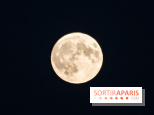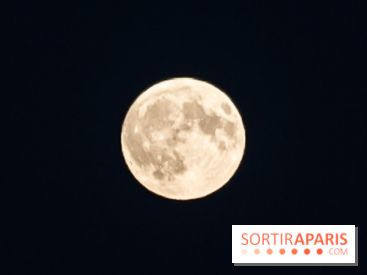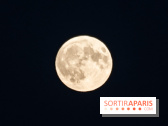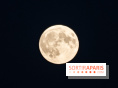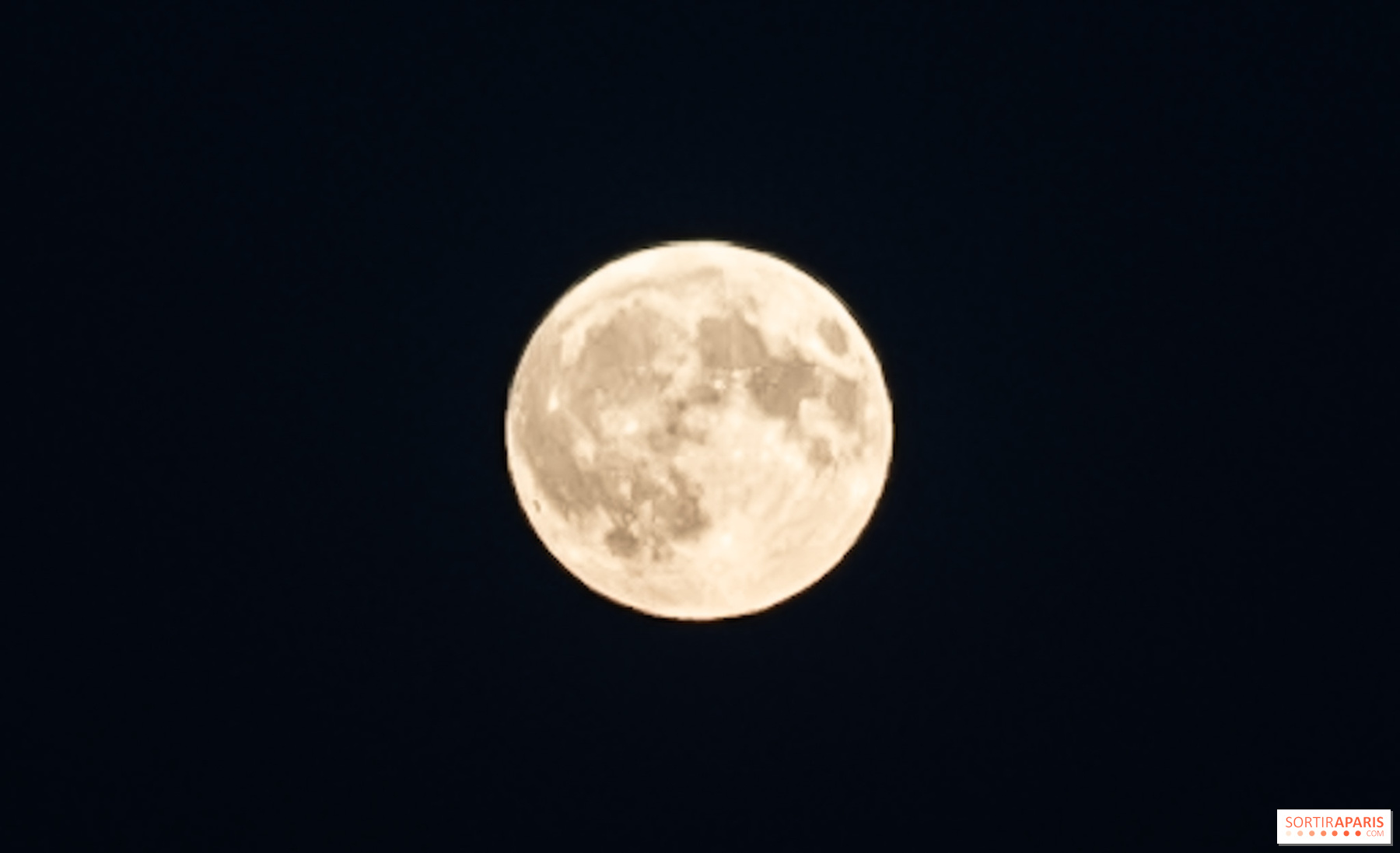
The Strawberry Moon makes its return this year in the night of Monday, June 29 to Tuesday, June 30, 2026, peaking around 1:58 a.m. local time in Paris. From the capital and across all of Île-de-France, this celestial encounter can be enjoyed with the naked eye—just look up toward the horizon. And this edition carries a notable twist: it’s a micromoon, the last one of 2026.
In practical terms, Earth's Moon will reach its apogee on June 28, the farthest point from Earth in its orbit (about 406,000 kilometers). The result: the Moon will appear roughly 7% smaller and a touch dimmer than a typical full Moon. Not spectacular to the naked eye, but that is what gives this year's phenomenon its distinctive character.
The name Strawberry Moon, or Lune des Fraises, originates from the U.S. Northeast. It rose to prominence in the 1930s thanks to American agricultural almanacs, which referenced the Algonquin peoples for whom the June full moon marked the brief wild strawberry harvest. As NASA notes, this nickname has nothing to do with any pink hue: the Moon does not turn red for that reason.
In Europe, it’s also known by other poetic names: the Rose Moon, linked to the blooming of roses in June, but also the Milky Moon or the Deer Moon among the Celts. The term Honeymoon could also share this origin, tied to a time of year traditionally favorable for weddings and the honey harvest.
What makes this full moon noteworthy is its low angle in the sky. As the closest full moon to the summer solstice (on June 21), it stays very low on the horizon in the northern hemisphere. As it passes through a thicker slice of atmosphere, its light often takes on golden, orange, and sometimes red hues, and the lunar illusion makes it appear larger than it actually is.
The best moment comes at moonrise, just after sunset, on the evenings of June 29 and 30, 2026. It’s advised to pick a clear vantage point toward the east-southeast, and to get as far away as possible from Paris’s light pollution. Photography enthusiasts will want to include a foreground element (a monument, a tree, a horizon line) to fully savor the sight of a giant Moon hanging over the landscape.
To check the exact Moonrise time for your Île-de-France commune, the site of the Institute of Celestial Mechanics and Ephemeris Calculations (IMCCE) is the go-to reference and offers a free calculator. That said, there's no need to rush out for a telescope: the Lune des Fraises is perfectly visible to the naked eye from a balcony, a park, or high vantage points in the city.
Looking to extend your stargazing over Paris and the Île-de-France region? Discover the other astronomical events taking place this year.
Dates and Opening Time
From June 29, 2026 to June 30, 2026
Location
Paris and the Île-de-France region
Paris
75 Paris