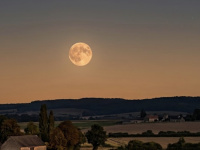
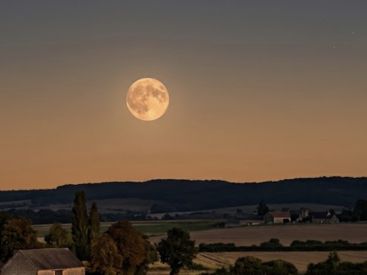
Tonight the Harvest Moon full moon lights up the skies over Paris (75) and across the Île-de-France. This Saturday, September 26, 2026, the Moon reaches its full phase at 18:49 (Paris time), according to the ephemerides of the IMCCE (Observatory of Paris). It isn’t a Super Moon, and yet it hides a peculiarity that distinguishes it from all other full moons of the year.
A small, amusing detail: at the exact moment of the full moon, the Moon is still below the Paris horizon. It rises around 7:20 p.m., about half an hour later. The Sun, by contrast, sets around 7:40 p.m. For a few minutes, the two celestial bodies face each other, one to the east, the other to the west, like two neighbors crossing paths on the landing.
Everything hinges on the Moon’s rising time. Under normal conditions, the Moon rises about fifty minutes later each evening. Around the autumn equinox, its path forms an almost parallel angle with the horizon in the Northern Hemisphere. From one night to the next, it mostly slides sideways, rather than dipping below the horizon.
The numbers speak for themselves. In Paris, the Moon rises at 6:35 p.m. on September 23, 6:51 p.m. on the 24th, 6:06 p.m. on the 25th, 7:21 p.m. on the 26th, and 7:37 p.m. on the 27th. That’s about a 15-minute shift per night, compared with more than an hour around the full Moon in March, according to calculations from the IMCCE reported by Actu Alt Plus.
Practically for several consecutive evenings, a nearly full Moon appears just as daylight fades. There’s hardly any darkness between twilight and Moonrise. Tomorrow, Sunday, September 27, Moonrise and sunset coincide to the very minute in Paris.
The Harvest Moon designates the full Moon closest to the autumnal equinox, which occurred this year on Wednesday, September 23. Its name hails from rural life: farmers took advantage of the extra light from dusk to push the harvest after sunset.
This is the only full Moon whose name is tied to the equinox rather than the month. It usually falls in September, but every three or four years it slips into October, as it did last year. The site Star Walk also explains the origin of these traditional names.
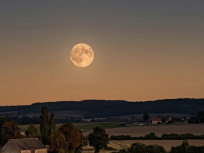
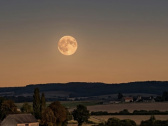
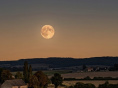
As it climbs at a very low angle, the Harvest Moon lingers near the horizon for a long spell. Its light must pass through a notably thicker layer of atmosphere, with suspended particles filtering out the blues and letting only the reds and oranges through. Hence this amber tint, a touch like an apricot resting on the rooftops.
As for its size, it’s a matter of perception. Framed by buildings or trees, the Moon can look enormous. Its apparent diameter doesn’t actually change: it’s the lunar illusion, especially evident when it rises low on the horizon.
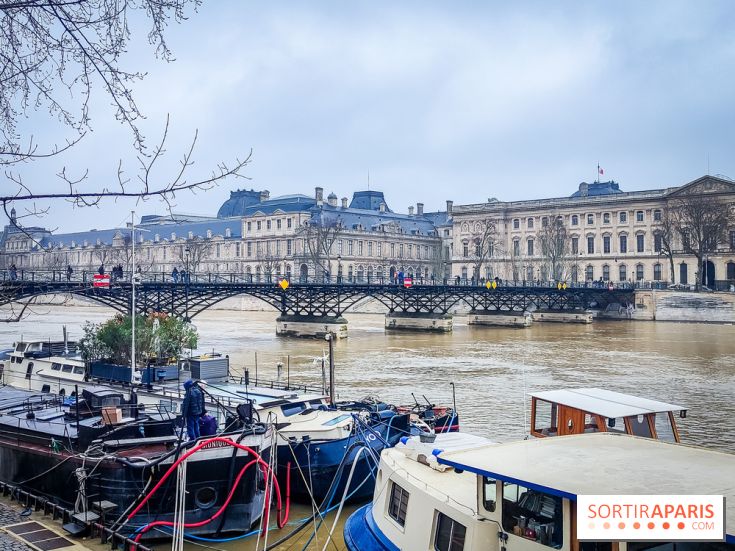
The show is free to watch and can be enjoyed with the naked eye. The ideal is to find a clear eastern horizon and settle in there a little before sunset. The quays and bridges along the Seine, looking upstream, provide pleasing vantage points. Further out, the wide-open spaces of the outer suburbs, away from the city lights, let you experience a darker sky.
Our pick for tonight: the Grand Terrace of Saint-Germain-en-Laye (78). Facing east toward the Seine valley, it offers an open viewpoint over Paris. Watching the Moon rise above the capital from this terrace designed by Le Nôtre feels like a living painting. Just be sure to check the site’s opening hours before you head out.
In the night sky, the Moon shines in the Pisces constellation, with Saturn nearby and easily visible to the naked eye. A practical tip for photographers: include a foreground element (a monument, a tree silhouette, a bridge) to provide scale and highlight the orange glow at dawn.
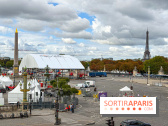
Two things to watch tonight. The forecast looks cloudier than in recent days, with possible high-altitude wisps: a quick check of the Météo-France forecast before heading out isn’t a bad idea. And with the Mass of Pope Léon XIV scheduled this afternoon between the Concorde and the Champs-Élysées, it’s smart to consult the neighborhoods to avoid this weekend to pick your viewing spot. If the sky turns overcast, don’t fret: the Moon will still appear just as full tomorrow evening.
Because it's a simple moment that requires no gear or reservations. A quarter of an hour facing east is enough to watch the Moon rise in its coppery gown, while the sky on the other side still glows. A lovely pause to share with family, friends, or a sweetheart, at the end of a week-end well spent in Paris.
And the season is only just getting started. The Hunter's Moon will take over on October 26, followed by the two Supermoons at the end of the year, on November 24 and December 24, the latter being the full moon closest to Earth in 2026. To make sure you don’t miss a thing, check out our guide to the supermoons, shooting stars and eclipses not to be missed in 2026, as well as our recap of the Eclipse and the Sturgeon Full Moon from August.
Dates and Opening Time
From September 25, 2026 to September 27, 2026
Prices
Free
Recommended age
For all