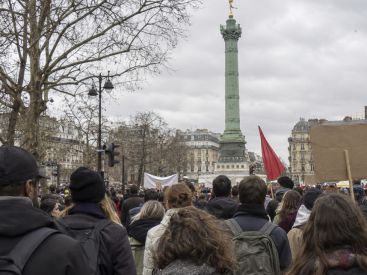
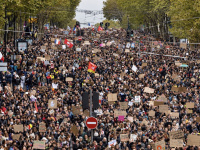
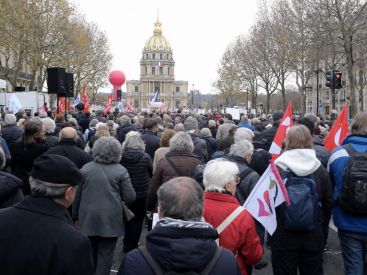
The national education strike and the student demonstration are back this Tuesday, November 10, 2026. Teachers, high school students, university students and researchers have been called to stop work and take to the streets in Paris and across the Île-de-France region. This morning, 49 of France’s 3,700 high schools were blocked at 9:30 a.m., or 1.3% of all schools, according to the Ministry of National Education, as reported by Démarches administratives. Schools, middle schools, high schools and universities in the capital, as well as in the Créteil and Versailles school districts, could be affected. In Paris, the police prefecture has authorized a single march, from the Panthéon (5th arrondissement) to the Place d'Italie (13th arrondissement), starting at 2 p.m.
The call was relayed this Saturday, November 7, by Snes-FSU, the leading union for middle and high schools. It comes five days after the November 5 strike and the day after a social conference that failed to quell the anger.
Fifteen organizations have signed the joint statement, according to Dijon Actualités, which details its contents. On the youth side, the signatories include the Union syndicale lycéenne (USL), Union étudiante, UNEF, FAGE, FSE and Solidaires étudiant-e-s. On the staff side, FSU, FERC-CGT, FO, SUD éducation and Sup'Recherche-UNSA are among the signatories.
In concrete terms, those called on to walk out on Tuesday include teachers from preschool through university, as well as student support staff, AESH (support staff for students with disabilities), university employees and researchers. High school and university students, meanwhile, are invited to join the marches and, in some cases, block access to their schools.
The tone is combative. The inter-union coalition, quoted by L'Express, says the movement is “in a position of strength” and that the government “is beginning to back down.” The CGT Éduc'action is even urging staff to meet in general assemblies starting Monday to discuss an open-ended strike.
The timing explains everything. This Monday, November 9, Prime Minister Sébastien Lecornu brought unions and employers’ representatives together at Matignon for a social conference on wages and purchasing power. After the meeting, he announced a 1.6% increase in the minimum wage (SMIC) from December 1 (including a 0.6% boost), bringing it to around 1,502 euros net per month, according to France 24. Some unions said the measure was far too small.
In the afternoon, the meeting with youth representatives quickly falls apart. After talks with the prime minister, most high school and student organizations walk out of the first Parcoursup reform committee, denouncing the presence of UNI and the RN at the table, reports Ouest-France. None of these announcements directly concerns teachers: public-sector unions, absent from the conference, will not be received at Matignon until Friday, November 13. Tuesday’s events therefore serve as a reminder that schools are still waiting for their share.
The momentum from November 5 is a factor. That day, the Snes-FSU said 52% of staff at middle and high schools were on strike, with nearly 1,000 high schools blocked or closed, according to Entrevue. Authorities counted nearly 600,000 demonstrators across France, while the CGT put the figure at 1.6 million.
It all started in mid-September at a high school in Créteil (94), where teachers and students denounced vacant positions and classes that were not being held. Since then, the demands have broadened. For schools, the signatories are calling for the public-sector pay index to be unfrozen and for more teachers, senior education advisers, support staff for students with disabilities, nurses and psychologists to be hired, as well as a building renovation plan.
For universities, they are calling for funding for 150,000 places they say are lacking, the creation of 15,000 permanent positions, and an end to the barriers they attribute to Parcoursup and Mon Master. The research sector is calling for the planned job cuts in the 2027 budget to be scrapped.
The government has already taken action. At the end of October, it promised a two-phase reform of Parcoursup, a €5 billion plan for high schools and universities, and smaller classes, as we reported in our article on student protests. The organizations say this is not enough, and are particularly disappointed by the lack of concrete measures for universities.
Three protests had been declared in Paris for Tuesday, but the police prefecture is allowing only one to go ahead. The November 10 demonstration in Paris will set off from Place du Panthéon at 2 p.m. (gathering from 12:30 p.m.) and head to Place d'Italie via Boulevard Saint-Michel, Boulevard de Port-Royal and Avenue des Gobelins, according to the order published on Monday evening. Declared by FSU Île-de-France, which had wanted to march as far as Boulevard Raspail, the route is now being promoted to students by Interfac Île-de-France. Between 2,000 and 4,000 people are expected to join the Paris march, according to an intelligence report cited by Public Sénat.
The other two marches, notified by Interfac Île-de-France and the Regional Student Coordination, between Place de la Bastille and Pitié-Salpêtrière, have been banned (orders 2026-01578 and 2026-01579). The police prefecture is instead authorizing only a stationary gathering from 2 p.m. to 6 p.m. at 83 boulevard de l'Hôpital (13th arrondissement), near Saint-Marcel metro station. “This is unacceptable,” says Kéo, a member of the Regional Student Coordination, which is not, for now, calling on people to join the march from the Panthéon.
This Tuesday is first and foremost a day for high school and university students: the interprofessional inter-union coalition is not calling for demonstrations, unlike on November 5 and 7. The Snes-FSU, however, is urging teachers to join the marches, Interfac is calling on workers to join the march, and Yellow Vests are expected to be there. The national high school and student coordinating committees, which met this weekend, say young people “will not give up” until Parcoursup is scrapped and €20 billion is put on the table.
To follow changes to the route and the metro stations to watch out for, see our dedicated article on the route of the November 10 demonstration in Paris, updated continuously.
November 10 demonstration in Paris: the authorized route
High school and university students are demonstrating in Paris this Tuesday, November 10, 2026, following marches on November 3, 5 and 7. Two routes have been announced, starting from two different squares, but the Paris police prefecture has authorized only one. [Read more]
In preschools and elementary schools, teachers must declare their intention to strike at least 48 hours in advance. What happens next depends on the number of striking teachers at each school:
If in doubt, the easiest thing to do is check with the school or district town hall, and consult our update on schools, cafeterias and nurseries open or closed in Paris.
At middle and high schools, there is no guarantee that students will be welcomed: there is no minimum service, classes may be canceled, and further blockades cannot be ruled out outside some schools. At universities, lecture halls may also remain empty. Unions have also filed strike notices covering the coming weeks, leaving the door open to further days of action.
The organizations are taking stock this Tuesday evening, but two dates are already on the calendar. On Friday, November 13, public-sector unions will meet with officials at Matignon, with the unfreezing of the index point pay scale topping the agenda. Then, on Tuesday, November 17, a new day of strikes has been called in the public sector and, at the CGT’s call, in the private sector, according to Basta!.
Monday’s announcements have nevertheless divided the inter-union alliance, which is approaching November 17 in disarray. Further disruption at primary and secondary schools and sixth-form colleges therefore remains possible next week.
No strike has been called at the RATP or SNCF for this Tuesday. However, metro stations along the march route may be closed at the prefecture’s request, as they are during every major autumn demonstration. Along the approved route, the stations to watch from early afternoon onward are Luxembourg and Port-Royal (RER B), Les Gobelins (line 7) and Place d'Italie (lines 5, 6 and 7), as well as Saint-Marcel (line 5), near the gathering outside Pitié-Salpêtrière. Our metro, RER and train traffic update is updated daily, as are the websites of the RATP and Île-de-France Mobilités. This week’s works can be found in our metro and RER disruptions this week.
A metro station closed, an RER train no longer stopping, or a bus rerouted because of a demonstration in Paris? Whether you’re a tourist or a local, there are several ways to keep your journey going. Apps, alternative routes, getting around on foot or by bike: here are some useful tips for navigating the capital despite disruptions. [Read more]
And if you’d rather keep your distance from the marches, our ideas for things to do this Tuesday, November 10 and our guide to public transport in the Île-de-France region will help you plan your day.

































 November 10 demonstration in Paris: the authorized route



 Metro closed in Paris: How to get around despite the demonstrations?