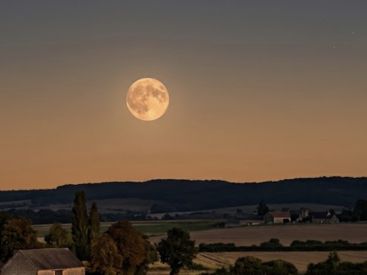
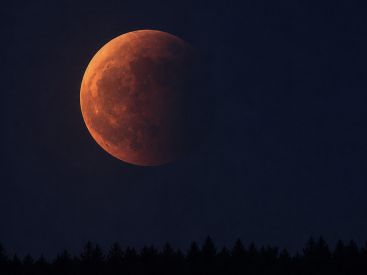
The Beaver Moon of 2026 lights up the sky on Tuesday, November 24. The full Moon reaches its peak around 3:54 p.m., Paris time, but it’s in the evening that you’ll want to look up in Paris and the Île-de-France region, weather permitting. The Moon will also appear nearly full on the neighboring nights.
NASA lists this full moon among the 2026 supermoons. The term refers to a full moon that coincides with the Moon being near its perigee, the closest point in its orbit to Earth. At this time, the Moon appears slightly larger and brighter than it does when farther away. The difference is subtle enough that it’s hard to notice with the naked eye, and you shouldn’t expect a suddenly giant-looking celestial body.
To observe it, choose a spot with a clear view of the eastern horizon in the early evening, then follow the Moon as it rises higher in the sky. The exact moment of full moon is an astronomical instant: it may not coincide with its moonrise in Paris, nor guarantee visibility at that time.
The event is free and visible to the naked eye. Binoculars or a telescope can reveal more surface details, but they are not essential. To plan your outing, locate a sky-watching spot in Paris or the Île-de-France region, and check that it will be accessible at your chosen time.
Clouds may hide the Moon: check Météo-France forecasts as the event approaches and dress for a November evening.
The name “Beaver Moon” belongs to the traditional full-moon names circulated by North American almanacs. According to The Old Farmer’s Almanac, it evokes the time when beavers prepare for winter and recalls the old trapping practices used to obtain their pelts. This designation does not describe any change in the Moon’s color or shape.
The next event after the November edition will be the cold full moon on December 24, 2026, which NASA has also described as a supermoon.