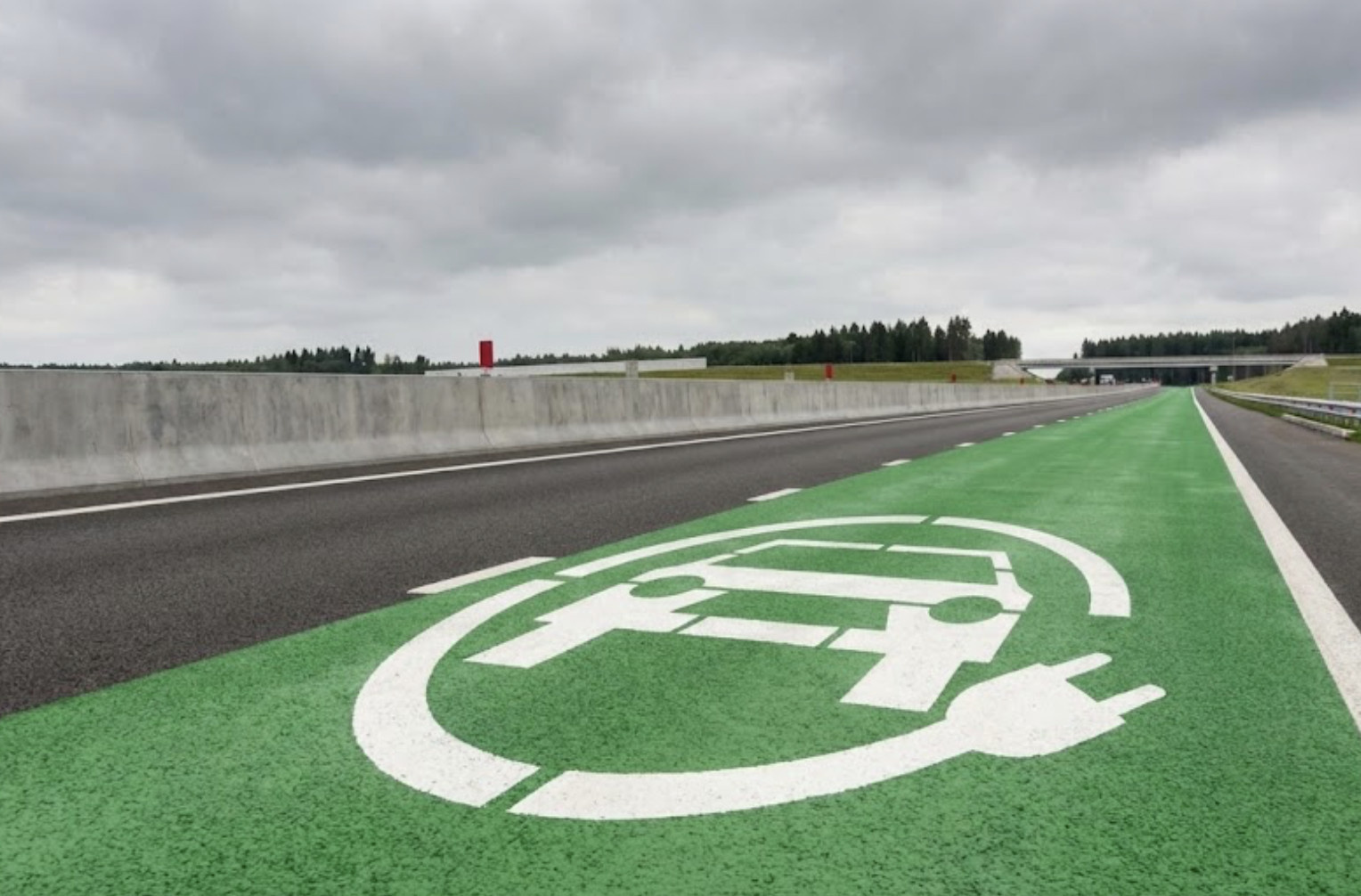
It is on a 1.5 km stretch near the town of Angervilliers, inEssonne, thatthe A10 is becoming a testing ground for this innovative technology. On October 22, 2025, an electric truck was able to recharge by induction while driving on the highway, marking a decisive step towards the decarbonization of road transport. This electric highway is the result of a project called "Charge as you drive," led by a consortium comprising VINCI Autoroutes, Israeli start-up Electreon, VINCI Construction, Gustave Eiffel University, and Hutchinson, with support from Bpifrance.
The principle is based on the installation of transmitter coils under the road surface that generate an electromagnetic field. In concrete terms, 900 copper coils have been installed over 1.5 kilometers of road, buried about ten centimeters below the asphalt of the right-hand lane. Vehicles equipped with receiver coils then capture this electromagnetic field and convert it into electricity to simultaneously power the engine and recharge the batteries. This induction charging technology therefore allows drivers to increase their range without ever having to stop at a charging station.
Four prototypes are now running on this section to test dynamic charging: a heavy goods vehicle, a bus, a car, and a utility vehicle. Power is supplied by an urban electrical substation located less than a kilometer away, connected by a high-voltage line installed by Enedis.
Tests conducted in real traffic conditions are proving very encouraging. The power transferred reaches up to 300 kW instantaneously and 200 kW on average, performance comparable to current fast charging stations. This allows a heavy goods vehicle to gain one kilometer of range per kilometer traveled, and up to three kilometers for a light vehicle.
This technology could radically transform the road transport sector. By enabling continuous recharging, it would pave the way for smaller and lighter batteries, thereby reducing purchase costs and the carbon footprint associated with their manufacture. For heavy goods vehicles, the potential gain would be between 10 and 17 fewer electric car batteries.
If the results continue to be conclusive, VINCI Autoroutes could consider rolling it out on other motorways. Road transport accounts for 95% of mobility in France and nearly a third of greenhouse gas emissions, making it a major challenge for the ecological transition. A study by the Ministry of Transport even envisages deployment on 9,000 km of motorways by 2035.
However, the main obstacle remains the cost: around €4 to €5 million per kilometer equipped. And for the moment, only vehicles equipped with compatible receivers can benefit from the system. These receivers can nevertheless be installed after the vehicle has been purchased, as part of a retrofit.
France is not alone in this field of innovation. Similar experiments are being conducted in Italy with the Arena del Futuro project in collaboration with Stellantis, in Karlsruhe, Germany, for electric buses, and in Sweden with eRoadArlanda. In the Ain region, the eRoad Mont Blanc project is testing another approach with a conductor rail inserted into the road surface. In short, the electric highway is no longer science fiction; it is gradually becoming a reality.
Recommended age
For all