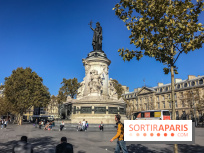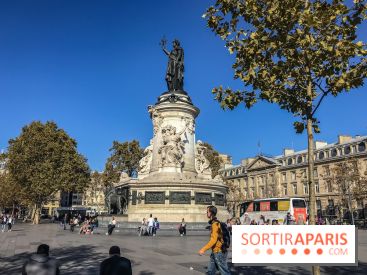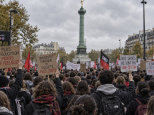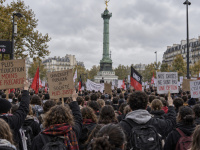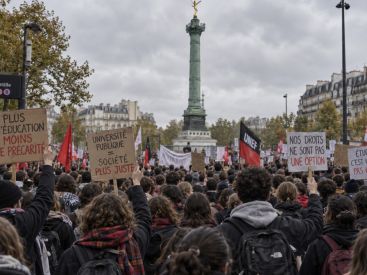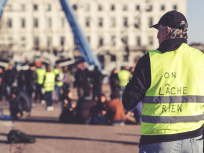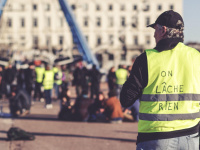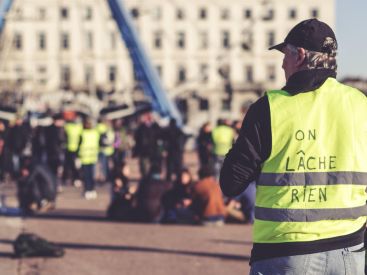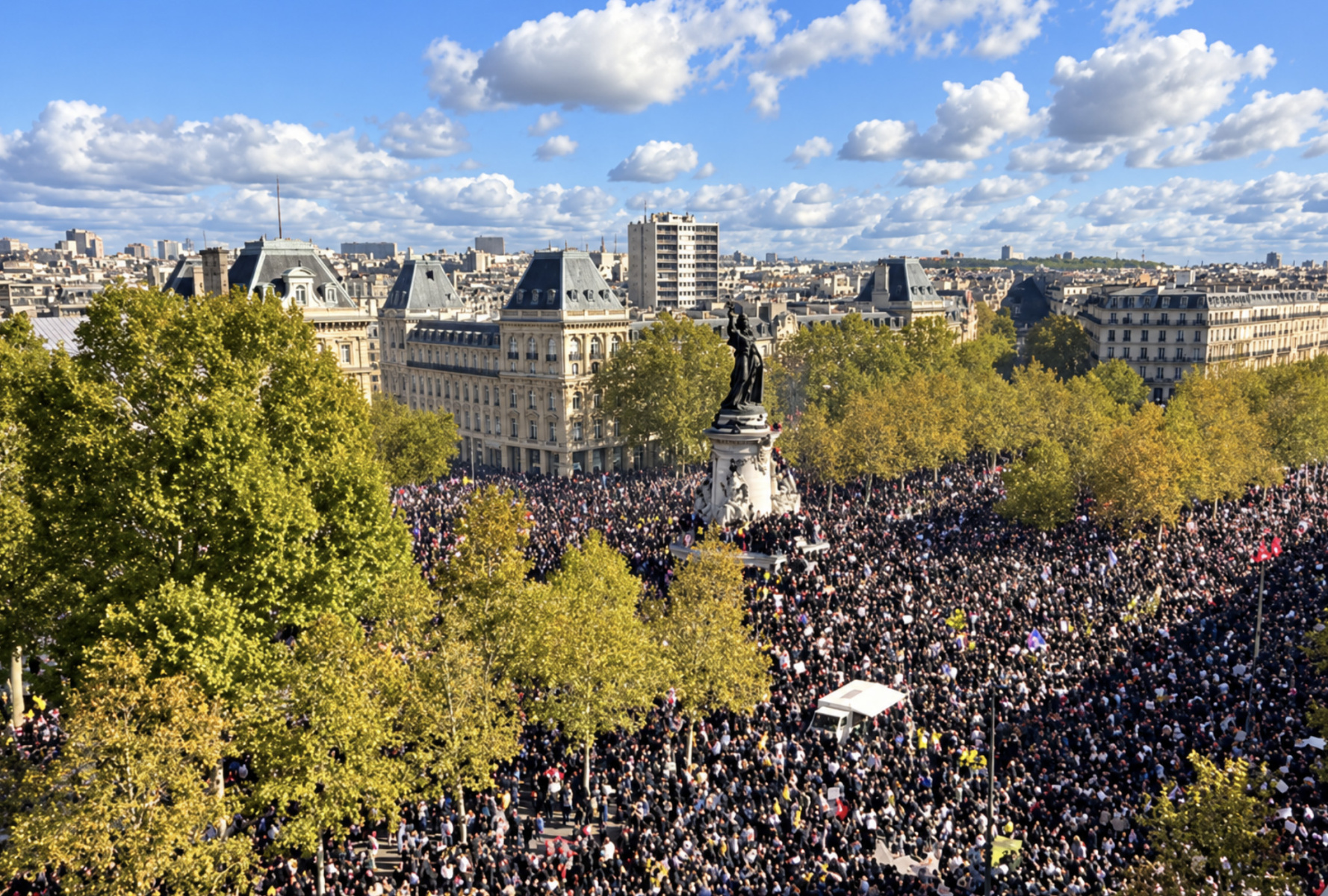
For the demonstration of the October 24 in Paris, two questions are now resurfacing: where will it take place, and what security arrangement is planned? The Act II of the Yellow Vests, announced on Monday, October 19, 2026 by the coordination behind the October 17 mobilization, is still targeting two eastern Paris squares: the Place de la République (3rd, 10th and 11th arrondissements) and the Place de la Bastille (4th, 11th and 12th).
This Tuesday, October 20, the government also shifted its tone. Soldiers from the Sentinelle operation, along with the GIGN, RAID, BRI units, and water-cannon vehicles, will be mobilized on Saturday for what Matignon describes as a "massive" deployment. Elsewhere in Île-de-France, protests are more scattered.
Tuesday evening, there was still no confirmed launch point or official timetable for the capital. Here we gather, point by point, what is known and what could still shift by Saturday. For the broader context of the mobilization, our article acte II ce samedi 24 octobre, à quoi faut-il s'attendre ? takes a closer look at the question.
The government conceded that the policing approach showed its limits last weekend. In the National Assembly, Prime Minister Sébastien Lecornu acknowledged that the setup was "too static and not mobile enough" during Act I and announced a far larger police deployment for Saturday.
In the wake of developments, Interior Minister Laurent Nuñez laid out the plan during questions to the government. The soldiers of the Sentinelle operation, who are usually seen in train stations and before major landmarks, will take over from police and gendarmes on fixed‑surveillance duties. The idea is simple: free up officers to put them in direct contact with the processions.
The former police prefect also promises to boost the number of officers available and to call on elite units, as during the July 2023 riots. The BRI, the GIGN and the RAID will be involved, along with helicopters, the Centaure armored vehicles of the gendarmerie and water-cannon launchers. Some of these assets were already deployed on October 17, but the minister says there is a need to go further.
The change is mainly about the approach. Laurent Nuñez is seeking a more reactive, mobile doctrine capable of tracking small, fast-moving groups as they move from one neighborhood to another. In practical terms, expect Saturday a highly visible police and military presence, extending far beyond the usual gathering spots.
Since Monday, the circulating appeals point to two gatherings: République and Bastille. They are among roughly a hundred mobilisations listed on the coordination's map of mobilisations, which its site says will feature demonstrations and rallies at roundabouts across France.
Readers should approach these announcements with caution. As Franceinfo reports, each venue only appears on the map after verification by the organizers’ team, and there is no guarantee the event will go ahead or be authorized. Until the Police Prefecture has weighed in, neither the route nor even the starting point can be regarded as confirmed.
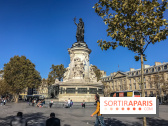
These two squares stand as Paris’s open-air stages of protest. Under the Marianne statue, Place de la République has witnessed countless processions, and even Nuit debout’s late-night assemblies in 2016. At the foot of the July Column, Bastille retains the symbolic charge of 1789. The Yellow Vests had already marched there during the winter 2018-2019 episodes.
Their position matters too. Linked by Beaumarchais Boulevard and Temple Boulevard, barely two kilometres apart, they form a natural corridor for a procession through the east of the city, well away from the power hubs of western Paris.
The October 17 precedent offers a clear sense of the authorities’ room for maneuver. The organizers had called for a gathering at the Bastille. The Police Prefecture ultimately barred the rally on the square and laid out a route from République to Place de Clichy, via Boulevard de Magenta and Barbès. It rejected any entry into central Paris.
Saturday could unfold in the same way again. In Paris, a protest must be registered with the Police Prefecture at least three clear days before the event, and Prefect Patrice Faure has the power to tweak the route or ban the gathering if he deems public order at risk. Earlier this week, the coordination group had not submitted any registration, according to L'Express.
The option is clearly on the table. Laurent Nuñez said he is weighing a ban on unregistered protests that risk disrupting public order. He did not rule out prohibiting gatherings that are officially registered with the prefecture if the organizer or the security service cannot provide enough guarantees that the event will run smoothly.
For a call issued without prior declaration, as was still the case at the start of the week, the risk of a ban order is real. The minister has also warned that he will personally oversee the rollout on Saturday and in the days that follow, promising firmness.
The overnight orders issued on October 19-20 paint a telling picture. The police prefecture had, at that time, banned unauthorised gatherings in several areas, with a couvre-feu in République and part of the Halles:
These measures expired on Tuesday morning, but Sébastien Lecornu warned that new curfews could be decided according to local circumstances. The two sites named for Act II are both inside this perimeter. If similar decrees are issued for Saturday, the Paris rally could therefore be moved, as it was on October 17.
The Paris march could be larger than the Yellow Vests alone. The CGT told RMC that it is urging its 600,000 members to join Saturday's peaceful demonstrations and rallies, without specifying any locations in Paris for now.
Youth are also expected to show up. The National High School Coordination is calling for a protest on Saturday, October 24, according to franceinfo, even though All Saints’ Day holidays could scatter some students. On October 17, a mix of yellow vests, high school students, university students, and trade unionists formed a single march that started from République.
Beyond Paris, the logic shifts. The coordination’s map catalogs protests, but also gatherings at roundabouts, outside service stations, oil depots, train stations, or toll booths. This lies at the heart of the demand championed by the site, which calls for capping pump prices and scrutinizing the margins of oil companies.
In practice, these actions are often shorter and more mobile than a Parisian protest, making them harder to anticipate. It’s precisely this kind of group that the new setup aims to track. If you’re hitting the road on Saturday in Seine-et-Marne, Yvelines, Essonne or Val-d’Oise, factor in extra time, especially near major arteries and shopping districts.
A first date is set for high schoolers and university students as well, on Thursday, October 22: the Interfac d'Île-de-France, which coordinates the mobilization committees for the universities in the Île-de-France region, voted to continue the movement that day, with a possible demonstration in Paris, according to France 24.
The Paris Police Prefecture remains the most reliable source, publishing its decrees on its site and through its social channels, often the night before. The final itineraries are listed there, as are restricted zones and any bans on demonstrations. On the transport side, the RATP announces station closures, and our metro and RER traffic update page repeats them daily.
If you live or work near République, Bastille, or the Grands Boulevards, monitor these sources through Saturday morning and expect tighter security checks. If you’d rather spend a day away from the demonstrations, our ideas for sorties ce samedi 24 octobre lean toward museums and exhibitions. The movement will resume on October 31 with Act III, followed by the grève intersyndicale du 5 novembre.
We will update this article as soon as the venues, the Paris route, and any banning orders are confirmed.
This page may contain AI-assisted elements, more information here.