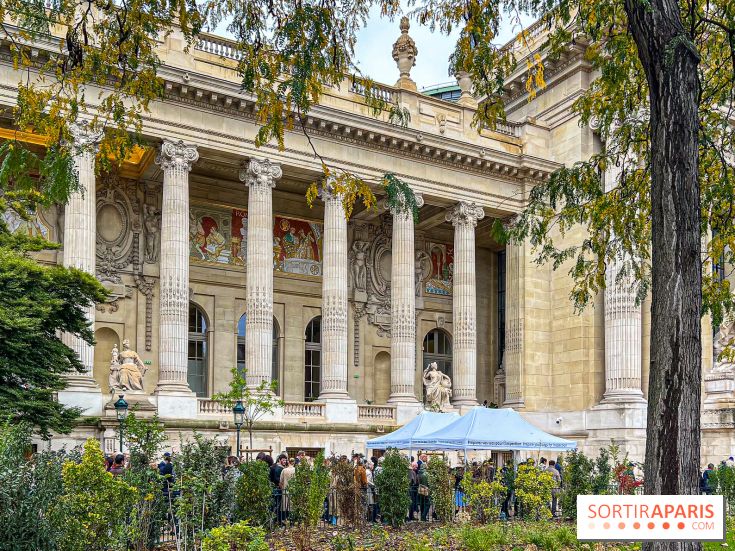
A hundred years after Claude Monet’s death, the Orangerie Museum in Paris pays tribute with a grand, authoritative exhibition running from September 30, 2026 to January 25, 2027. Tracing his artistic journey—from early plein-air sketches to the ultimate masterpiece of the Water Lilies—the presentation probes how the famed Impressionist sought to capture the present moment, changing light, and the passage of time at the heart of his creative process.
Entitled Monet, Painting Time, this exhibition is co-organized by the Musée de l’Orangerie in Paris and the Tate Modern in London (where it will be shown from February 25 to June 27, 2027), with the exceptional support of the musée Marmottan Monet and the Académie des beaux-arts in Paris.
The exhibition brings together nearly forty paintings, primarily from the collections of the Musée d’Orsay and the Marmottan Monet Museum, supplemented by loans from public and private collections in France and abroad, to offer a cross-cutting, renewed reading of Monet’s work through the notion of temporality.
Considered in the 1870s as the quintessential Impressionist — although he took part in only five of the group's exhibitions — Monet develops a painting style rooted in capturing the moment, propelled by a brisk brushwork, clear harmonies and outdoor painting. His work accompanies the upheavals of the 19th century, marked by the speeding up of time, the proliferation of clocks in public spaces, the synchronization of social rhythms and the development of transport (notably the railway). In this context, Monet's painting emerges as an effort to seize the present, to translate the fleeting nature of light and the rapid transformations of urban and natural landscapes.
After the period of the Impressionist exhibitions, Claude Monet deepened his inquiry by exploring variations of a single motif at different times of day and under changing atmospheric conditions. It is in this vein that he developed in Normandy his famous series: The Haystacks (1888-1891), The Poplars on the Epte (1891-1892), The Rouen Cathedral (1892-1898), or also Mornings on the Seine (1896-1897). Through these bodies of work, Monet pushes the logic of immediacy toward a true fragmentation of time, seeking to grasp its essence through the repetition of the motif.
The presentation of the Cathédrales de Rouen series at Durand-Ruel in 1895 marked a turning point, as Georges Clemenceau described in his article in La Justice as "a revolution without a single shot." This serial approach, bordering on a nearly scientific observation of reality, reflects the era’s fascination with the meticulous analysis of visible phenomena. The exhibition sheds light on this pivotal moment, where Monet dissects time to render it perceptible, while foreshadowing the later research that would culminate in the Nymphéas.

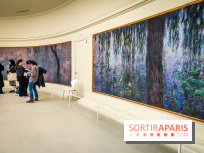
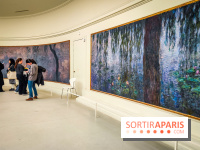
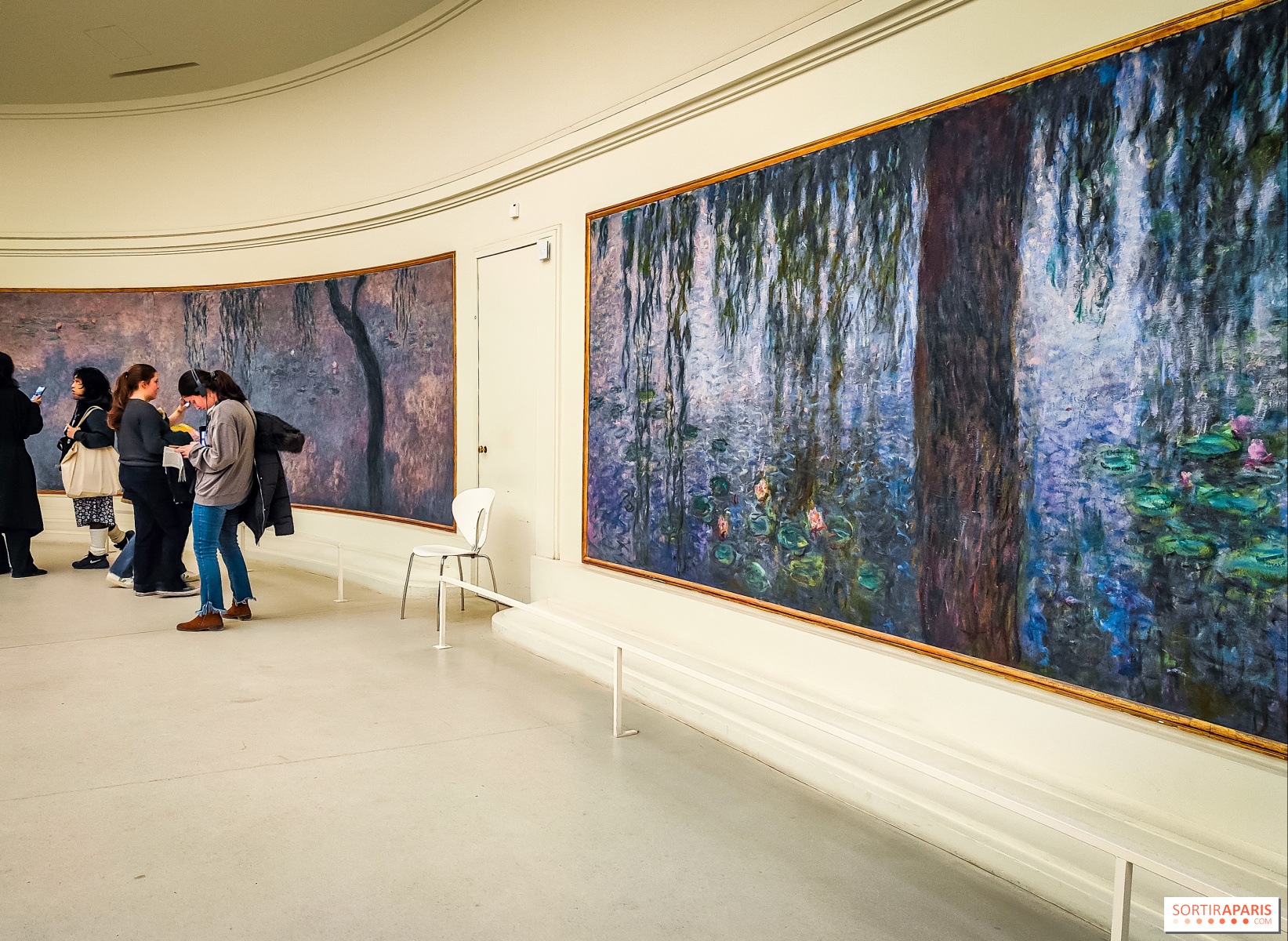
In the 1890s, Monet began what would become the final phase of his life: the Nymphéas cycle. More than 250 canvases were devoted to this motif, culminating with the large panels painted specifically for two dedicated rooms, donated to France after the 1918 armistice and installed at the Musée de l’Orangerie. Opened in 1927, a year after the painter’s death, these monumental decorations mark the culmination of his meditation on time, moving beyond the logic of the series to merge into a continuous pictorial flow.
The exhibition fits naturally at the Orangerie, which preserves this unique ensemble, described in 1952 by André Masson as "Sixtine de l’impressionnisme". The itinerary invites reflection on the notion of duration, in the Bergsonian sense, by offering a progressive immersion into the work of the last Monet. The viewer is no longer faced with a succession of fragmented moments, but immersed in an enveloping experience where time seems suspendu.
In addition to the route, the museum offers a virtual reality experience titled Monet – Along the Water. Lasting about twenty minutes, this immersive creation draws on the project L’Obsession des Nymphéas, already presented at the Orangerie in 2018 and in 2024. Equipped with a standalone headset, the visitor is invited to travel from Argenteuil to Giverny, from the Seine to the Nymphéas pool, to explore how Monet sought to capture the passage of time through changes in light, the seasons and the watery landscapes.
This experience also touches on more personal aspects of the painter's life, such as the creation of his garden in Giverny, his fixation with reflections and his struggle with blindness, which gradually pushes him toward painting at the edge of abstraction. Available in French and English, it offers a complementary entry point for understanding Monet's work from a sensory perspective.
With Monet, painting time, the Orangerie Museum offers an in-depth rereading of Claude Monet’s work, highlighting how the painter tracked and interrogated the upheavals of his era through the representation of the moment, the series, and duration. By bringing together emblematic paintings and the great decorations of the Nymphéas in their original setting, the exhibition provides a particularly coherent frame for understanding the evolution of his artistic approach. See you from 30 September 2026 to 25 January 2027 for a plunge into time... and art!
There’s no French text inside the provided snippet to translate. The div is empty. Please share the French content (text inside the HTML, or adjacent lines) and I’ll rewrite it in natural, journalistically adapted English while preserving the structure and tags.
This page may contain AI-assisted elements, more information here.
Dates and Opening Time
From September 30, 2026 to January 24, 2027
Location
Musée national de l'Orangerie
Jardin Tuileries
75001 Paris 1
Route planner
Accessibility info
Access
Metro 1, 8 and 12, Concorde station
Prices
Tarif réduit: €10
Plein tarif: €12.5
Official website
www.musee-orangerie.fr
More information
Open from Wednesday to Monday, 9 a.m. to 6 p.m. Evening hours on Friday until 9 p.m.






![[IN]IMAGINABLE : nos photos de l'expo à Fluctuart - Fluctuart 15](https://cdn.sortiraparis.com/images/18/114756/1309577-imaginable-nos-photos-de-l-expo-a-fluctuart-fluctuart-15.jpg)
![[IN]IMAGINABLE : nos photos de l'expo à Fluctuart - Fluctuart 15](https://cdn.sortiraparis.com/images/19/114756/1309577-imaginable-nos-photos-de-l-expo-a-fluctuart-fluctuart-15.jpg)
![[IN]IMAGINABLE : nos photos de l'expo à Fluctuart - Fluctuart 15](https://cdn.sortiraparis.com/images/20/114756/1309577-imaginable-nos-photos-de-l-expo-a-fluctuart-fluctuart-15.jpg)