The Pont Notre-Dame may be less famous than some other Parisian bridges, yet its history takes us back to the very origins of Paris. At this very spot, probably since antiquity, stood the Grand-Pont romain, which carried the great north–south axis of Lutèce across the Seine in continuation of the Petit-Pont.
After the Norman invasions, tracing the crossings at this site becomes difficult. In the Middle Ages, a wooden passage appears, known as the Planches-Mibray, swept away by the waters in 1406. A few years later, on May 31, 1413, Charles VI takes part in the ceremonial launch of a new bridge by striking the first pile.
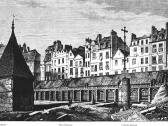
Completed in 1421, this first Pont Notre-Dame is wooden and supports about sixty houses, thirty on each side, where gunsmiths and booksellers set up shop. An astonishing feature for the era: these houses already bore numbers in Roman numerals.
But living above the Seine wasn’t without risk. On 28 October 1499, the bridge, whose poor condition had been flagged, collapsed suddenly along with the houses it supported. The reconstruction was quickly decided, and a new structure, this time made of stone, was built between 1501 and 1512. It too hosted rows of houses and shops. The Pont Notre-Dame thus became a bustling commercial thoroughfare and even saw several royal processions pass by during the solemn entrances into Paris.
By the end of the 18th century, the bridge’s appearance had changed radically. The removal of its houses was decided as early as 1769 under Louis XV, but it would not be until 1786, under Louis XVI, that they actually disappeared. Parapets and sidewalks were then laid out. During the French Revolution, the bridge also changed its name and for a time became the Pont de la Raison.
The 16th-century structure ultimately disappears in the 19th century. A new bridge is constructed on its site in the middle of the century, but its design quickly creates problems for navigation on the Seine. Its arches and piers form tricky passages for vessels, and accidents multiply, to the point that the boatmen give it the ominous nickname of "Pont du Diable".
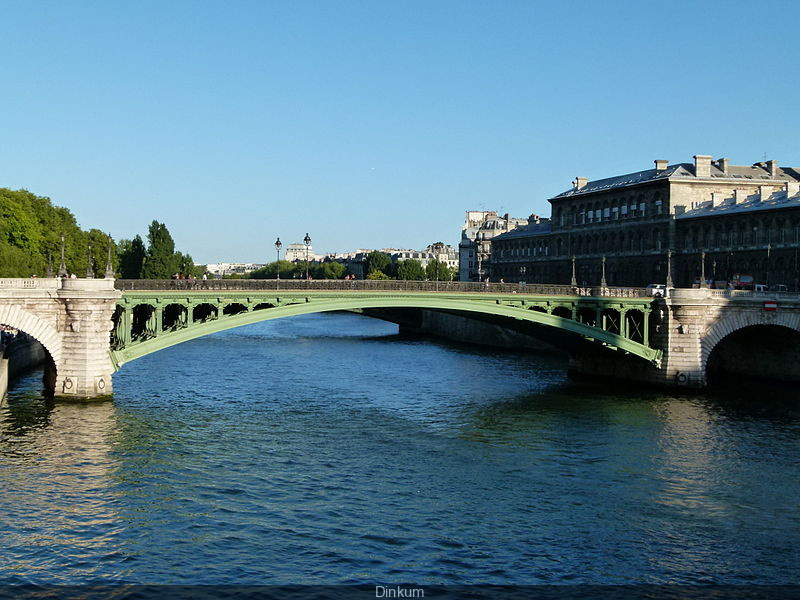
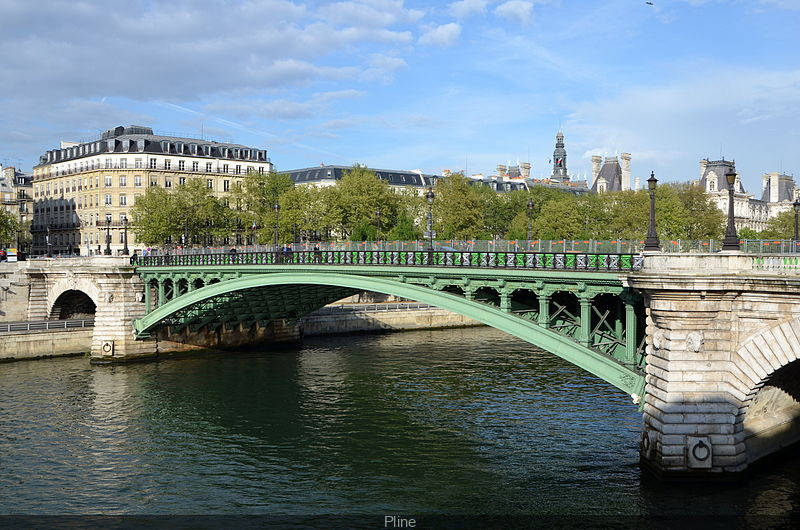
To improve navigation, the bridge was redesigned again at the start of the 20th century. The central metal arch of the current Pont Notre-Dame was put into service in 1919, based on a design associated with engineer Jean Résal, also known for his work on the Pont Mirabeau and the Pont Alexandre III. It is this bridge that we still cross today to reach the Île de la Cité!
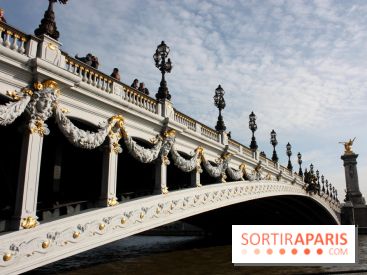
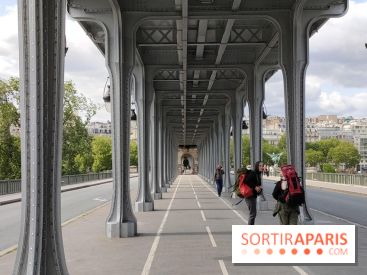
Paris's most beautiful bridges, wonders to discover along the Seine
From Pont-Neuf to the Bir-Hakeim Bridge, via the utterly romantic Pont des Arts, discover the history of Paris’s most beautiful bridges. [Read more]
Dates and Opening Time
Next days
Thursday:
from 12:00 a.m. to 11:59 p.m.
Friday:
from 12:00 a.m. to 11:59 p.m.
Saturday:
from 12:00 a.m. to 11:59 p.m.
Sunday:
from 12:00 a.m. to 11:59 p.m.
Monday:
from 12:00 a.m. to 11:59 p.m.
Tuesday:
from 12:00 a.m. to 11:59 p.m.
Wednesday:
from 12:00 a.m. to 11:59 p.m.
Location
Notre-Dame Bridge
Pont Notre-Dame
75004 Paris 4
Route planner
























 Paris's most beautiful bridges, wonders to discover along the Seine