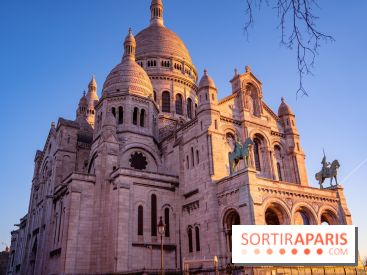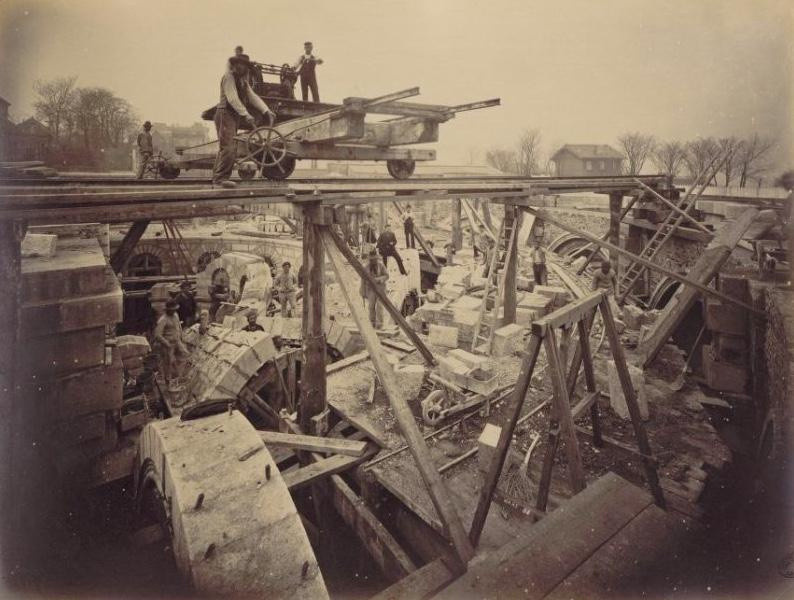
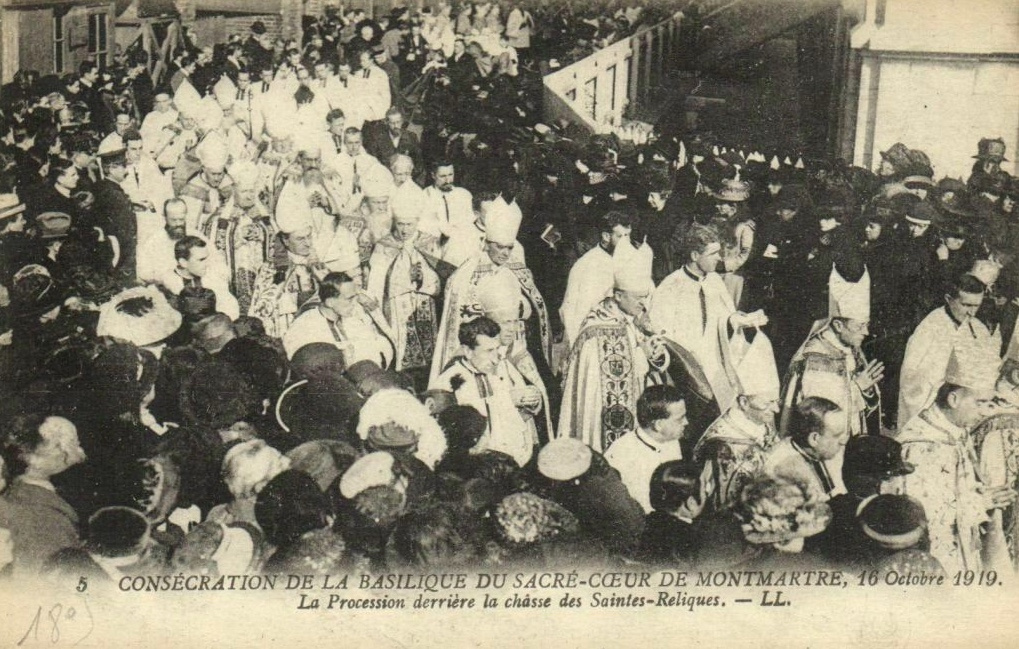
On Thursday, October 16, 1919, the church of the Sacré-Cœur de Montmartre was consecrated by Cardinal Amette, Archbishop of Paris, with Cardinal Vico, papal legate, presiding, and elevated to the rank of basilica. Begun in 1875, the construction of the religious edifice, perched on the heights of the butte Montmartre, would not be completed until 1923.
Throughout history, the Montmartre Hill has been seen by peoples as a place of worship, from the alleged earliest Gallic rites to the construction of the Saint-Pierre Church in the 12th century, an integral part of the royal abbey of Montmartre, passing by the beheading of Saint-Denis in the 3rd century and the Gallo-Roman temples erected in honor of Mercury and Mars. For a bit of trivia, the name of the hill "Montmartre" is said to derive from Mons Martis ("hill of Mars"), later reinterpreted as Mons Martyrum ("hill of the Martyrs") and then Mont de Martre (martre meaning "martyr" in Old French).

On September 4, 1870, the day the Third Republic was proclaimed, as France was being overrun by the Prussian forces and Paris stood on the brink of siege, several clergymen proposed erecting, in the heart of the capital, a sanctuary dedicated to the worship of Jesus Christ to expiate France’s sins and bring to an end what they viewed as a divine punishment in response to a century of decline that began with the 1789 Revolution.
The initiative, championed by philanthropist Alexandre Legentil, strikes a national chord, and alongside his brother-in-law, the Parisian painter and prominent figure Hubert de Fleury, Legentil launches the drive to build a church in honor of Christ. Together, the two gentlemen turn to the Assemblée nationale at the end of 1872, seeking to have the church recognized as being of public utility, so that the necessary land—city property and parcels owned by numerous private individuals—could be acquired.
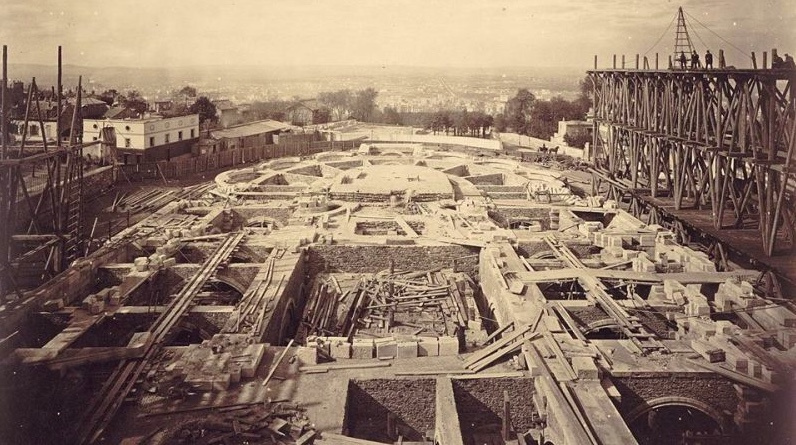
Mostly royalist, conservative and Catholic, the National Assembly, elected in February 1871, votes by a large margin for the Public Utility Law on July 24, 1873. For many, this decision was taken to atone for the crimes committed during the Paris Commune and thus to establish the new "moral order" of a clerical France promoted by conservatives.
Indeed, Montmartre is seen as the starting point of the insurrection populaire de la Commune, the uprising from March to May 1871, with the famous "cannon affair." Even today, many Parisians believe that the Sacré-Cœur was "built on the blood of the Communards". Hubert de Fleury, himself, declared during the laying of the foundation stone of the edifice : "This is where the Commune began, where Generals Clément-Thomas and Lecomte were assassinated, that the church of the Sacred Heart rises! We remember this hill lined with cannons, traversed by drunken zealots, inhabited by a population that seemed hostile to any religious idea and that the hatred of the Church seemed to animate above all."
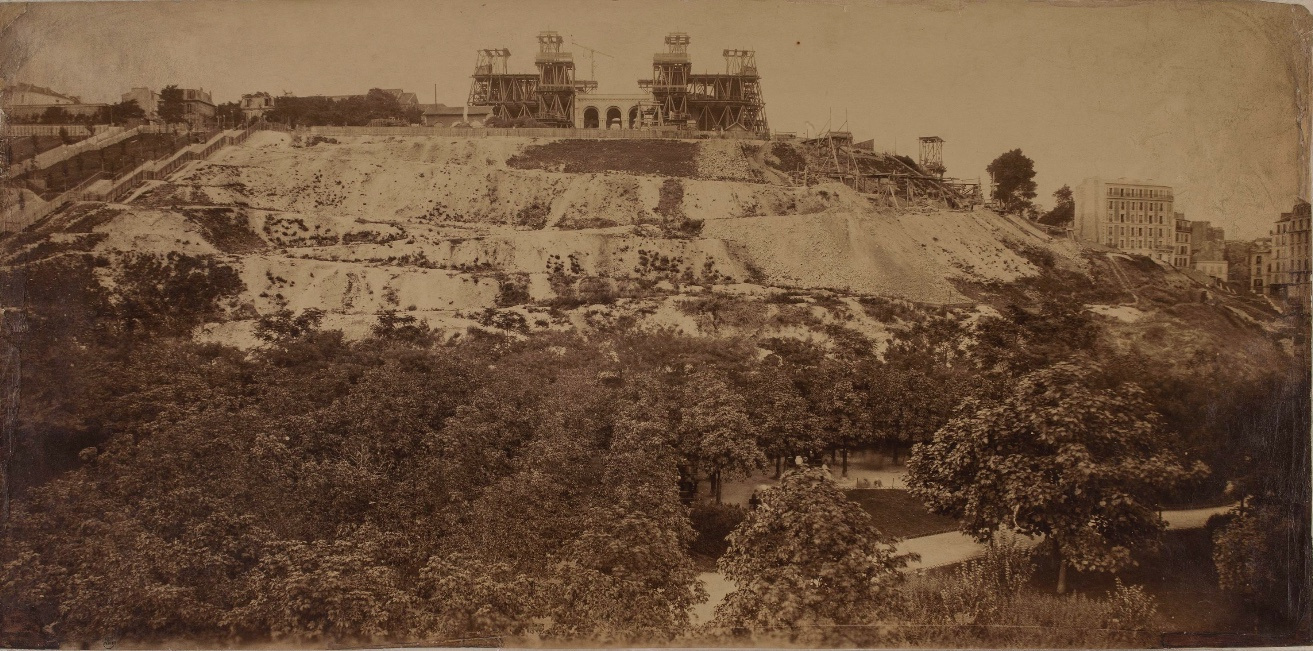
The law of July 24, 1873 thus allows monseigneur Guibert, the Archbishop of Paris, to acquire the land on the Montmartre hill by means of expropriation, if necessary. Until then, the land behind Saint-Pierre Church was occupied by guinguettes, small gardens as well as a fairground. In the same year, a competition was organized by the Committee of the Œuvre du Vœu National and the Archbishop of Paris to select the architect of the project.
A number of constraints shape the competition: the site on the Montmartre ridge, a budget capped at 7 million francs, the plan for a crypt, and the siting of a monumental Sacred Heart statue visible from afar, placed outside the building. The winning entry comes from architect Paul Abadie, who prevailed over 77 other proposals, including efforts by leading figures in architecture and Grands Prix de Rome laureates. Abadie envisions a Romano-Byzantine basilica adorned with the traditional ceremonial elements—dome, cupolas and a campanile—to set it apart from the neo-baroque style then in vogue.

Honoré Daumet succeeded Paul Abadie after his death in 1884; and he himself was followed by Charles Laisné, who enlisted the stained-glass painter Émile Hirsch to create the vitraux. A succession of architects then took the lead, Henri-Pierre Rauline, Lucien Magne and later Jean-Louis Hulot.
The construction of the edifice was made possible by the support of a large number of devotees, notably through the Stone Subscriptions scheme which urged families to contribute the funds needed to purchase a stone, a column or a chapel, on which the donor's full name, initials or coat of arms are engraved. In all, nearly 46 million francs were raised in half a century thanks to gifts from almost 10 million devotees.
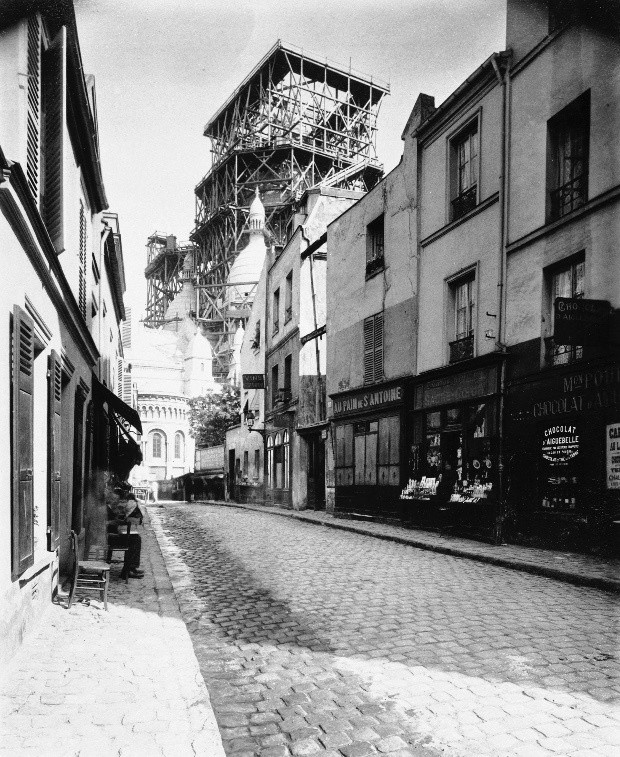
The travertine cornerstone, a white stone with an incredibly fine grain that brightens even when wet, was laid on June 16, 1875 by Cardinal Guibert, Archbishop of Paris, just steps from the old Moulin de la Galette. Eighty-three 33-meter-deep shafts were filled with concrete to strengthen the foundations, while 35,000 m3 of loose earth were replaced by stone and cement. Less than a year later, a provisional chapel was opened beside the works.
Construction of the crypt begins in 1878, followed in 1881 by the basilica. The interior of the nave was inaugurated on June 5, 1891, at a time when the Third Republic, fundamentally anti-clerical, hoped to turn the religious building into a house of the people or a theater. Straying somewhat from Paul Abadie’s original plans, the architects Rauline and Magne added Neo‑Renaissance elements to the ensemble, such as elongated cupolas and slender domes.
As the consecration of the church was due to take place on October 17, 1914, France's entry into the war pushed the event back. Moreover, the work was far from finished. It wasn’t until 1912 that the campanile, standing 91 meters tall, was completed, and 1914 for the entire façade to be finished.
It was finally on Thursday, October 16, 1919 that the Church of the Sacred Heart was consecrated by Cardinal Amette, Archbishop of Paris, with Cardinal Vico, papal legate, presiding, and a host of bishops, ecclesiastical dignitaries, members of the clergy, civil figures and ordinary faithful; and elevated to the rank of basilica.
Officially completed in 1923, the construction of the Sacré-Cœur continued into the 1930s with the addition of annexes, offices, dormitories, and the sacristy. The stained-glass windows, installed between 1903 and 1920 and destroyed during World War II, were later replaced with contemporary glass.

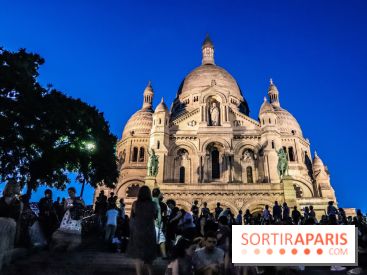
Outside the Sacré-Cœur, passersby—today as in the past—can still glimpse a Romanesque- and Byzantine-inspired architectural style, a central dome soaring 83 meters high that, until the construction of the Eiffel Tower, stood as Paris’s highest point, the campanile housing France’s largest bell, and a number of statues including Joan of Arc, Christ on the Sacred Heart carved on its chest, and Saint Louis, sword in one hand and the Christ Crown in the other.
Inside the basilica, the choir vault captivates with its decoration: the largest mosaic in France depicting the Sacred Heart of Jesus, flanked by the Virgin Mary and Saint Michael, and kneeling, Pope Leo XIII and Joan of Arc, crafted in Briare enamels by the Parisian mosaicists of the Guilbert-Martin workshop between 1918 and 1922. More than a dozen chapels surround the nave, while the great organ, installed in 1919, remains in place. In the basement, the crypt houses tombs, several chapels, and statues of saints and the Virgin.
For more information:
There is no French text in this snippet to translate; the HTML remains as is.
Location
Basilica of the Sacred Heart of Montmartre
35 Rue du Chevalier de la Barre
75018 Paris 18
Route planner
Access
Metro Jules Joffrin (Line 12) Pigalle (Lines 12 and 2) Anvers (Line 2)
More information
Iconographies :
Header: Louis-Emile Durandelle, 1882
Square Saint-Pierre, Louis-Emile Durandelle, 1877
Louis-Emile Durandelle, 1882
Construction of the Sacré-Cœur, circa 1884, Anonymous, Musée Carnavalet
The scaffolding of the Sacré-Cœur from Place Saint-Pierre, Hippolyte Blancard, Musée Carnavalet
The construction of the Basilica of the Sacré-Cœur in Montmartre, view taken from Rue du Chevalier-de-la-Barre, Eugène Atget, Musée Carnavalet
Consecration of the Basilica of the Sacré-Cœur
Basilique du Sacré-Cœur de Montmartre. View taken from 53, Rue du Chevalier-de-la-Barre, Eugène Atget, Musée Carnavalet