On Monday, October 21, 1680, the cultural institution La Comédie-Française, born from the merger of the city’s two sole troupes at the time—the group from the Hôtel de Guénégaud, the former Molière company, and the group from the Hôtel de Bourgogne—was established by royal decree of Louis XIV.
Also known as The French Theatre, this was the first permanent troupe of Comédiens-Français, created by the sovereign for several reasons: to counter the Italian acting troupes at a time when the Comédie-Italienne was in high demand, to effectively promote the French classical theatre while reasserting the monarch’s authority, and to put an end to the sterile bickering between the two rival Parisian troupes.
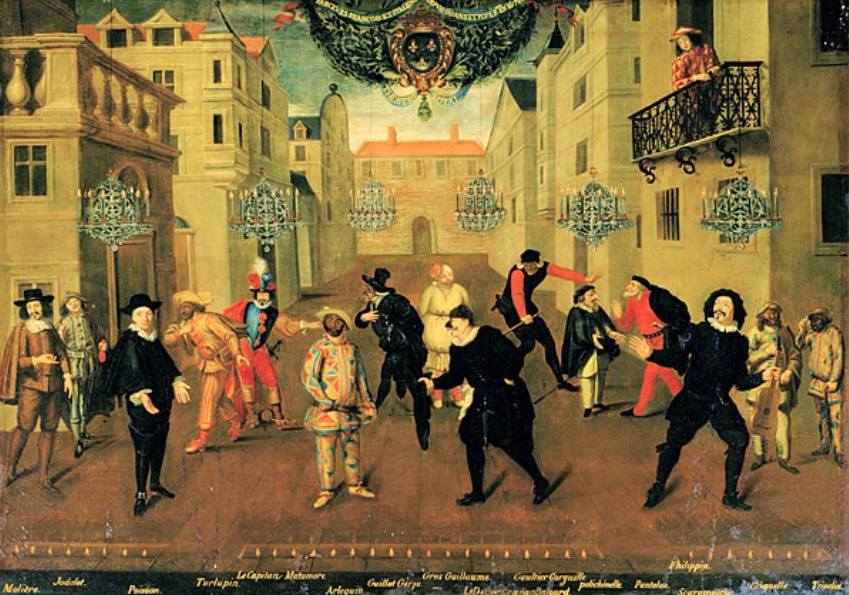
As early as 1658, Molière's company makes its debut before the court of Louis XIV, and the playwright quickly becomes the young king's favorite, for whom he stages a multitude of performances in collaboration with the era's top scenic designers, choreographers, and musicians. But in 1673, the playwright dies at the age of 51, mere hours after performing the title role in the Imaginary Invalid for the fourth time.
The King’s Company, deprived of its guiding mind, now led by Molière’s widow, Armande Béjart and his onstage partner Charles Varlet, known as La Grange, has grown pale and listless. The rival troupe at the Hôtel de Bourgogne is taking advantage of the crisis to lure away several actors, including Michel Baron, La Thorillière, and the Beauvals, who quit Molière’s troupe to join theirs.

To put an end to those quarrels that sometimes have the two companies performing the same plays at the same time, Louis XIV ordered, on October 21, 1680, seven years after Molière’s death, the fusion between the king’s troupe, housed at the Hôtel de Guénégaud on rue Mazarine, and the troupe of the Bourgogne theatre, effectively uniting the comic and the tragic troupes. The Comédie-Française was born.
The first joint performance is staged a week later, and the Comédie-Française quickly adopts a telling motto: "Simul et singulis", "Being together and being oneself". From then on, a French exception, the troupe alternates between performances of comedies and tragedies. The repertoire then comprises the complete works of Molière and Racine, as well as a few pieces by Corneille, Scarron, and Rotrou.
This fusion also serves as a way for the sovereign to spotlight French classical theater while reaffirming the grandeur of the French monarchy, at a moment when the Comédie-Italienne is all the rage. As a result, the French actors secure from the king the monopoly on French-language performances in Paris, along with a generous pension of 12,000 livres. Within the troupe itself, they are ranked between "pensionnaires" and "sociétaires" who have the opportunity to participate in the theater’s management.

Initially based at the Hôtel de Guénégaud, the Comédie-Française was forced to relocate several times over the following century. Expelled in June 1687 from the Hôtel de Guénégaud by royal order on the pretext that they risked disturbing the peace of the Four Nations College, the company settled in 1689 at the Jeu de Paume de l'Étoile, then moved to the Palais des Tuileries, and finally in 1782 to the Théâtre de l'Odéon, then known as the Hôtel de Condé, where the troupe staged Beaumarchais's Le Mariage de Figaro for the first time, a work previously censored for its sharp critique of the nobility and aristocracy.
Until now, under royal protection, the sovereign and the gentlemen of the King’s Chamber who had the power to decide the program in detail and to choose the actors—and who thus controlled the troupe—are undergoing a change of status. Granted civil rights, they are now effectively stripped of their royal pension and of the monopoly on the French repertoire.
But during the Révolution française, under the Terreur, the Comédie-Française's monarchist leanings led to its fermeture on September 3, 1793, by order of the Committee of Public Safety and the imprisonment of its actors. Escaping the guillotine, the troupe, somewhat fractured by a split between pro-monarchists and pro-republicans, was restored in 1799 by the Directoire.

With the help of writer François de Neufchâteau, who would later become Minister of the Interior, the Comédie-Française settles permanently at the Théâtre Français de la République, the salle Richelieu built in 1786 by architect Victor Louis on the edge of the Palais-Royal following the Opéra’s 1781 fire.
In vogue during the First Empire and the early years of the Restoration, the Comédie-Française enjoyed the protection of Napoleon I, who, by the Moscow Decree signed in 1812, governed its functioning and organization. Across 87 articles, the Emperor laid out the theatre’s administration, the funding of the troupe, and the admission of new plays—measures that remain in force today.
Now under the auspices of the Ministry of Culture, the Comédie-Française has, to date, three theatres in Paris — the Salle Richelieu, the Théâtre du Vieux-Colombier and the Studio-Théâtre — where it performs a repertoire of 3,500 plays, primarily consisting of classical drama, but also including more modern productions and works by foreign authors.
To learn more:
How can you tour the backstage of the Comédie-Française and see what goes on behind the scenes?
The Comédie-Française occasionally opens the doors to its backstage areas. Discover the dressing rooms, the technical spaces, and the traditions of the prestigious House of Molière. [Read more]
Every season, the Comédie-Française offers a rich program of theater classics and contemporary creations. A must-see for lovers of tragedy, comedy and drama, with constantly renewed productions. [Read more]
Dates and Opening Time
On October 21, 2026
Location
Comédie française - Salle Richelieu
1 Place Colette
75001 Paris 1
Route planner
Accessibility info
Access
Metro Palais Royal - Musée du Louvre
More information
Iconography: Header: Interior of the Comédie-Française in 1790 Molière's troupe Molière's death The Odéon theater The French theater of the Republic, Salle Richelieu

























 How can you tour the backstage of the Comédie-Française and see what goes on behind the scenes?


 Current and upcoming plays at the Comédie-Française