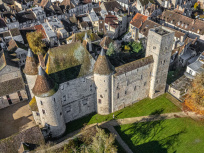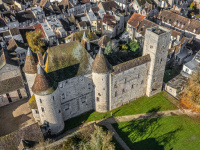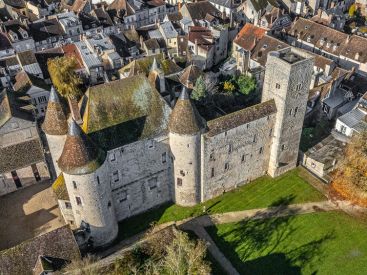
When you think of the Louvre, you picture the glass pyramid, the vast galleries, the Mona Lisa. It’s hard to imagine that 44 kilometers southwest of Paris, in the heart of the Essonne (91), a 13th‑century keep tells the story of the Louvre’s origins better than any exhibit. The donjon du château de Dourdan is not simply a provincial curiosity: it stands as the most accomplished variant of the architectural model crafted by Philippe Auguste, the same monarch who erected the first fortress that would anchor the Louvre in Paris. Classé monument historique since 1964 and musée de France since 2003, it opens to visitors in 2026 and still holds plenty of surprises.
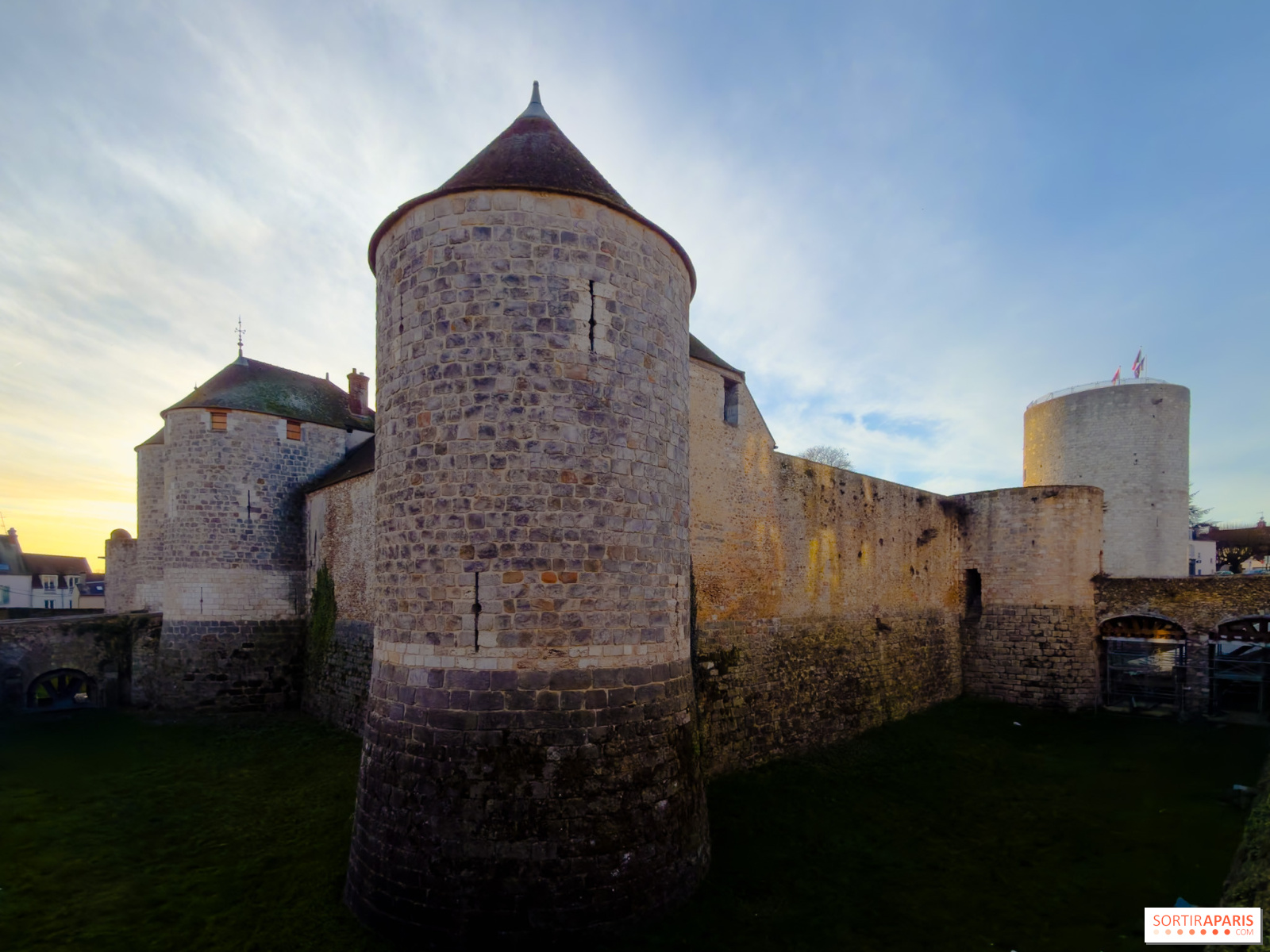
To understand the link between the two buildings, one must go back to the late 12th century. The so-called Philippian architecture is a model of fortifications erected under Philip II Augustus to replace the old palisade mounds. Its defining feature is the round keep, which becomes the standard after 1180-1220. The plan of the first Louvre is of Philippian type: a square with four corner towers and an intermediate tower on each face, surrounded by a moat with a masonry escarpment and counterscarp.
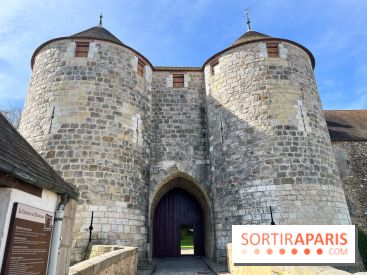
The Castle of Dourdan, one of the last fortifications built under Philip II Augustus, stands as the most accomplished embodiment of this Philippian system. In practical terms, the two strongholds share the same layout, the same dry ditches, the same circular towers, and the same type of isolated circular keep. The difference? The Louvre’s keep sat at the center of the enclosure, whereas Dourdan’s is tucked to a corner and separated by its own moat, with two drawbridges: one opening toward the courtyard, the other toward the fields, ensuring fully autonomous defense. In short, Dourdan sharpens the Paris model. And while the medieval Louvre disappeared under successive renovations, the colossal Louvre keep was demolished in 1527, the moats filled, and the old walls torn down. At Dourdan, by contrast, the keep endures—standing, visitable, rising 25 meters above the moat and hewn from Beauce limestone barely touched by eight centuries of history.
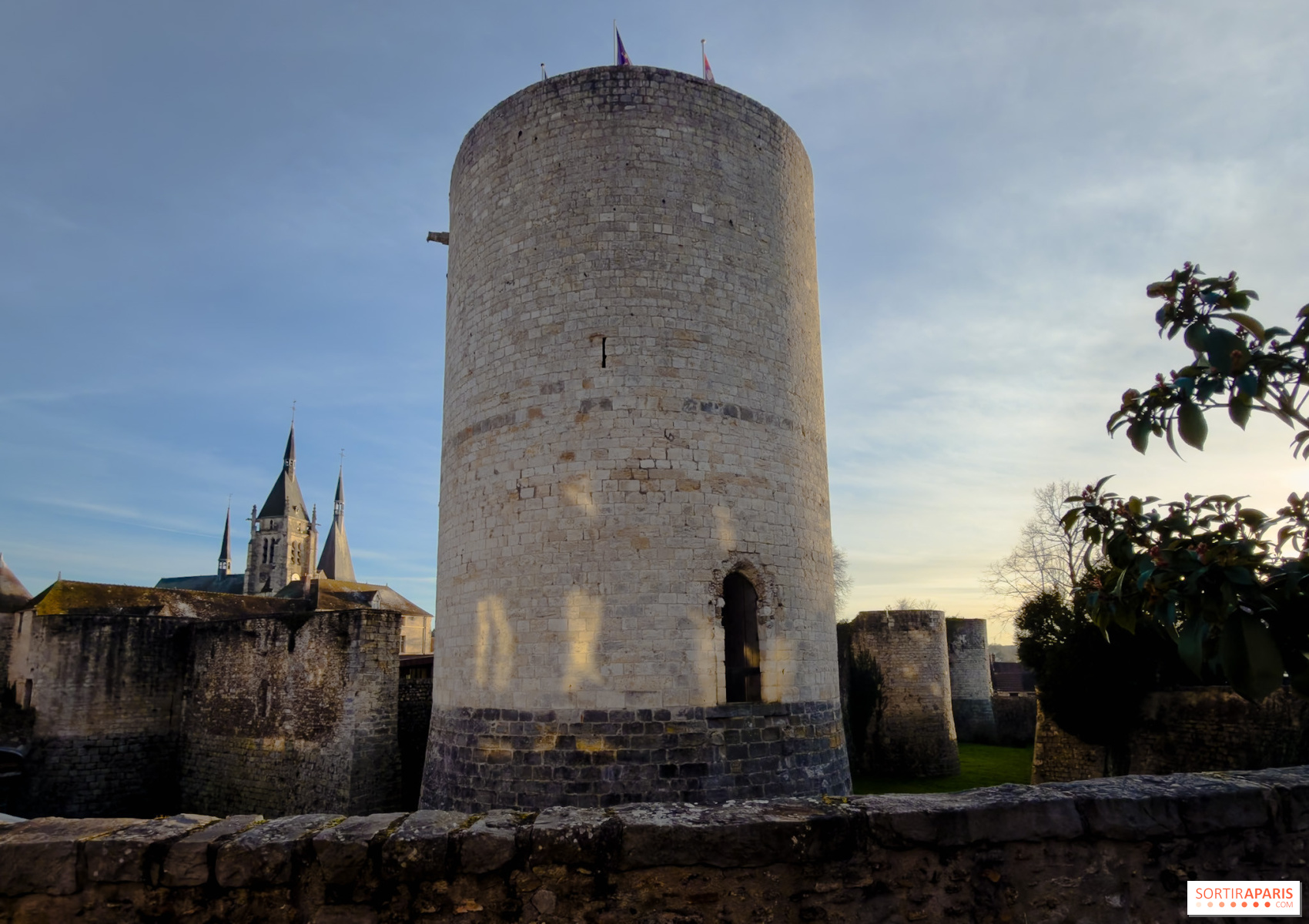
What makes the site truly fascinating is the density of its human history. In 1314, Jeanne de Bourgogne, wife of Philip V and involved in the Tour de Nesle scandal, was imprisoned in this dungeon for a year during her trial. Acquitted, she would go on to become Queen of France. Maurice Druon recounts this episode in his famous saga The Accursed Kings, and once you climb the tower, you can’t help but think of it.
A century on, another larger‑than‑life figure finds himself locked up here. Étienne de Vignolles dit La Hire, Joan of Arc’s comrade in arms, betrayed by the Burgundians, is imprisoned in the dungeon in 1430 before making his escape in 1433. A small, amusing detail few people know: La Hire lent his name to the valet de cœur in playing cards. The next time you play belote, you’ll have this Essonne dungeon in mind.
In 1672, Philippe d'Orléans turns the castle into a royal prison. By 1710, the donjon is redesigned with a false floor that splits the guardroom into two levels, iron bars at the openings, and wicketed doors with bolts. During the Revolution, it becomes a departmental prison capable of housing up to 300 inmates. That prison role would not end until 1852, nearly two and a half centuries after it began.
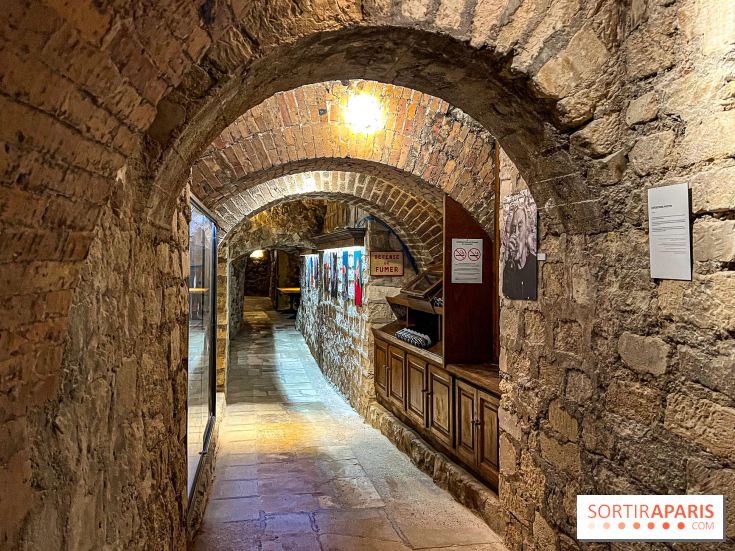
The keep that visitors see today is the result of meticulous restoration work carried out since the 1970s under the aegis of the Monuments historiques. In 1975, the moats filled with earth since 1608 were finally cleared. The base of the old piling supporting the drawbridge and the circular rampart wall was rediscovered. A oak footbridge built with mortise-and-tenon joints was then added to provide access to the keep from the courtyard, inspired by the Château de Vitré in Brittany. In 2018, this footbridge was entirely rebuilt by the Charpentiers de Paris: every component had been numbered before dismantling, in the manner of restoring a work of art, before being re-fabricated in oak in the workshop. The keep reopened for the 2018 Medieval Festival and has since welcomed visitors under optimal conditions.
The Château de Dourdan is reachable from Paris in under an hour by RER C (terminus Dourdan-La Forêt) or by car via the A10, exit 10. The museum is open Wednesday to Sunday, with a midday break: in summer (May to September), hours run from 10:30 to 12:30 and 14:00 to 18:00; in winter (October to April), it closes at 17:00. Mondays and Tuesdays are reserved for pre‑booked groups, and the museum is closed on January 1, May 1, and December 25.
On pricing, the self-guided visit is 5 € full price and 2.50 € reduced (ages 6-25, students, job seekers). A guided tour by a Heritage mediator is also available at 7 € (full price) and 3.50 € (reduced), on Sundays at 3:00 p.m. from May to September, and in July-August on Wednesdays and Saturdays at 3:00 p.m., with no prior reservation. Under-6s go free, as do teachers, art history, history or architecture students, and journalists with valid proof. Tickets are purchased on site only, with no advance booking for individuals. All information is available on the site's practical information page.
Here, we take the time to stroll along the dry moats, press on to the nearby Gothic church of Saint-Germain-d'Auxerre, and wander the cobbled lanes of the historic center. For those curious to deepen the theme, the Cluny Museum in Paris preserves fine examples of Capetian medieval architecture.
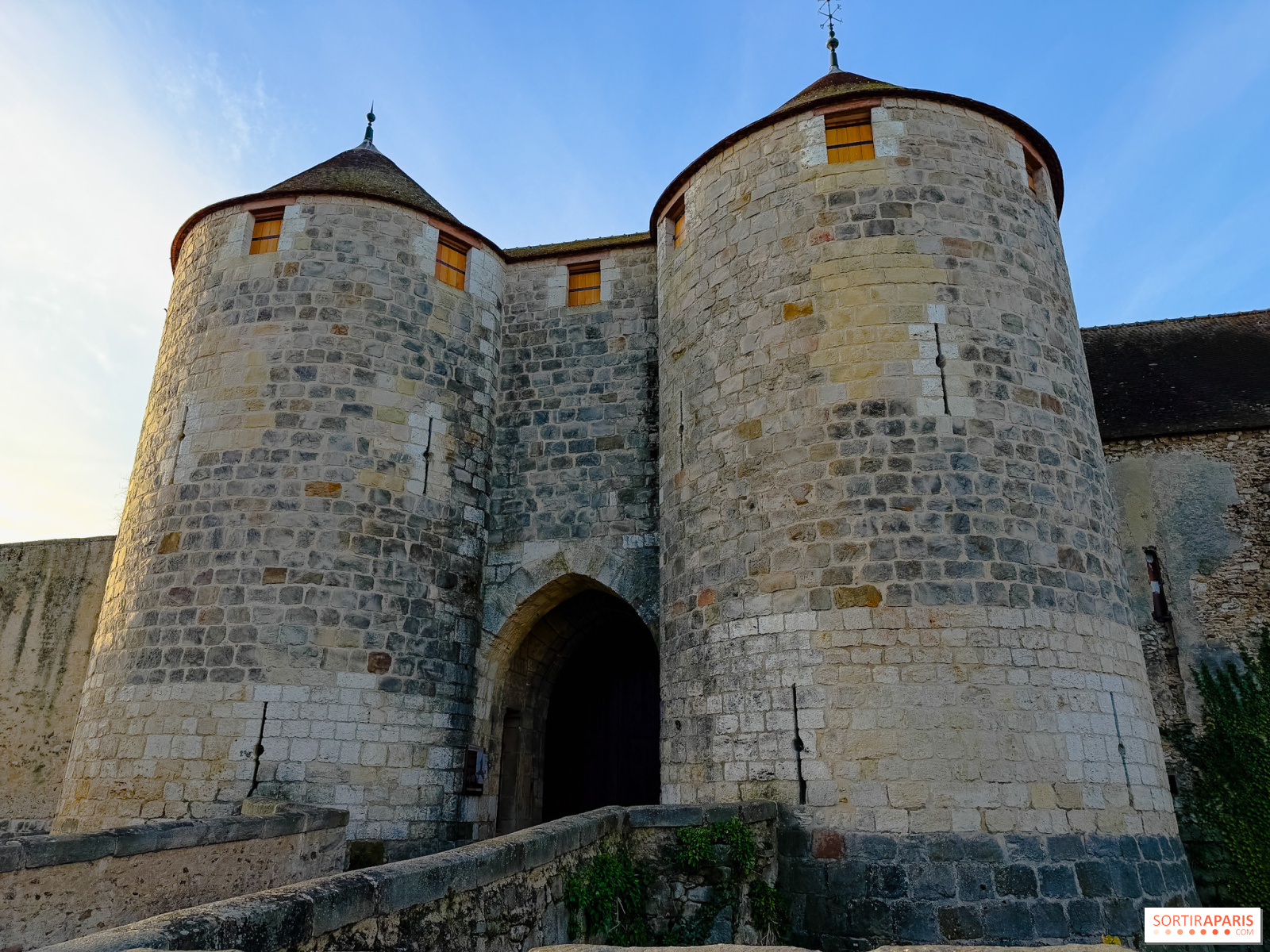
This site is designed for families, history buffs, and fans of medieval architecture, and for anyone seeking a unique getaway in Île-de-France without boarding a plane. Visitors come here for the rare pleasure of witnessing a piece of Paris’s vanished architectural heritage, and for those tales of queens, knights, and royal prisoners that the castle’s stones still seem to whisper.
Two more medieval fortresses to discover in Île-de-France:
- The Château de Vincennes (94) and its 52-meter royal keep, one of the tallest in France, on the doorstep of Paris.
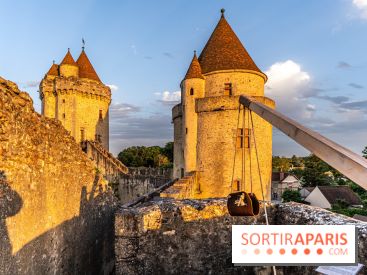
- The Château de Blandy-les-Tours (77), in Seine-et-Marne, a medieval fortress undergoing restoration and open to the public.
Dates and Opening Time
Next days
Friday:
from 02:00 p.m. to 05:00 p.m.
Saturday:
from 10:30 a.m. to 12:30 p.m.
- from 02:00 p.m. to 05:00 p.m.
Wednesday:
from 10:30 a.m. to 12:30 p.m.
- from 02:00 p.m. to 05:00 p.m.
Thursday:
from 02:00 p.m. to 05:00 p.m.
Location
Château de Dourdan
Place du Général de Gaulle
91410 Dourdan
Prices
Billets: €2.5 - €5
Recommended age
For all
Official website
chateau.dourdan.fr