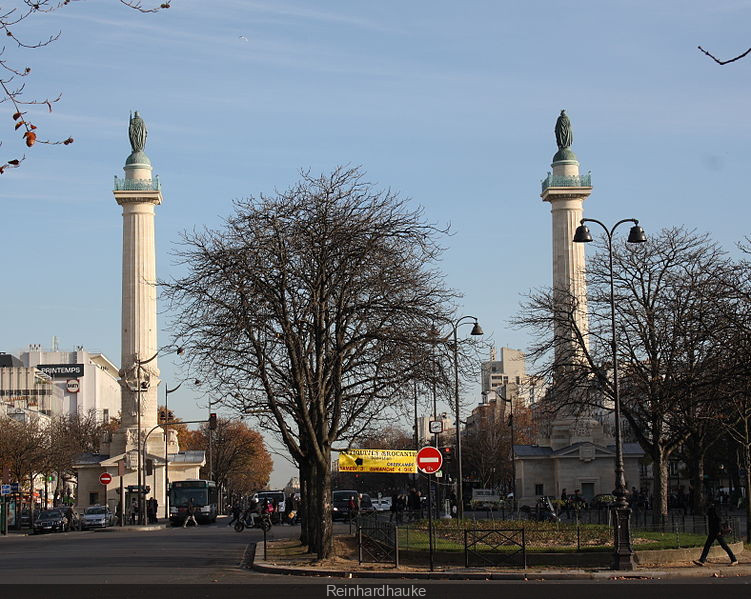
They stand there, immense, like two sentinels. East of the place de la Nation, at the entrance to the avenue du Trône, the famous Throne Columns are a paradox : two crowned heads watching over a republican square, and that’s enough to pique curiosity.
So what exactly are these two columns that overlook Place de la Nation? They’re the monumental remnants of the old Barrière du Trône, also known as the Barrière de Vincennes, built at the end of the 18th century as part of the Mur des Fermiers généraux. This wall wasn’t a military fortification but a fiscal enclosure: it was where goods entering Paris were checked to collect the octroi, an entry tax.
Originally the square was not called Nation, but the Place du Trône. Its name hails from 1660, when two thrones were set up for the ceremonial entry of Louis XIV and Maria Theresa of Austria into Paris. The columns were erected around 1787-1788, following the plans of Claude-Nicolas Ledoux, the leading architect of neoclassicism. This style is marked by a fondness for simple geometric forms, imposing volumes, references to Antiquity, and a certain theatrical display of authority. The railing comprised two columns and two toll pavilions, placed symmetrically on either side of the avenue.
The two statues visible at the summit are not from the original construction. They were added in the 19th century and depict two Paris-connected kings: Saint Louis and Philippe Auguste. The former evokes a pious, justiciar king; the latter embodies the builder and the ruler who fortified Paris, notably with its medieval walls. The statues were crafted by Antoine Étex for Saint Louis and by Auguste Dumont for Philippe Auguste.
But how did the throne's square become the nation’s square? During the French Revolution, it took on the striking name of Place du Trône-Renversé. The guillotine was installed there in 1794, and many victims were executed in this area before being buried, notably near Picpus. This square was renamed after the Revolution, before later becoming the Place de la Nation.
Today, the columns are listed as historic monuments, alongside the former pavilions of the Barrière du Trône. These, moreover, have been converted into social housing. Next time you pass by Nation, you’ll know the history behind these monuments that have become part of its identity.
This page may contain AI-assisted elements, more information here.
Location
Place de la Nation
Avenue du Trône
75011 Paris 11
Route planner
Accessibility info