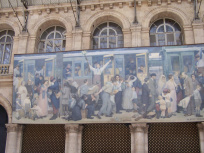
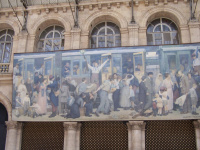
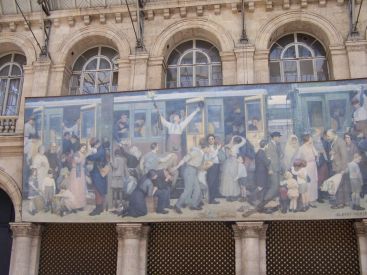
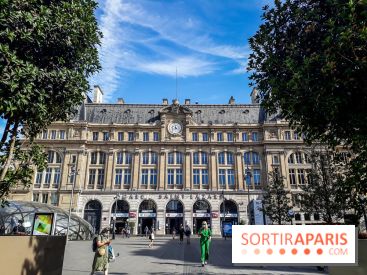
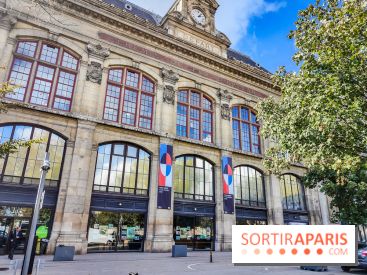
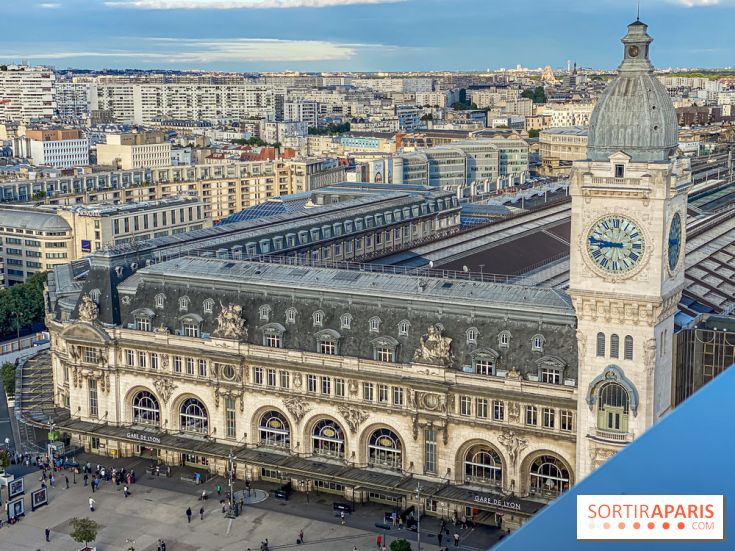
Just a few hundred meters from the Gare de Lyon, there is a station whose history is far older and more surprising than one might imagine. Today known as Paris-Bercy-Bourgogne-Pays d’Auvergne, the gare de Bercy hosts Intercités trains and welcomes many travelers.
Yet its existence is inextricably tied to an activity that had nothing to do with passenger transport: the wine trade. To understand the birth of this gare, you must go back to a time when Bercy was not yet fully integrated into Paris, and when the banks of the Seine formed one of Europe's leading centres de négoce viticole d'Europe.
During the 19th century, the Bercy district was famous for its massive wine warehouses. Millions of hectoliters arrived from across France by boat, then by rail. The site enjoyed a significant advantage: until its annexation to Paris in 1860, Bercy lay outside the mur des Fermiers généraux.
Merchants could thus store their wine before paying certain duties on entering the capital. At the height of its influence, the district boasted hundreds of cellars, streets lined with barrels, and intense economic activity. The railway quickly became essential to feed this gigantic market.
By the end of the 19th century, rail traffic was rising sharply. The Gare de Lyon, already under heavy demand, struggled to absorb all the train movements. It was in this context that additional railway facilities in Bercy were laid out.
The passenger station as we know it really comes into its own in the 20th century, notably serving as an overflow station for Gare de Lyon. For decades, it has hosted extra trains during peak holiday periods. Many holidaymakers still recall the overnight trains or the summer convoys departing from Bercy to the center and south of France.
In the 1970s, 1980s and 1990s, Bercy station became almost synonymous with great departures. When the Gare de Lyon is overwhelmed on busy weekends or school holidays, a portion of the traffic is diverted to Bercy. Travelers then discover a more modest, less monumental station, but often calmer.
This particular role has earned it a distinctive reputation among Parisians: the "little sister" to Gare de Lyon. The arrival of the TGV, however, profoundly reshapes the railway network. Many services are reorganized, and the station's role gradually evolves.
As the station continues its railway role, the district is undergoing a spectacular transformation. From the 1980s onward, the former wine warehouses are gradually disappearing. Some buildings are demolished, while others are preserved and rehabilitated.
Thus the current Bercy Village comes into being, whose cobblestones and former halls still recall the area's wine-producing past. Nearby also appear the Parc de Bercy, Paris Bercy, and numerous modern buildings. The district is gradually moving from a logistics zone to a residential and cultural district.
Today, Paris's Bercy station remains largely overlooked by visitors. Many travelers stumble upon it only after booking an Intercités train to Clermont-Ferrand, Nevers, or Limoges. Yet, beyond its modest platforms lies a history inextricably linked to the growth of Paris, the wine trade, and the expansion of France's railway network.
So, the next time you pass by its slightly weathered façades, imagine wagons loaded with barrels, crowds of hurried holidaymakers, and the thousands of trains that shaped it!
Restaurants near Paris-Bercy-Bourgogne-Pays d'Auvergne Station: our top picks
Discover our best places to eat and drink in the Gare de Paris-Bercy-Bourgogne-Pays d'Auvergne area - formerly Gare de Paris-Bercy. [Read more]
Location
Paris-Bercy-Bourgogne-Pays d'Auvergne station
gare de paris-bercy-bourgogne-pays d'auvergne
75012 Paris 12
Official website
www.garesetconnexions.sncf







 Restaurants near Paris-Bercy-Bourgogne-Pays d'Auvergne Station: our top picks